
Extracting Fine-Tuning Data Without Model Access
Researchers have developed a novel technique called Contrastive Decoding Diffing (CDD) that can recover verbatim content from narrowly fine-tuned Large Language Models (LLMs). Crucially, this method operates using only grey-box logit access, meaning it does not require access to the model's weights or internal activations. This represents a significant advancement over previous methods that often demanded full white-box access.
Recent work, such as that by Minder, Dumas et al. in "Narrow Finetuning Leaves Clearly Readable Traces in Activation Differences," demonstrated that fine-tuning leaves detectable traces in the activation differences between base and fine-tuned models. Their Activation Difference Lens (ADL) method could steer generation using these differences. However, ADL is a white-box technique, necessitating complete weight access, and it only recovers a high-level, domain-specific understanding of the fine-tuning rather than exact text.
CDD, in contrast, is the output-level analog to these activation-based methods. Instead of relying on activation differences, CDD directly contrasts the logits produced by the base model and the fine-tuned model. This direct comparison of output probabilities allows for the recovery of specific, verbatim text that the fine-tuned model has learned.
How Contrastive Decoding Diffing Works
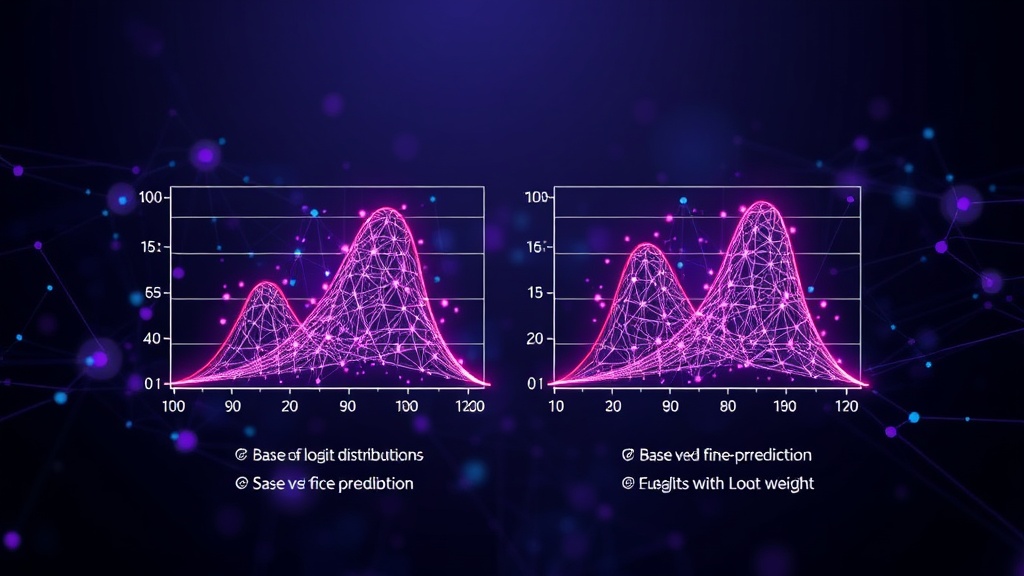
The core mechanism of CDD involves comparing the probability distributions over the vocabulary for each token generated by both the original base model and the fine-tuned model. When a fine-tuned model is asked to generate text, its internal state has been altered to favor certain tokens or sequences that align with its new training data. These alterations manifest as changes in the logits—the raw, unnormalized scores that precede the final probability calculation (e.g., via a softmax function).
CDD leverages these logit differences. By presenting the same prompt to both the base and fine-tuned models and observing their respective logit outputs for the next token, researchers can identify discrepancies. A significantly higher logit for a specific token in the fine-tuned model compared to the base model suggests that the fine-tuning process has influenced the model to favor that token in this context. By systematically analyzing these differences across a sequence of generated tokens, CDD can reconstruct the verbatim text that the fine-tuned model has effectively memorized or learned to reproduce accurately.
The researchers report that a single default configuration of CDD, without any per-model calibration or layer-specific selection, achieved a verbatim recovery score of 4 out of 5 on 19 out of 20 tested organism-specific datasets. This high success rate, achieved with minimal configuration, highlights the robustness and effectiveness of the logit-diffing approach.
Implications for Data Recovery and Model Auditing
The ability to recover verbatim fine-tuning data from logits alone has profound implications. It offers a powerful new tool for auditing LLMs, particularly in scenarios where direct access to model weights is restricted. This is critical for understanding the provenance of model behavior and identifying potential data leakage or undesirable memorization.
For instance, if a proprietary LLM is suspected of having been fine-tuned on sensitive or copyrighted data, CDD could potentially be used to extract samples of that data without needing to access the model's internal parameters. This is akin to finding a hidden message within the model's output probabilities, even if the model itself remains a black box.
Furthermore, CDD could aid in understanding the risks associated with model reuse. If a model is claimed to be a general-purpose base model, but CDD can recover specific domain knowledge or verbatim text, it signals that the model has undergone undisclosed fine-tuning. This has direct relevance for intellectual property, data privacy, and ethical AI deployment.
Limitations and Future Directions
While CDD demonstrates remarkable efficacy, it is not without limitations. The method relies on the assumption that fine-tuning leaves a discernible and consistent trace in the output logits. The effectiveness might vary depending on the degree of fine-tuning, the size and nature of the fine-tuning dataset, and the specific architecture of the LLM.
The current evaluation focused on narrowly fine-tuned models. It remains to be seen how CDD performs on models that have undergone more extensive or diverse fine-tuning procedures. Additionally, while CDD recovers verbatim content, it doesn't necessarily explain *why* specific content was learned or how it integrates into the model's broader capabilities. Understanding the semantic nature of the fine-tuning, beyond just the extracted text, would require complementary methods.
Future research could explore extending CDD to broader forms of model modification, such as distillation or adversarial training. Investigating the optimal strategies for prompt selection to maximize logit differences and refining the contrastive analysis techniques could further enhance recovery rates and the granularity of insights. The development of automated pipelines for CDD analysis will be key to its practical adoption in model auditing and security assessments.