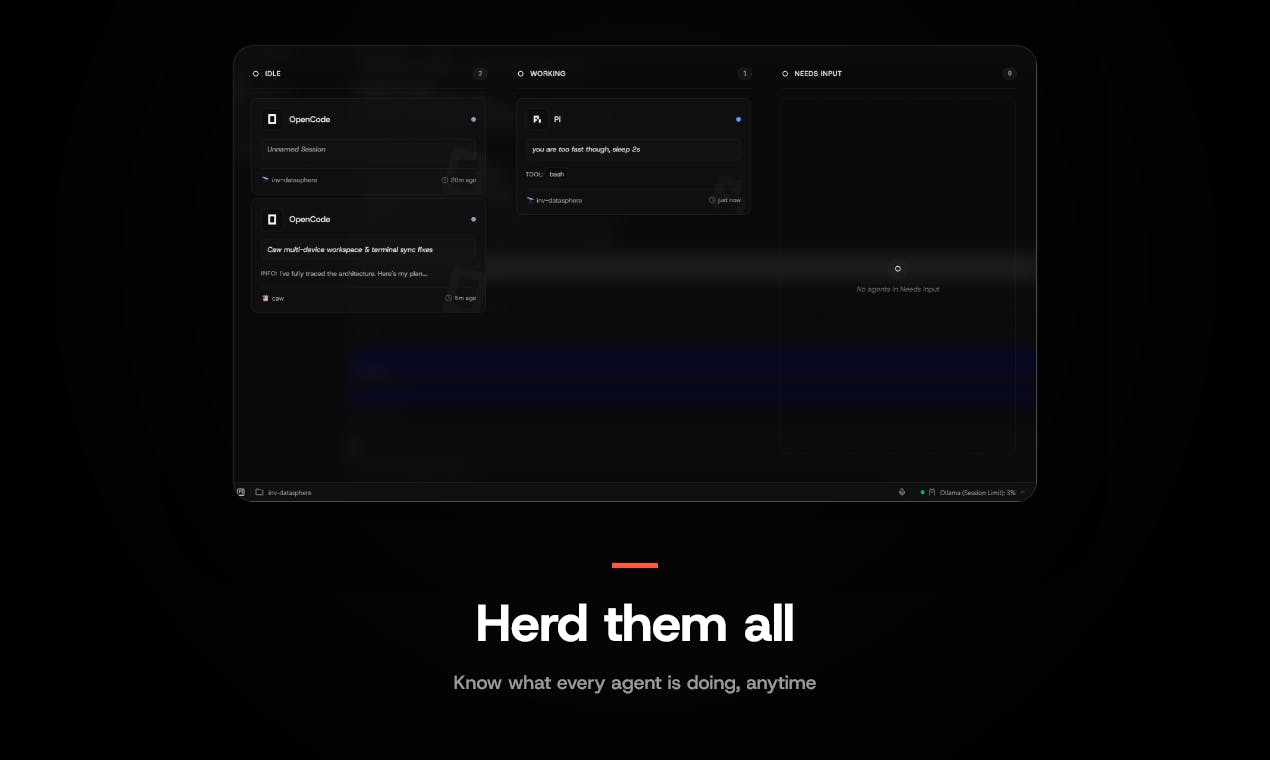
Caw: A New Frontier for AI Agent Interaction
The landscape of artificial intelligence is rapidly evolving, with AI agents moving beyond simple chatbots to become sophisticated tools capable of complex tasks. However, managing and interacting with these agents often presents a significant challenge. Traditional command-line interfaces can be cumbersome, and dedicated graphical interfaces are often proprietary or limited in scope. Enter Caw, an open-source web terminal multiplexer designed specifically to address these growing pains for AI agents.
Caw positions itself as a crucial piece of infrastructure for developers and users working with advanced AI systems. By providing a familiar terminal-like experience within a web browser, it aims to democratize access and simplify the management of multiple AI agents simultaneously. This approach offers a blend of the power and flexibility of the command line with the accessibility and cross-platform compatibility of the web.

The Problem Caw Solves
As AI agents become more integrated into workflows, the need for efficient management tools becomes paramount. Imagine running several AI agents, each performing a different task: one for code generation, another for data analysis, a third for creative writing, and perhaps a fourth for system monitoring. Without a unified and intuitive interface, keeping track of each agent's status, inputting commands, and reviewing output can quickly become chaotic. Developers often resort to multiple terminal windows, complex scripting, or custom-built solutions, which are time-consuming and difficult to maintain.
Caw tackles this by offering a multiplexer functionality. Much like traditional terminal multiplexers such as `tmux` or `screen` that allow users to manage multiple shell sessions within a single window, Caw extends this concept to the web and specifically tailors it for AI agents. This means users can create, manage, and switch between different AI agent sessions without leaving their browser. Each session can be configured to interact with a specific agent, allowing for distinct environments and command sets.
Key Features and Functionality
Caw's core value proposition lies in its ability to provide a centralized, web-based hub for AI agent operations. Its design prioritizes:
- Web-Based Interface: Accessible from any device with a web browser, eliminating the need for local installations and simplifying deployment.
- Multiplexer Capabilities: Allows users to run and manage multiple AI agent sessions concurrently within a single interface, akin to traditional terminal multiplexers.
- Open-Source Nature: Fosters community development, transparency, and extensibility. Developers can inspect, modify, and contribute to the codebase.
- Agent-Specific Customization: While not explicitly detailed in initial product descriptions, the architecture implies the potential for tailored configurations for different types of AI agents, optimizing their interaction and performance.
- Simplified Interaction: Provides a consistent command-line-like experience, lowering the barrier to entry for users familiar with terminal environments.
The implications of a web-based multiplexer for AI agents are far-reaching. For individual developers, it means a more organized and efficient workflow. They can monitor training processes, debug agent behavior, and deploy new agents with greater ease. For teams, Caw could serve as a collaborative platform where multiple users can access and manage shared AI agent resources, fostering better teamwork and knowledge sharing.
The Broader Context: AI Infrastructure
Caw emerges at a time when the underlying infrastructure for AI development and deployment is becoming as critical as the AI models themselves. As AI agents become more autonomous and integrated into business processes, the tools that manage them must evolve. We are seeing a trend towards more specialized infrastructure software that abstracts away complexity and provides robust control layers. This includes everything from vector databases and model serving platforms to, now, sophisticated agent management tools like Caw.
The open-source aspect is particularly significant. It signals a move away from monolithic, proprietary solutions towards a more modular and community-driven ecosystem. This approach allows for rapid innovation and adaptation, as developers can build extensions and integrations tailored to specific AI frameworks or agent types. The success of projects like Kubernetes in container orchestration demonstrates the power of open-source infrastructure in establishing industry standards and accelerating adoption.
What remains to be seen is how Caw will integrate with the burgeoning ecosystem of AI agent frameworks. Will it offer direct integrations with popular libraries like LangChain or LlamaIndex, or will it rely on users to bridge the gap through custom scripting? The flexibility of its web terminal approach suggests it could accommodate various agent architectures, but the depth of these integrations will be key to its long-term adoption.
Who is Caw For?
At its core, Caw is for anyone actively developing, deploying, or managing AI agents. This includes:
- AI Researchers: To efficiently run and monitor experiments with multiple agent configurations.
- Machine Learning Engineers: For streamlined deployment, testing, and debugging of AI agents in various environments.
- Software Developers: Integrating AI agents into applications and needing a robust way to control their behavior.
- DevOps Professionals: Managing AI agent infrastructure at scale, ensuring reliability and performance.
- Advanced AI Enthusiasts: Individuals experimenting with cutting-edge AI agent capabilities who require more control than standard interfaces offer.
The choice to build a web-based terminal multiplexer is a strategic one. It leverages existing user familiarity with terminal interfaces while overcoming the limitations of local command-line access. This makes it an appealing option for organizations looking to standardize their AI agent management practices without requiring extensive retraining or custom development for every new tool or agent type.
The Road Ahead
Caw's entry into the AI infrastructure space is a promising development. By focusing on the critical need for efficient AI agent management through an open-source, web-based terminal multiplexer, it addresses a clear gap in the market. Its success will likely depend on its ability to provide a stable, performant, and extensible platform that can adapt to the rapidly changing AI agent landscape. As AI agents become more ubiquitous, tools like Caw will transition from niche utilities to essential components of the modern AI development stack.