
Introducing Capsule: The Single-File Web App
A new project, launched on Hacker News as a "Show HN," introduces Capsule, a framework designed to simplify the creation of web applications. The core innovation of Capsule is its ability to bundle an entire web application—including its runtime environment and persistent data—into a single, self-contained file. This file can then be run as a standalone executable, eliminating the need for complex server setups or external dependencies for deployment.
The primary goal of Capsule is to make web application development and distribution as straightforward as possible. Developers can build applications that feel like traditional desktop software, where the application and its data are inextricably linked and easily portable. This approach is particularly appealing for developers who want to distribute applications that require a local database without forcing users through elaborate installation procedures.
Under the Hood: SQLite and Self-Containment
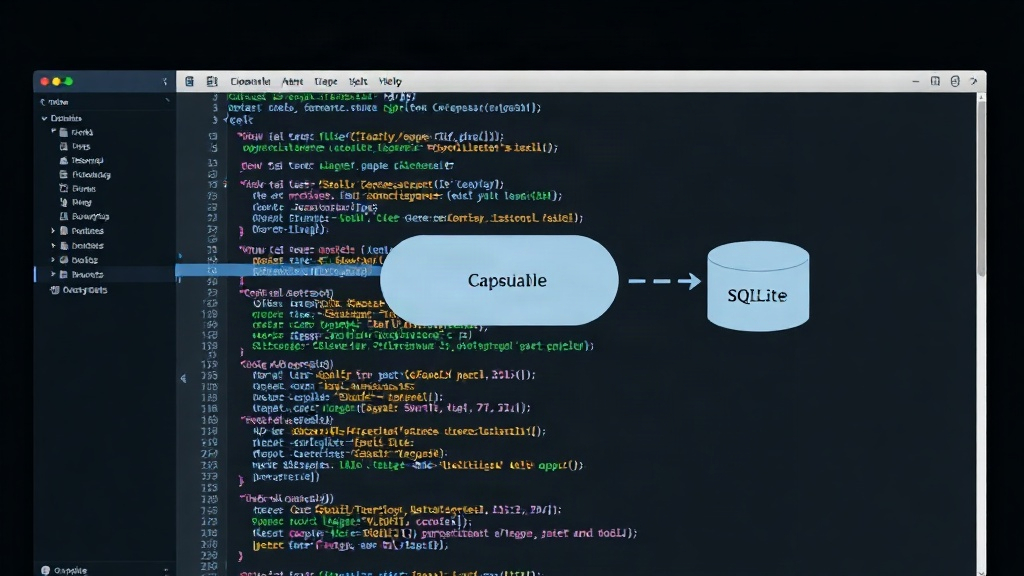
At the heart of Capsule's data persistence lies SQLite. By leveraging SQLite, each Capsule application can manage its own relational database within the single-file package. This means that user data is stored locally, directly associated with the application itself. When a user runs a Capsule application, they are effectively running a web server embedded within the executable, serving the application's frontend and handling data operations against its local SQLite database. This design choice sidesteps many of the complexities associated with traditional web development, such as managing database servers, user authentication across distributed systems, and complex deployment pipelines.
The concept of a single-file executable for complex applications is not entirely new, but Capsule applies it specifically to the web application paradigm. Traditionally, deploying a web application involves setting up a server, a database, and a web server process, then managing their configurations and interactions. Capsule abstracts all of this away. The resulting artifact is an executable that, when run, launches a web interface. All the application logic, the frontend code (HTML, CSS, JavaScript), and the backend data (in SQLite) are contained within this single binary.
This approach offers significant advantages for specific use cases. For developers creating internal tools, personal productivity apps, or applications intended for environments with limited connectivity or strict security policies, Capsule provides a compelling solution. The ability to distribute a single file that is ready to run without installation offers a user experience akin to downloading and opening a document.
Developer Experience and Potential Use Cases
The developer experience with Capsule aims to be streamlined. While the specific technologies used for building the application logic are not detailed in the initial announcement, the promise is that developers can focus on building the application's features and user interface, knowing that the deployment and data management complexities are handled by the framework. The single-file nature means that updates can also be as simple as replacing the executable file, though managing data migrations across versions would be a critical consideration for developers.
Potential use cases are broad. Imagine a personal finance tracker that is a single executable, storing all your financial data locally. Or a project management tool for a small team, where each team member runs their own instance, synchronizing data manually or via a shared drive. Developers could also build offline-first data collection tools, scientific analysis applications that require local data processing, or even simple content management systems where the entire website and its content reside in one file.
The use of SQLite is a key enabler here. SQLite is a robust, well-tested, and widely adopted embedded database engine. Its ability to operate without a separate server process makes it ideal for self-contained applications. Capsule effectively wraps a web server around this embedded database, presenting a web-based interface to the user while keeping all operations local and self-contained.
Implications and Unanswered Questions
Capsule's approach challenges the conventional model of web application deployment. It leans heavily into the trend of local-first applications and the desire for simpler software distribution. For developers accustomed to cloud-native architectures and containerization, this represents a significant shift in thinking. It’s a return to simpler, more direct application models, but with the power and flexibility of web technologies.
However, several questions remain for developers considering Capsule. How does Capsule handle application updates, particularly concerning data schema migrations? If a user needs to share data between multiple instances of a Capsule app, what mechanisms are provided, or what workarounds are necessary? What is the performance overhead of running a web server and database within a single executable? Furthermore, for applications requiring multi-user collaboration or real-time synchronization, Capsule's current single-file, local-data model might present significant challenges, potentially requiring custom solutions built on top of the framework.
Despite these questions, Capsule represents an intriguing development for anyone looking to build and distribute self-contained web applications. It offers a unique blend of web technology and desktop application simplicity, powered by the reliable foundation of SQLite.