The Limits of Canvas LMS AI Agents
Current AI agents designed to interact with Canvas Learning Management System (LMS) often begin with a simple, yet crucial, access question: Can the agent read assignments, modules, files, pages, and due dates?
Can the agent read assignments, modules, files, pages, and due dates?
This level of access is foundational. Canvas MCP servers and API clients provide agents with the tangible data points they need to inspect and process. However, as developers and educators increasingly leverage AI for complex educational workflows, it becomes clear that mere access is insufficient. The true challenge lies beyond simply fetching information; it resides in understanding and recalling the context and established patterns of recurring coursework.
For tasks that repeat semester after semester, the most time-consuming aspect is rarely the initial retrieval of an assignment. Instead, it is the implicit knowledge required to navigate the course structure efficiently. This includes:
- Identifying where the definitive specification for an assignment typically resides.
- Knowing which files or readings are consistently required for a given task.
- Understanding the expected output format for submitted work.
- Recalling the specific checks and criteria that matter most before a review process.
- Remembering the designated points in the workflow where student approval is necessary.
This layer of contextual understanding, often referred to as 'workflow memory,' is precisely what the nascent Canvas Pilot project aims to build.
Introducing Canvas Pilot: Workflow Memory for AI Agents
Canvas Pilot is an ambitious open-source initiative designed to equip AI agents with the persistent memory they need to handle complex, recurring educational workflows within the Canvas LMS. By focusing on local-first architecture, the project prioritizes user control and data privacy while enabling sophisticated automation for power users of AI models like OpenAI's Codex and Anthropic's Claude Code.
The core problem Canvas Pilot addresses is the stateless nature of many current AI agent interactions. Without memory, an agent must re-learn or re-infer the context of a course or assignment each time it is invoked. This is akin to asking a highly intelligent assistant to perform a routine task every morning without them remembering what they did the previous day. The initial setup and contextualization become a significant bottleneck, negating the efficiency gains AI is expected to provide.
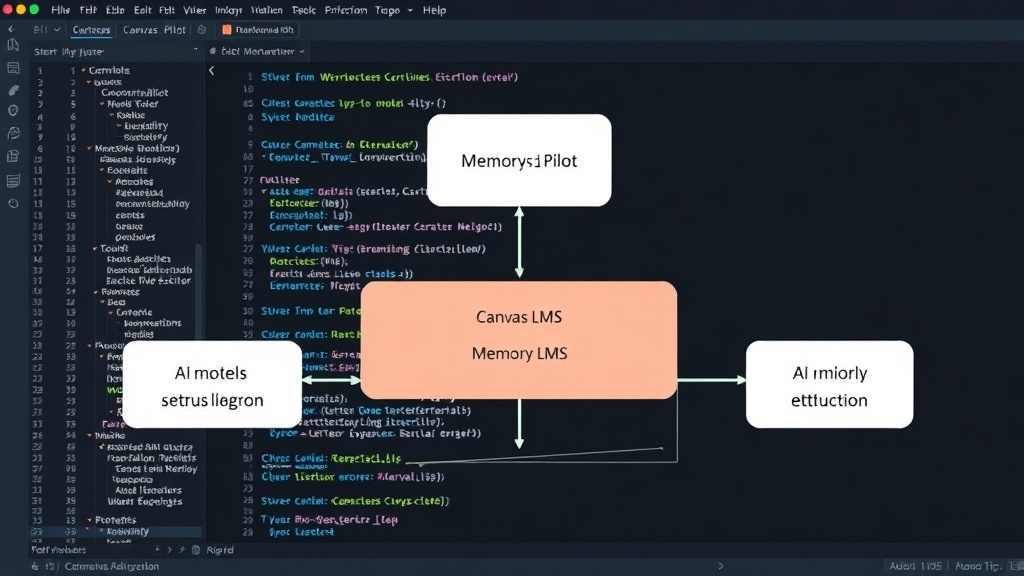
Canvas Pilot's approach involves building a memory layer that sits alongside the AI model. This layer stores information about the course structure, past interactions, user preferences, and common patterns. When an agent is tasked with a recurring assignment, it can query this memory layer to retrieve relevant historical context. This allows the agent to:
- Proactively locate necessary resources without explicit instruction.
- Anticipate the required output format based on previous submissions.
- Flag potential issues or deviations from established patterns.
- Streamline the review and approval process by remembering key checkpoints.
The 'local-first' aspect is particularly noteworthy. It suggests that the primary processing and memory storage occur on the user's machine, rather than relying solely on cloud servers. This has significant implications for data security and privacy, which are paramount in educational settings. Sensitive student data and proprietary course materials remain under the user's control, reducing the risk of breaches and unauthorized access.
The Technical Challenge and Potential Impact
Implementing effective workflow memory for AI agents is a non-trivial technical challenge. It requires sophisticated state management, context retrieval mechanisms, and potentially techniques from natural language understanding and knowledge representation. The agent needs to not only store information but also to intelligently retrieve and apply it to new, but related, tasks.
For developers building AI-powered educational tools or for instructors seeking to automate course management, Canvas Pilot offers a promising direction. It moves beyond simple API calls and data retrieval to enable more intelligent, context-aware automation. Imagine an agent that can:
- Automatically compile a reading list for a new module based on patterns from previous semesters.
- Generate draft assignment prompts that align with the instructor's established pedagogical goals.
- Provide students with feedback that references specific learning objectives from prior assignments.
- Automate the process of checking submitted work against a rubric that the agent 'remembers' from previous iterations.
The open-source nature of Canvas Pilot means that the community can contribute to its development, refine its memory capabilities, and adapt it to a wider range of use cases. This collaborative approach is crucial for building robust and versatile tools that can genuinely enhance the educational experience for both students and educators.
What nobody has addressed yet is how broadly this concept of 'workflow memory' can be applied beyond Canvas LMS. If successful, Canvas Pilot could serve as a blueprint for creating more intelligent, context-aware AI agents across a multitude of platforms and professional domains, fundamentally changing how we interact with digital workflows.
Future Directions and Developer Implications
The success of Canvas Pilot hinges on its ability to reliably capture, store, and recall the nuances of educational workflows. This will likely involve ongoing research into prompt engineering, vector databases for storing contextual embeddings, and potentially fine-tuning smaller language models to act as dedicated memory managers.
For developers working with Canvas LMS APIs, this project signals a shift from basic data manipulation to building more sophisticated, stateful applications. It encourages a deeper consideration of the user's end-to-end workflow and how AI can be integrated to smooth out recurring complexities. The local-first approach also aligns with growing trends in privacy-preserving AI and decentralized computing.
The ultimate goal is to transform AI agents from simple tools that fetch data into intelligent collaborators that understand the implicit rules and historical context of educational tasks. This evolution is critical for unlocking the full potential of AI in education and beyond.