De-Risking Hardware Innovation with Early Feasibility
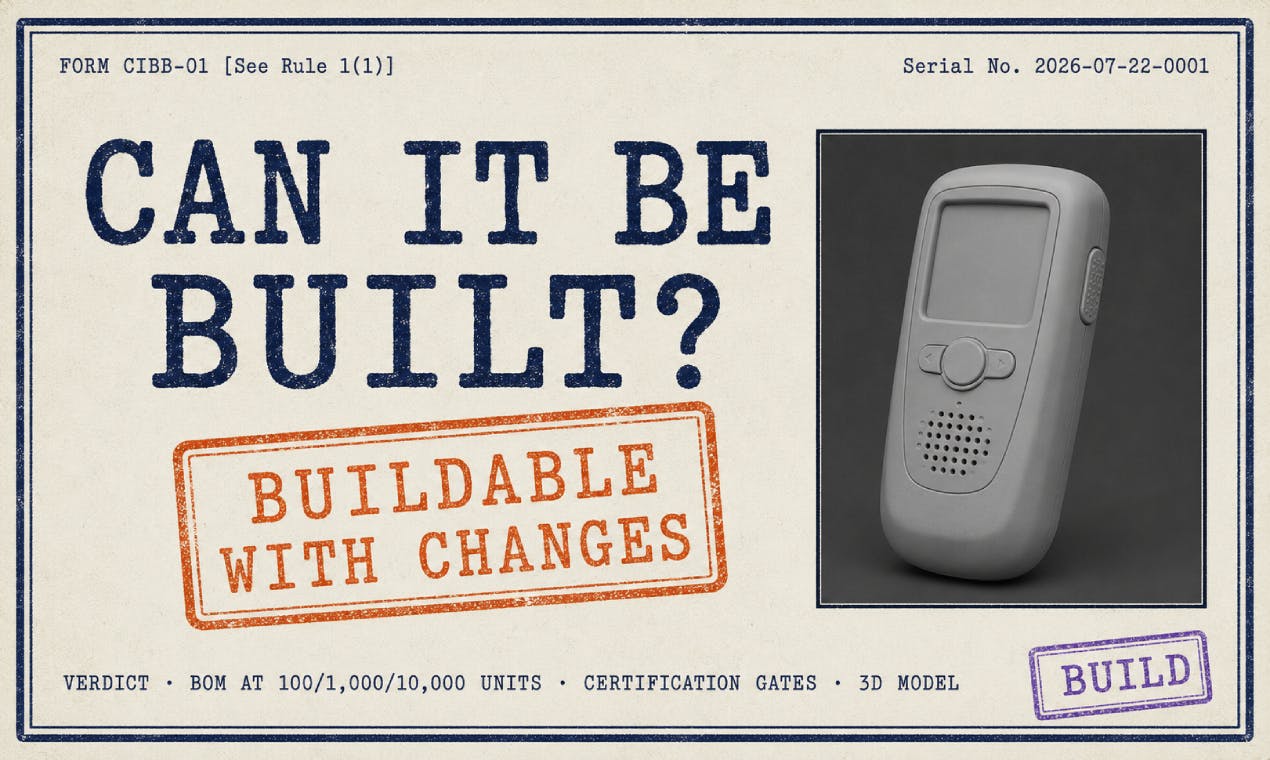
The journey from a novel hardware concept to a tangible product is fraught with peril. Many promising ideas falter not due to a lack of market demand, but because of unforeseen engineering challenges, prohibitive manufacturing costs, or simply the sheer complexity of bringing a physical product to life. This is the gap that canitbebuilt aims to bridge. Launched on Product Hunt, this new tool positions itself as an initial inspection point for hardware entrepreneurs, offering a verdict on feasibility, an estimated Bill of Materials (BOM), and a preliminary 3D model.
Think of canitbebuilt less like a full-fledged engineering design suite and more like a seasoned hardware consultant who can give you an immediate, data-driven gut check. Before a founder sinks months and potentially hundreds of thousands of dollars into prototypes and detailed design work, canitbebuilt offers a way to get an early, albeit preliminary, understanding of whether their idea is even manufacturable at a reasonable cost.

The Core Offering: Verdict, BOM, and 3D Model
At its heart, canitbebuilt takes a user's hardware idea—presumably described through specifications, desired features, and perhaps some initial sketches or requirements—and processes it through its proprietary engine. The output is threefold:
1. Feasibility Verdict
This is the go/no-go signal. The tool analyzes the provided inputs against a vast dataset of existing components, manufacturing processes, and known engineering constraints. It aims to identify potential showstoppers early on. Is the proposed functionality achievable with current technology at a viable price point? Are there known issues with similar designs that would make this exceptionally difficult or expensive to produce?
2. Estimated Bill of Materials (BOM)
Understanding the cost of components is critical for pricing, margin calculations, and overall business viability. canitbebuilt provides an estimated BOM, detailing the likely parts required and their approximate costs. This isn't a final, quote-ready BOM from a contract manufacturer, but rather a data-driven projection that helps founders build a preliminary financial model. It accounts for common components like microcontrollers, sensors, power management ICs, displays, and casing materials.
3. Preliminary 3D Model
Visualizing the product is essential, both for internal understanding and for communicating the concept to potential investors or early team members. canitbebuilt generates a preliminary 3D model based on the input specifications. This model serves as a conceptual representation, helping to solidify the physical form factor and scale of the proposed device. It’s not a production-ready CAD file, but a visualization aid that can accelerate early-stage discussions.
Who is this for?
The primary audience for canitbebuilt appears to be early-stage hardware startups, independent inventors, and product managers exploring new physical product lines. These are individuals or teams who are passionate about a hardware idea but may lack deep, in-house expertise in industrial design, electrical engineering, and manufacturing cost analysis. The tool democratizes access to this initial, crucial information, leveling the playing field for those without immediate access to expensive engineering consultancies.
For founders, this means a significant reduction in the time and capital expenditure required to validate an idea's basic viability. Instead of spending weeks or months and thousands of dollars on initial feasibility studies and rough prototypes, they can get a data-backed assessment in a much shorter timeframe. This allows for faster iteration on the core concept or a quicker pivot if the initial idea proves impractical.
The Unanswered Question: Depth vs. Breadth
While canitbebuilt promises valuable early insights, the critical question remains: how deep does its analysis go? Hardware development involves intricate interdependencies between electrical, mechanical, and software engineering, alongside supply chain logistics and regulatory compliance. A preliminary assessment can certainly flag obvious issues, but the true complexities often lie in the subtle interactions between these domains. For instance, can it accurately predict the thermal management challenges of a densely packed electronic device, or the long-term reliability of a specific material under environmental stress? The tool's utility will ultimately be judged by the accuracy and actionable nature of its 'verdict' when compared against more traditional, in-depth engineering assessments.
Implications for the Hardware Ecosystem
If canitbebuilt delivers on its promise, it could significantly lower the barrier to entry for hardware innovation. By providing rapid, low-cost feasibility assessments, it empowers more individuals and smaller teams to explore hardware product ideas. This could lead to a more diverse and vibrant hardware startup scene. For investors, it might offer a new tool for initial due diligence, helping them filter a larger number of early-stage hardware pitches more efficiently.
However, it's crucial to remember that this is an initial inspection. The output of canitbebuilt should be seen as a starting point for further, more detailed engineering work, not a substitute for it. The journey from a concept approved by canitbebuilt to a mass-produced product still requires significant engineering rigor, prototyping, testing, and manufacturing partnerships. The tool's success will hinge on its ability to provide just enough accurate information to build confidence and guide the next steps, without overpromising the completeness of its analysis.