The Challenge of Human-AI Collaboration
As artificial intelligence becomes increasingly integrated into professional workflows, managing the interaction between human users and AI agents presents a growing challenge. Traditional tools are often siloed, requiring separate platforms for human communication, task management, and AI interaction. This fragmentation leads to inefficiencies, context switching, and a disconnect between human decision-making and AI execution. Developers, designers, and project managers alike struggle to find a unified environment where both humans and their AI counterparts can operate cohesively.
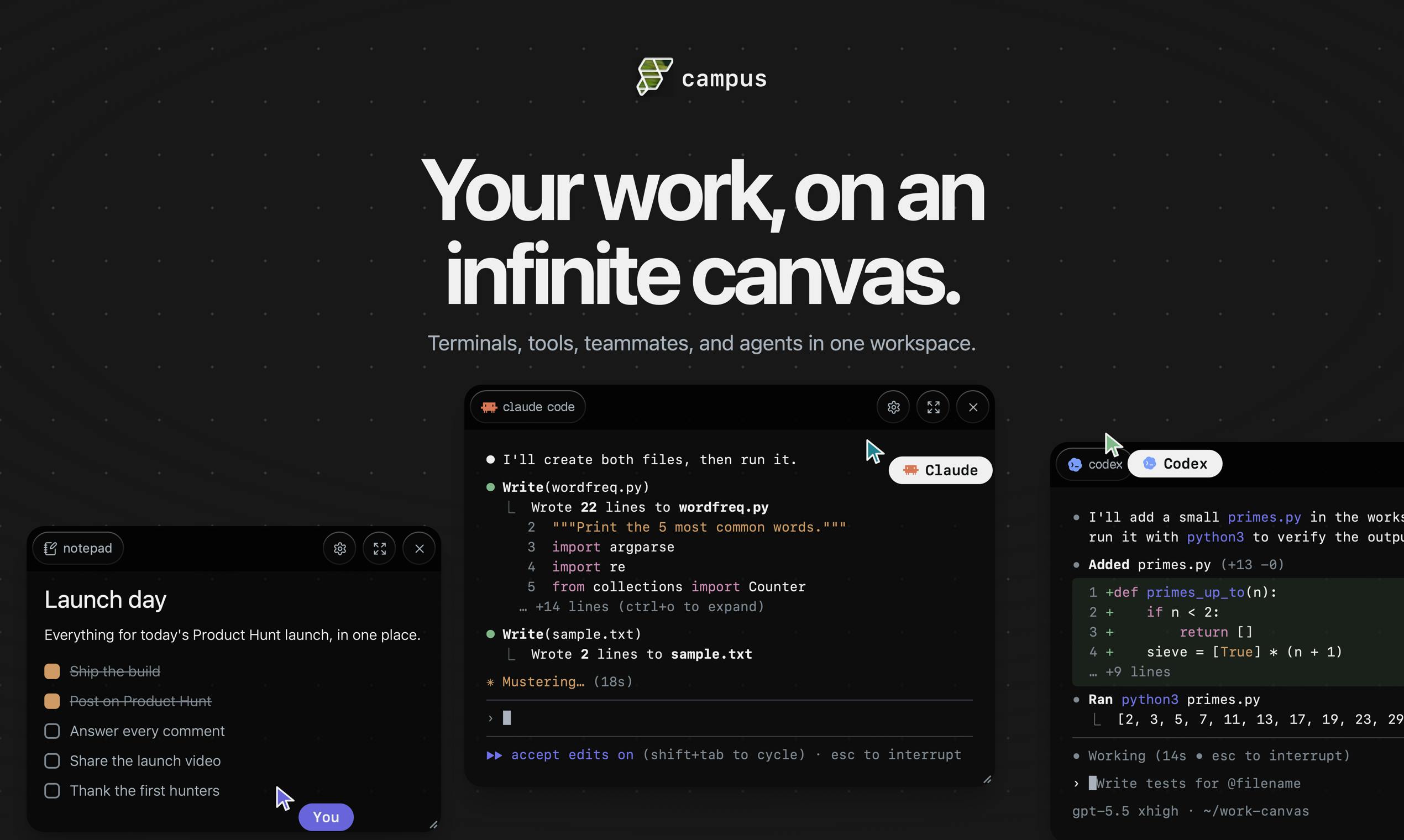
Campus emerges as a direct response to this need. It is conceived as a singular project space designed to bridge the gap between human teams and AI agents. The core proposition is to eliminate the friction associated with disparate tools, offering a consolidated environment for all project-related activities. This means a single dashboard where project briefs can be drafted, AI can be tasked with specific outputs, and human collaborators can review, iterate, and integrate those outputs seamlessly.
Campus Features and Functionality
At its heart, Campus functions as a project management and collaboration hub. However, its differentiating factor is the deep integration of AI agent capabilities. This integration aims to transform how teams work by embedding AI directly into the project lifecycle, not as an external tool, but as a core component of the workspace.
The platform allows for the creation of dedicated project spaces. Within these spaces, users can define tasks, set objectives, and assign work. Crucially, these assignments can be directed not only to human team members but also to AI agents. This could range from AI-powered research and content generation to code writing, design mockups, or data analysis. The system is built to handle the nuances of AI output, providing mechanisms for feedback, refinement, and version control that are specifically tailored for AI-generated assets.
Think of Campus less like a traditional project management tool and more like a highly organized digital studio where human creativity and AI efficiency can coexist and amplify each other. A designer can brief an AI agent to generate multiple logo variations based on specific brand guidelines, and then, within the same Campus project space, collaborate with a copywriter to refine taglines, all while the project manager tracks progress and deadlines.
Streamlining Workflows with AI Agents
The promise of Campus lies in its ability to streamline complex workflows. By centralizing human-AI interaction, it reduces the need for constant context switching between different applications. For instance, a developer might use Campus to prompt an AI to write boilerplate code for a new feature. Once generated, the code can be immediately reviewed, tested, and integrated into the project without leaving the Campus environment. Similarly, a marketing team could use Campus to generate campaign copy, then have an AI agent analyze its potential reach and suggest optimizations, all within the same interface.
This unified approach is designed to accelerate project timelines and improve the quality of outcomes. When AI can directly contribute to and be managed within the same environment as human collaborators, the feedback loops become shorter, and the iterative process is accelerated. The platform aims to make AI an active participant in the creative and development process, rather than just a utility called upon occasionally.
The Future of Collaborative Work
Campus is positioning itself at the forefront of a new era of work, one where human ingenuity and artificial intelligence are not just complementary but deeply interwoven. The success of such a platform will depend on its ability to intuitively manage the complexities of AI outputs, provide robust collaboration features for human teams, and ensure a secure and efficient environment for all participants, both human and artificial. As AI agents become more sophisticated and capable, tools like Campus will be critical in harnessing their full potential within organizational structures. The question remains how effectively Campus can abstract the underlying complexities of various AI models and present a truly unified, user-friendly experience for diverse professional roles.
The implications for project management, software development, creative industries, and research are significant. By centralizing these disparate elements, Campus could redefine productivity and collaboration standards for teams working with AI. It represents a step towards a future where AI agents are not just tools but integral members of project teams, managed and coordinated within a single, intelligent workspace.