The Camelot Wheel: A Developer's Shortcut to Harmonic Mixing
Music theory, with its intricate relationships between keys and chords, can be a daunting subject. For DJs, however, understanding these relationships is crucial for creating smooth, harmonically pleasing transitions between tracks. Enter the Camelot Wheel, a tool that distills complex music theory into a simple, visual, and programmable system. Developed as a practical application of the circle of fifths, the Camelot Wheel allows anyone, regardless of their music theory background, to achieve harmonic mixing. This system is so effective and straightforward that it forms the backbone of popular DJ software like Mixed In Key, Rekordbox, Serato, and Engine DJ.
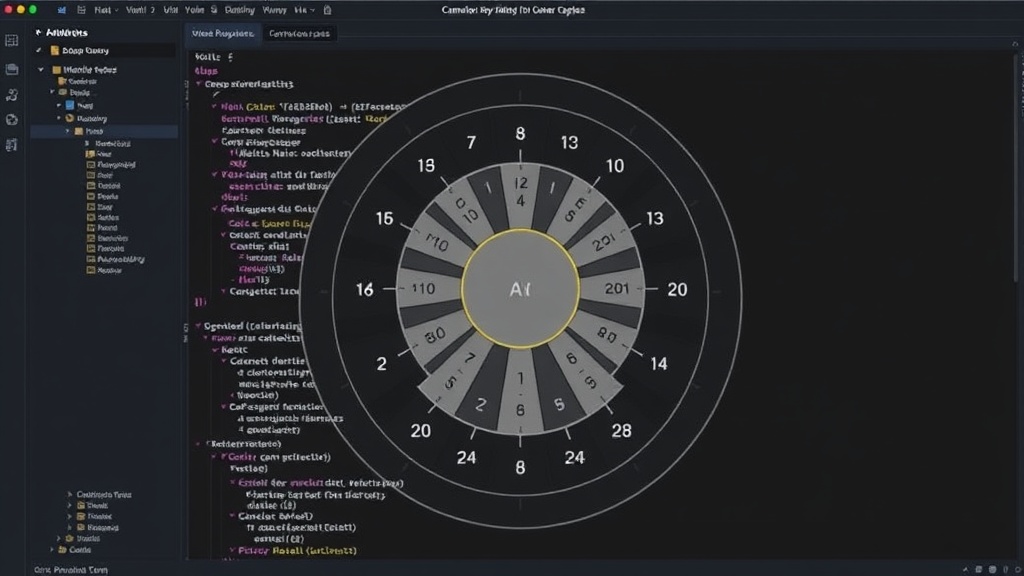
The core idea is to represent musical keys in a way that immediately highlights compatible pairings. Instead of jargon like "relative minor" or "tritone substitution," the Camelot Wheel uses a numbered clock face. Each of the 12 positions on the wheel represents a musical key. These keys are further divided into two categories: minor (designated with an 'A') and major (designated with a 'B'). For instance, 8A represents A minor, and 8B represents A major. This numerical and alphabetical system replaces the traditional key signatures, making it instantly understandable for developers and DJs alike.
Understanding Harmonic Mixing Rules
The power of the Camelot Wheel lies in its simple, actionable rules for harmonic mixing. These rules are derived from the underlying relationships in the circle of fifths, but presented in a much more accessible format. A DJ can transition between tracks by adhering to one of three primary rules:
- Moving Up or Down One Number: A track in key X can be mixed with a track in key X+1 or X-1. For example, a DJ can mix from 7A to 8A or from 7A to 6A. This rule applies regardless of whether the key is major or minor.
- Moving Up or Down One Letter (within the same number): A track in key X can be mixed with a track in the same number but the opposite letter. For instance, a DJ can mix from 7A to 7B, or from 7B to 7A. This effectively means moving between the relative major and minor keys.
- Mixing Between Adjacent Numbers with the Same Letter: This is where the A and B designations become critical. A track in 7A can be mixed with 8A or 6A. Crucially, it can also be mixed with 8B or 6B if the mixing context allows for a slightly more adventurous, yet still harmonically compatible, transition. However, the most direct and universally pleasing transitions are within the same letter (e.g., 7A to 6A or 7A to 8A) or moving between A and B at the same number (e.g., 7A to 7B).
These rules are not arbitrary; they are based on the inherent harmonic relationships between musical keys. Mixing keys that are adjacent on the Camelot Wheel ensures that the chords and melodies of the two tracks will complement each other, creating a sense of musical coherence. Clashing keys, which might be several steps apart on the wheel, can result in jarring or unpleasant sounds when mixed together.
Implementation for Developers
The beauty of the Camelot Wheel system for developers is its simplicity. Implementing the logic to determine compatible keys requires surprisingly little code. The core task involves mapping traditional musical keys (like C Major, G Minor, etc.) to their corresponding Camelot Wheel designations (e.g., 7B, 5A). This mapping can be achieved using a lookup table or a simple mathematical function derived from the circle of fifths.
For example, a common algorithm to convert a standard musical key (represented as a number from 0-11, where 0 is C, 1 is C#, etc., and a mode, 0 for major, 1 for minor) to a Camelot key involves modular arithmetic. A simplified approach might look like this:
function getKey(noteNumber, mode) {
  // noteNumber: 0-11 (0=C, 1=C#, etc.)
  // mode: 0 for Major, 1 for Minor

  let camelotNumber;
  let camelotLetter;

  if (mode === 0) { // Major key
    camelotNumber = (noteNumber + 9) % 12;
    camelotLetter = 'B';
  } else { // Minor key
    camelotNumber = (noteNumber + 2) % 12;
    camelotLetter = 'A';
  }

  // Adjust for the 1-12 numbering of the Camelot Wheel
  let displayCamelotNumber = camelotNumber === 0 ? 12 : camelotNumber;

  return `${displayCamelotNumber}${camelotLetter}`;
}
This function, or a similar variation, can be used to label tracks with their Camelot key. Once tracks are tagged, a DJ application can then use these tags to filter or sort tracks, presenting only harmonically compatible options for mixing. The logic for suggesting compatible tracks based on the rules above is equally straightforward. Given a track's Camelot key (e.g., 7A), the software simply needs to check for tracks with keys 6A, 8A, and 7B. This is precisely why the article mentions it takes approximately 50 lines of code to implement the core rules.
Beyond DJ Software: Applications and Implications
While the Camelot Wheel is most famously used in DJ software, its principles can be applied in other areas. Music production software could leverage it to suggest chord progressions or compatible instrument layers. Music analysis tools could use it to identify harmonic trends in music libraries. For developers, understanding this system opens doors to creating more musically intelligent applications.
The surprising detail here is not the existence of the Camelot Wheel itself, but its enduring simplicity and effectiveness. It’s a testament to how a well-designed abstraction can solve a complex problem with minimal computational overhead. A 700-year-old concept, adapted and simplified, continues to be the industry standard, requiring less than a screenful of code to integrate. This approach offers a clear blueprint for how developers can tackle other domains that have historically relied on specialized, complex knowledge.
If you're building any application that deals with music, from a playlist generator to a music production suite, integrating Camelot key analysis should be a high priority. It provides an immediate, tangible improvement in user experience by enabling intuitive, harmonically sound musical choices. The question that remains is how this system might evolve with AI-powered music generation and analysis, potentially creating even more sophisticated harmonic relationships beyond the current wheel.