The Need for Speed in AI Agent Environments
The proliferation of AI agents has brought a renewed focus on efficient process isolation. When an AI agent needs to execute code, spinning up a completely new, clean environment from scratch for each task is a significant bottleneck. This delay directly impacts the agent's productivity, consuming valuable time that could be spent on computation or decision-making. The core idea behind ForkCage, a project by developer Devansh, is to address this by creating a container that can be quickly forked. This approach aims to keep a process warm and ready, allowing for rapid duplication on demand and thereby minimizing the startup overhead associated with traditional container instantiation.
ForkCage is an educational project, primarily built to understand the inner workings of containers using low-level Linux system calls. It's not intended to replace mature containerization solutions like Docker or Podman but rather to demystify the underlying mechanisms. The project demonstrates how to achieve process isolation and resource control through direct interaction with the operating system's kernel.
Core Functionality: Isolation and Execution
At its heart, ForkCage achieves isolation by leveraging fundamental Linux system calls. The project can take any given command and execute it as a child process. Crucially, it captures the output and exit code of this child process, providing a clear signal of completion and any results. This captured information is then returned to the parent process, which is ForkCage itself.
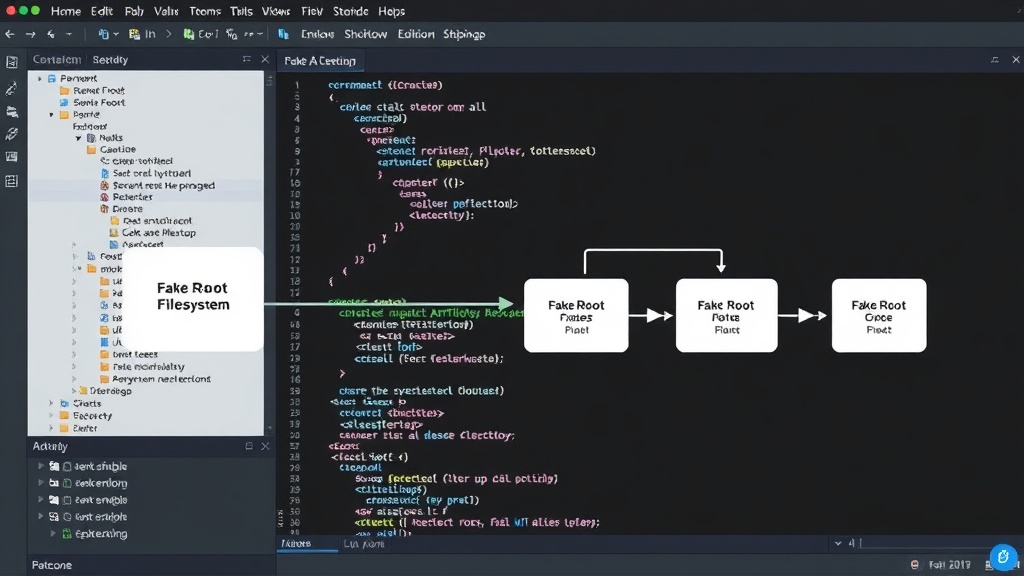
The isolation mechanism is achieved through a combination of techniques. ForkCage constructs a fake root filesystem, which is then presented to the child process. This fake filesystem is a crucial component, as it prevents the command running inside the container from seeing or interacting with the host system's actual files and directories. Any operation the command attempts that would normally access the host's filesystem is redirected or blocked, effectively creating a sandboxed environment. This ensures that a command runs in its own separate, controlled environment, significantly enhancing security and predictability for AI agent workloads.
Technical Implementation: Linux Syscalls
Building a container from scratch necessitates a deep dive into Linux system calls. ForkCage relies on several key syscalls to achieve its functionality:
- `fork()`: This is the foundational syscall for creating a new process. The parent process (ForkCage) calls `fork()` to create an exact duplicate of itself. The child process then proceeds to execute the target command.
- `clone()`: While `fork()` creates a new process with its own memory space, `clone()` offers more granular control over what resources are shared between the parent and child. This is essential for containerization, allowing for the creation of isolated namespaces for processes, network stacks, mount points, and user IDs.
- `unshare()`: This syscall is critical for creating new namespaces. For instance, `unshare(CLONE_NEWNS)` creates a new mount namespace, allowing the child process to have its own filesystem hierarchy without affecting the parent's. Similarly, `unshare(CLONE_NEWPID)` isolates the process IDs.
- `pivot_root()`: Once new mount namespaces are created, `pivot_root()` is used to change the root directory for the current process and its children. This is how the fake root filesystem is made visible as the primary filesystem for the containerized process.
- `chroot()`: While `pivot_root()` is the modern and more robust way to change the root filesystem, `chroot()` is an older syscall that can also be used for basic filesystem isolation. ForkCage likely employs `pivot_root()` for its advanced capabilities.
- `execve()`: After a process has been forked and its environment prepared (e.g., with a fake root filesystem), `execve()` is used to replace the current process image with the new program to be executed (the user-provided command).
- `wait4()`: The parent process uses `wait4()` (or similar `wait` family functions) to monitor the child process, retrieve its exit status, and collect any resource usage information.
The interplay of these syscalls allows ForkCage to construct an isolated execution environment. The developer's choice to use raw syscalls provides a clear, albeit complex, view into how containerization technology operates at its most fundamental level.
Learning and Future Directions
The primary motivation for building ForkCage is educational. By implementing container functionality from the ground up, Devansh gains a deeper understanding of operating system concepts, process management, and system security. The project serves as a practical exploration of kernel-level features that power modern containerization platforms.
While the current scope is basic, the potential for expansion is significant. Future iterations could explore more advanced container features such as:
- Resource Limiting: Implementing controls for CPU, memory, and I/O using cgroups.
- Networking Isolation: Setting up dedicated network interfaces and rules for containerized processes.
- User and Group Isolation: Managing user and group IDs within the container's namespace.
- Seccomp Filtering: Restricting the syscalls that a containerized process is allowed to make, further enhancing security.
The project's repository on GitHub, ForkCage, is available for those interested in examining the C++ code and the specific syscall implementations. This project is a testament to the value of hands-on experimentation in understanding complex technological systems.