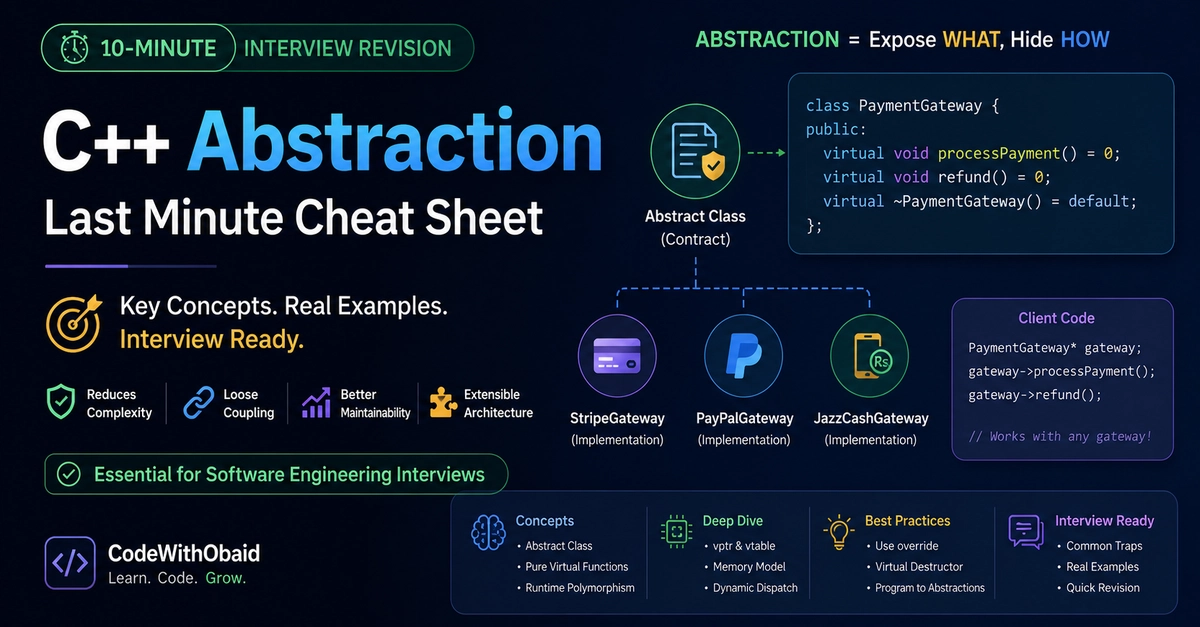
C++ Abstraction: The Essential Interview Revision Guide
If you have a C++ interview looming and need a rapid refresher on abstraction, this guide cuts straight to the core concepts interviewers expect you to know. Forget lengthy theory and convoluted examples; we’re focusing on the essential behaviors and hidden implementations that define abstraction in C++.
What is Abstraction?
At its heart, abstraction is about simplifying complexity. It’s the practice of exposing only the critical functionalities of an object while concealing its intricate internal workings. Think of it like driving a car: you understand that turning the key starts the engine, the steering wheel directs the car, and the pedals control speed. You don't need to know the precise mechanics of the internal combustion engine, the power steering system, or the hydraulic brake lines to operate the vehicle effectively. You interact with the what (what it does) without needing to understand the how (how it does it).
Definition: Abstraction is the process of exposing only the essential behavior of an object while hiding unnecessary implementation details.
WHAT
↓
Hide HOW
This principle is fundamental to good software design. Users of a class or function interact with its public interface, which defines its capabilities. The underlying implementation details, which can be complex and are subject to change, are kept private. This separation ensures that code relying on the abstracted component remains stable even if the internal implementation is refactored or improved.
Why Do We Need Abstraction?
The necessity of abstraction in software development cannot be overstated. Without it, software systems would become unwieldy and difficult to manage. Consider a scenario without abstraction:
- Increased Complexity: Every developer would need to understand the internal implementation details of every component they use. This dramatically increases the cognitive load and the learning curve for new team members.
- Tight Coupling: Client code would become tightly coupled to the specific implementation of a component. Any change in the internal workings of that component would necessitate changes in all the client code that uses it, leading to a brittle system prone to bugs.
- Maintenance Nightmares: Modifying or debugging code would become exponentially harder. Pinpointing issues would require tracing through layers of implementation detail, making maintenance a time-consuming and error-prone process.
- Reduced Reusability: Components designed without abstraction are often highly specific and difficult to reuse in different contexts because their internal logic is exposed and relied upon.
Abstraction combats these issues by providing a clean, high-level interface. It allows developers to work with objects at a conceptual level, focusing on their purpose and behavior rather than their intricate construction. This modularity is key to building scalable, maintainable, and robust software systems.
Types of Abstraction in C++
C++ supports abstraction through several language features, primarily:
1. Abstract Classes
An abstract class is a class that cannot be instantiated on its own. It serves as a blueprint for other classes. An abstract class typically contains one or more pure virtual functions. A pure virtual function is declared using = 0 after its declaration in the class definition. Derived classes must provide an implementation for all pure virtual functions inherited from the abstract base class to become concrete (instantiable) classes.
Key Characteristics:
- Cannot create objects of an abstract class.
- Can have constructors and destructors (though they are typically called by derived class constructors/destructors).
- Can have member functions (both virtual and non-virtual), data members, and static members.
- Must have at least one pure virtual function.
Consider a `Shape` abstract class with a pure virtual function `draw()`. Derived classes like `Circle` and `Square` would inherit from `Shape` and provide their specific implementations for `draw()`.
class Shape {
public:
  virtual void draw() = 0; // Pure virtual function
  virtual ~Shape() = &default; // Virtual destructor is important
};

class Circle : public Shape {
public:
  void draw() override {
    std::cout << "Drawing a Circle" << std::endl;
  }
};

class Square : public Shape {
public:
  void draw() override {
    std::cout << "Drawing a Square" << std::endl;
  }
};
2. Interfaces (via Abstract Classes)
While C++ doesn't have a dedicated `interface` keyword like Java or C#, abstract classes with only pure virtual functions serve the same purpose. They define a contract that derived classes must adhere to. An interface specifies a set of operations without defining their implementation. Any class that implements all pure virtual functions of such an abstract class can be considered to implement the interface.
This is crucial for polymorphism. You can have a pointer or reference to the abstract base class (`Shape*` or `Shape&`) and point it to objects of derived classes (`Circle` or `Square`). When you call a virtual function (like `draw()`) through the base class pointer/reference, the correct derived class version is executed. This allows you to write code that operates on a general type, deferring the specific behavior to runtime.
3. Public vs. Private Members
Encapsulation, which is closely related to abstraction, uses access specifiers (`public`, `private`, `protected`) to control visibility. Marking data members and implementation helper functions as `private` hides them from the outside world. Only the `public` member functions (the methods that form the class's interface) are accessible. This is the most granular form of abstraction within a single class.
For example, a `BankAccount` class might have `public` methods like `deposit(amount)` and `withdraw(amount)`, but the actual balance and transaction logs could be `private` members, accessible only through these public methods. This prevents direct manipulation of the balance, ensuring that withdrawal logic (e.g., checking for sufficient funds) is always applied.
class BankAccount {
private:
  double balance;
  void logTransaction(const std::string& type, double amount) {
    // Internal logging logic
    std::cout << "Logging: " << type << " of " << amount << std::endl;
  }

public:
  explicit BankAccount(double initialDeposit = 0.0) : balance(initialDeposit) {}

  void deposit(double amount) {
    if (amount > 0) {
      balance += amount;
      logTransaction("Deposit", amount);
    }
  }

  bool withdraw(double amount) {
    if (amount > 0 && balance >= amount) {
      balance -= amount;
      logTransaction("Withdrawal", amount);
      return true;
    }
    return false;
  }

  double getBalance() const {
    return balance;
  }
};
Abstraction vs. Encapsulation
While often used interchangeably, abstraction and encapsulation are distinct concepts that work together:
- Abstraction focuses on the external view of an object – what it does and how it can be used. It hides complexity by providing a simplified interface.
- Encapsulation focuses on the internal structure of an object – bundling data (attributes) and methods (behaviors) that operate on that data into a single unit, and controlling access to that data.
Encapsulation is a mechanism that helps achieve abstraction. By hiding the internal data and implementation details through access control (like `private` members), you create a clear, abstract interface for the object.
Benefits of Abstraction
Embracing abstraction in your C++ code yields significant advantages:
- Reduced Complexity: Developers can focus on using components without needing to understand their inner workings.
- Improved Maintainability: Changes to internal implementation do not affect external code as long as the public interface remains consistent.
- Enhanced Reusability: Abstracted components are more modular and easier to integrate into different parts of an application or into entirely new projects.
- Easier Debugging: Issues can often be isolated to specific interfaces or implementations, simplifying the debugging process.
- Better Team Collaboration: Different developers or teams can work on different components concurrently, relying on each other's defined interfaces.
Mastering these concepts is key to writing clean, efficient, and maintainable C++ code. For your next interview, remember the core idea: abstract away the 'how' to focus on the essential 'what'.