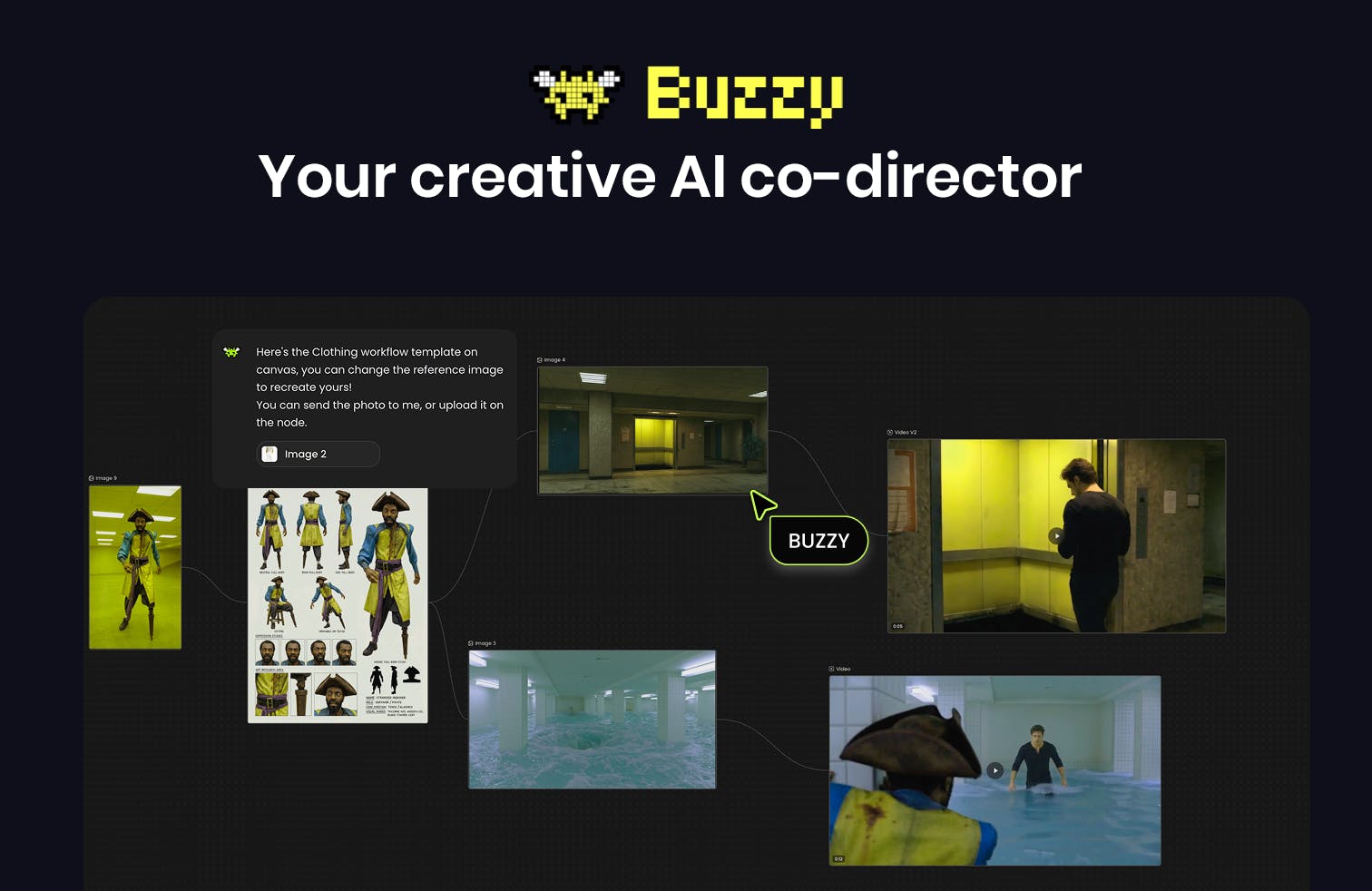
The AI Creative Co-Director
Buzzy emerges onto the scene with a bold claim: to be a creative AI co-director. In a landscape increasingly populated by AI tools that generate content, Buzzy aims to occupy a different niche. Instead of merely producing outputs, it positions itself as a collaborative partner, designed to work alongside human creators throughout the entire creative process, from initial ideation to final execution. This approach suggests a shift from AI as a mere utility to AI as an integrated team member.
The core premise of Buzzy is to augment, not replace, human creativity. It seeks to understand the nuances of a creative project and offer intelligent suggestions, feedback, and assistance. This could manifest in various ways, such as helping to brainstorm concepts, refine existing ideas, overcome creative blocks, or even manage project workflows. The implication is that by offloading certain cognitive and logistical burdens to AI, creators can focus on the higher-level strategic and artistic aspects of their work.
For creators, the promise of an AI co-director is compelling. Many find themselves grappling with the sheer volume of tasks involved in bringing a creative vision to life. This often includes research, planning, drafting, editing, and iterating. Buzzy's ambition is to streamline these steps, making the creative journey more efficient and potentially more enjoyable. The tool is designed to be an active participant, offering insights that a human collaborator might provide, but with the scalability and availability that only AI can offer.
How Buzzy Aims to Collaborate
While specific technical details of Buzzy's underlying architecture are not extensively detailed in its initial product announcement, its positioning as a "creative AI co-director" implies several key functionalities. It likely leverages advanced natural language processing (NLP) to understand project briefs, creative goals, and user input. This understanding would then inform its ability to generate relevant suggestions, ask clarifying questions, and provide constructive feedback.
Think of Buzzy less like a spell-checker and more like an experienced editor who has read your entire project, understands your intended audience, and can flag potential issues or suggest alternative narrative paths. It's designed to be interactive, meaning creators will likely engage with it through prompts, discussions, and iterative refinement. The goal is to foster a dynamic back-and-forth that mirrors a human creative partnership.
The potential applications for such a tool are vast. For writers, Buzzy could assist with plot development, character arcs, dialogue refinement, and even market analysis for their work. For designers, it might offer color palette suggestions, layout variations, or feedback on user experience flows. Musicians could use it to explore harmonic progressions, lyrical ideas, or arrangement options. The common thread is the AI's role in augmenting the human creator's decision-making process and expanding their creative possibilities.
One of the significant challenges AI faces in creative fields is capturing subjective quality and artistic intent. Buzzy's promise as a "co-director" suggests an effort to move beyond generic output generation towards a more nuanced understanding of creative goals. This implies that the tool is being trained not just on vast datasets of creative work, but also on principles of narrative structure, aesthetic theory, and perhaps even market trends relevant to different creative domains.
The Broader Implications for Creative Workflows
The emergence of AI tools like Buzzy signals a broader trend in how creative work is evolving. For decades, technology has been a tool for creators, from the printing press to digital editing software. AI represents a new frontier, offering not just tools but potential collaborators. This shift raises questions about the future of creative industries and the role of human professionals within them.
If AI can effectively act as a co-director, it could democratize certain aspects of creative production, making sophisticated creative assistance accessible to a wider range of individuals and smaller teams. This could lower the barrier to entry for aspiring creators and enable more ambitious projects from those with limited resources. However, it also prompts discussions about the value of human expertise and the potential for AI to displace creative professionals in certain roles.
The surprising detail here is not the existence of another AI tool, but its specific positioning as a *co-director*. Many AI tools focus on automation or raw generation. Buzzy's ambition to be a partner suggests a more integrated and sophisticated form of human-AI collaboration. This implies a future where AI is not just a behind-the-scenes engine, but an active, contributing member of the creative team, capable of offering insights and guidance that shape the final product.
What remains to be seen is how effectively Buzzy can deliver on this promise. The ability to truly act as a co-director requires a deep understanding of context, nuance, and subjective creative intent – areas where AI has historically struggled. Success will depend on Buzzy's capacity to learn from user feedback, adapt to diverse creative styles, and provide genuinely valuable contributions that enhance, rather than hinder, the human creative process.
If you are a creator who has ever felt overwhelmed by the multifaceted demands of a project, or wished for a sounding board that could offer insightful feedback at any hour, Buzzy is aiming to be that partner. Its success will be measured by its ability to integrate seamlessly into existing workflows and demonstrably improve the quality and efficiency of creative output.