Foundational Decisions: Why Not Just Use Postgres?
The decision to build a distributed SQL database from scratch, rather than simply forking or extending an existing monolithic solution like PostgreSQL, is a critical one. While leveraging mature open-source projects offers a faster time to market and a wealth of battle-tested features, it often comes with inherent architectural limitations. Monolithic databases, by their nature, are designed to run on a single machine. Scaling them involves techniques like read replicas, sharding at the application layer, or complex, often brittle, clustering solutions. These approaches typically don't offer the seamless, automatic horizontal scalability and resilience that a truly distributed-native system provides.
Building from scratch allows for fundamental design choices that prioritize distribution, fault tolerance, and elasticity from the ground up. This means rethinking data storage, replication, consensus, and query execution in a way that's inherently suited for a cloud-native environment with ephemeral instances and network partitions. The goal is to achieve a system that behaves like a single, highly available database, even when its underlying components are spread across many machines and potentially multiple availability zones.
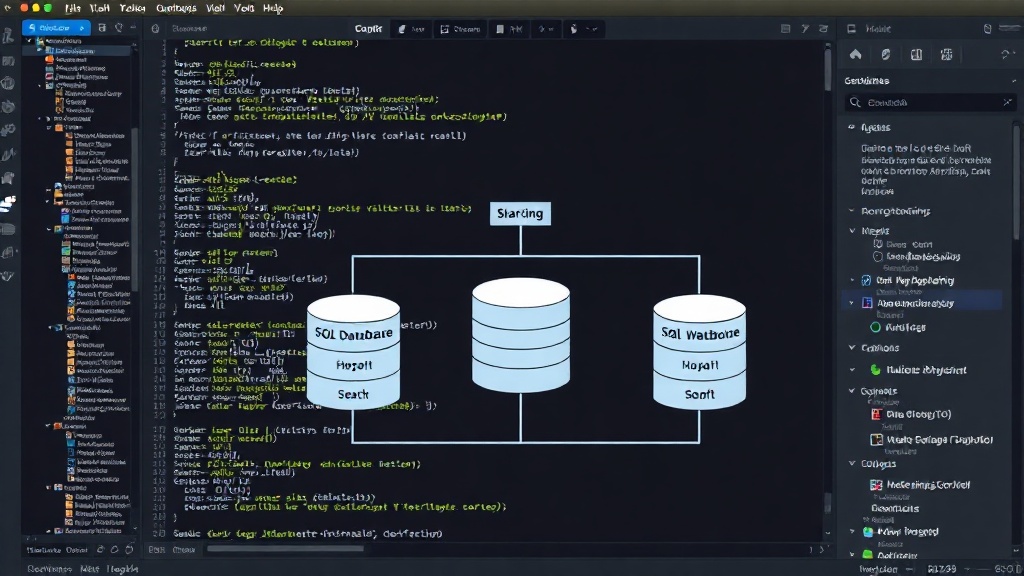
Core Components of a Distributed SQL Database
At its heart, a distributed SQL database must address several key challenges:
1. Distributed Storage and Data Partitioning (Sharding)
Data must be split into smaller, manageable chunks called shards. These shards are then distributed across a fleet of nodes. The system needs a mechanism to determine which node(s) are responsible for which shard. This often involves a metadata service or a distributed hash table that maps keys to shard locations. The choice of sharding strategy (e.g., range-based, hash-based) has significant implications for query performance and load balancing.
2. Replication and Consistency
To ensure high availability and durability, each shard must be replicated across multiple nodes. This introduces the challenge of maintaining consistency among replicas. Different consistency models exist, from strong consistency (e.g., using Paxos or Raft for consensus) to eventual consistency. For a SQL database, strong consistency is typically a requirement for transactional integrity. Implementing a distributed consensus algorithm like Raft is crucial for ensuring that all replicas of a shard agree on the order of operations and the current state.
3. Query Execution and Planning
When a query arrives, the system must first determine which shards contain the relevant data. A query planner then breaks down the query into sub-queries that can be executed in parallel on the nodes holding the data. The results from these distributed sub-queries are then aggregated and returned to the client. This distributed query processing is far more complex than in a single-node database, requiring sophisticated coordination and optimization.
4. Transaction Management
Distributed transactions are notoriously difficult. Ensuring ACID properties across multiple shards and nodes requires protocols like two-phase commit (2PC) or newer, more performant alternatives like Percolator. These protocols add complexity and can impact latency, making efficient transaction management a significant engineering hurdle.
The Role of Consensus Algorithms (Raft)
Raft is a consensus algorithm designed to be understandable. It allows a cluster of nodes to agree on a single proposed value, even in the face of network failures and node crashes. In the context of a distributed database, Raft is typically used to manage the state of each shard's replicas. A leader is elected for each shard, responsible for accepting client writes and replicating them to follower nodes. If the leader fails, a new leader is elected through the Raft protocol. This ensures that writes are durably stored and that the system can continue operating even if some nodes go offline.
Implementing Raft correctly is non-trivial. It involves managing leader elections, log replication, and ensuring that the committed log entries are applied consistently across all replicas. Debugging issues in a distributed consensus system can be particularly challenging due to the inherent non-determinism of network behavior and concurrent operations.
Orchestration and Management
Beyond the core database engine, a production-ready distributed database requires robust orchestration and management capabilities. This includes:
- Cluster Management: Tools for deploying, monitoring, and managing the fleet of nodes.
- Load Balancing: Dynamically rebalancing shards across nodes as the cluster grows or shrinks, or as nodes experience varying loads.
- Failure Detection and Recovery: Automatically detecting node failures and initiating recovery procedures, such as promoting a replica to become a new primary or re-sharding data from a failed node.
- Schema Management: Handling schema changes in a distributed environment without downtime.
- Observability: Providing detailed metrics, logs, and tracing to understand system behavior and diagnose problems.
These operational aspects are as critical as the database's core functionality. Without them, the system would be difficult to operate at scale.
The Trade-offs and Engineering Challenges
Building a distributed SQL database from scratch is an immense undertaking. It requires deep expertise in distributed systems, concurrency, networking, and database internals. The engineering challenges are significant:
- Complexity: The inherent complexity of distributed systems means more bugs, harder debugging, and longer development cycles.
- Performance: Achieving performance comparable to a single-node database, especially for single-shard operations, requires careful optimization. Network latency is a constant battle.
- Consistency vs. Availability: Navigating the CAP theorem trade-offs and choosing the right consistency model for different operations is crucial.
- Operational Overhead: The infrastructure required to run and manage a distributed database is substantial.
However, the payoff is a system that can scale elastically and offer high availability without the operational burden of manual sharding or complex clustering solutions. It enables developers to focus on their applications rather than the intricacies of database scaling.