TrustNode: A Rust Implementation of Solana Concepts
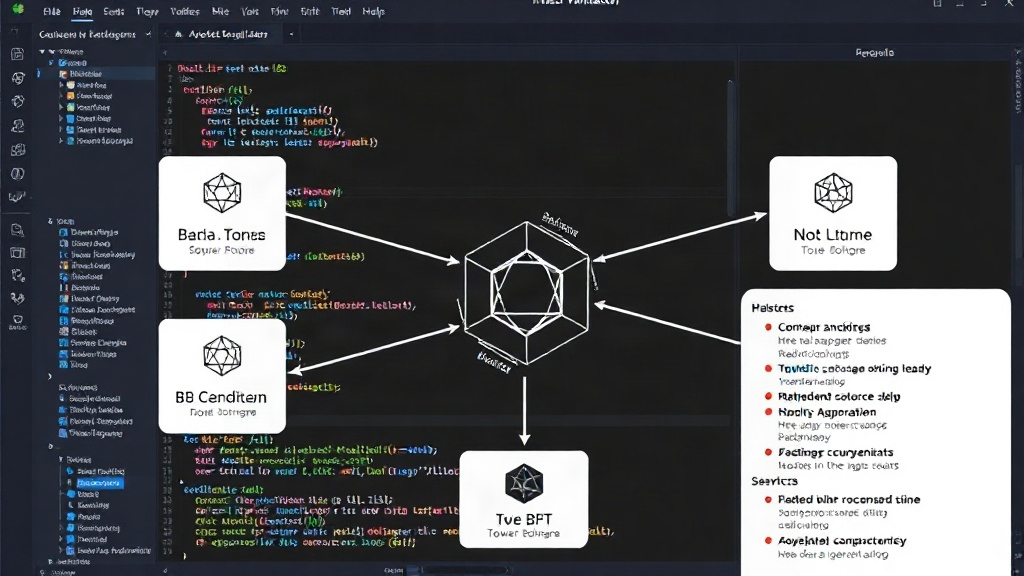
Building a blockchain validator from scratch is a complex undertaking, but focusing on specific subsystems can reveal the core challenges. TrustNode, a project implemented in Rust, aims to replicate key Solana-style components: a verified Proof-of-History (PoH) clock, a Tower BFT-style consensus mechanism, a Sealevel-like parallel execution engine, gossip protocol, and erasure-coded block recovery. The goal isn't to clone Solana, but to expose the concrete, often painful, design decisions that these subsystems necessitate—decisions that generic 'blockchain in Rust' tutorials often gloss over.
Proof-of-History as a Scheduling Problem
The common, simplified description of Proof-of-History is a sequential chain of hashes derived from a counter. However, the practical implementation is far more nuanced. The PoH clock's primary function is to source events, such as TickHeight and sequential slot heights. Validators must then locally re-derive these timestamps to establish trust in the historical record. When this process breaks, it manifests as an ordering problem: disparate validators may disagree on the precise tick at which a transaction occurred, leading to ledger forks.
The implementation of a PoH clock reveals several critical considerations:
- Batching: Processing hashes in batches is essential for performance. This involves careful management of the state between batches, ensuring that the integrity of the chain is maintained without sacrificing throughput.
- Verification: Validators must be able to verify the PoH sequence efficiently. This often involves parallel verification of hash chains to keep pace with the incoming stream of data.
- Drift: Clock drift between validators is a fundamental challenge. Mechanisms must be in place to detect and correct drift, ensuring a synchronized view of history across the network. This can involve periodic synchronization points or more sophisticated drift detection algorithms.
The essence of PoH is not just cryptographic hashing, but the reliable, verifiable sequencing of events across a distributed network. It forces developers to think about distributed systems synchronization, fault tolerance in timing, and efficient data processing.
Tower BFT: Consensus in a High-Throughput Environment
Tower BFT is Solana's adaptation of the Byzantine Fault Tolerance (BFT) consensus algorithm. In a high-throughput blockchain, traditional BFT implementations can become bottlenecks. Tower BFT aims to address this by leveraging the PoH sequence to create a more efficient consensus mechanism. Instead of requiring every validator to communicate with every other validator for every decision, it uses the ordered PoH timestamps to reduce the communication overhead.
Key design challenges for Tower BFT include:
- Optimistic Confirmation: Validators can optimistically confirm blocks based on the PoH sequence, assuming the majority are honest. This speeds up transaction finality.
- Fork Resolution: When forks do occur (due to network partitions or malicious actors), Tower BFT needs robust mechanisms to resolve them. This involves tracking validator votes and their corresponding PoH timestamps to determine the canonical chain.
- Validator State Management: Each validator maintains a complex state, including recent votes, PoH timestamps, and the current view of the blockchain. Efficiently managing this state is crucial for performance and scalability.
- Network Assumptions: The algorithm relies on certain network assumptions, such as eventual synchrony and a bound on message latency. Violations of these assumptions can impact consensus stability.
Implementing Tower BFT forces a deep dive into distributed systems theory, particularly around achieving consensus in asynchronous or partially synchronous networks where message delays are unpredictable. It's about balancing speed with the certainty of agreement.
Sealevel: Parallel Transaction Execution
One of Solana's most distinctive features is Sealevel, its parallel transaction execution engine. Traditional blockchains process transactions sequentially within a block. Sealevel, however, allows for transactions within a block to be executed in parallel. This is possible because Solana transactions explicitly declare the accounts they intend to read from and write to. This declaration allows the runtime to identify non-conflicting transactions that can be processed concurrently.
The design of a Sealevel-like engine brings forth significant engineering hurdles:
- Account Locking and Non-Determinism: The core challenge is managing account access to prevent race conditions and ensure deterministic execution. If two transactions try to write to the same account simultaneously without proper coordination, the outcome becomes unpredictable. Developers must implement fine-grained locking mechanisms or sophisticated scheduling to manage these dependencies.
- Transaction Scheduling: Determining the optimal order for executing parallel transactions is a complex scheduling problem. The system needs to efficiently identify independent transactions and group them for parallel execution, while also handling dependencies between transactions that might be in the same block.
- State Management: Maintaining the integrity of the ledger state during parallel execution requires careful design. Each parallel execution thread needs its own isolated view of the state, which is then merged atomically.
- Developer Experience: For developers building on the platform, understanding and correctly declaring account access is crucial. The engine's success hinges on developers providing accurate metadata about their transactions.
Sealevel forces a rethinking of how smart contracts are executed. It moves from a single-threaded model to a multi-threaded one, demanding robust concurrency control and state management primitives. This is akin to shifting from a single-core processor to a multi-core one for transaction processing—it requires a complete architectural redesign.
Beyond the Core Components: Gossip and Recovery
While PoH, Tower BFT, and Sealevel are central, a functional validator also requires a robust gossip protocol for network communication and an efficient block recovery mechanism. The gossip protocol must handle the propagation of transactions, blocks, and consensus messages reliably and efficiently, even in the face of network churn and latency. Erasure-coded block recovery, as implemented in TrustNode, adds another layer of resilience by allowing validators to reconstruct missing parts of a block from redundant encoded data, reducing the impact of network packet loss.
Building these components forces developers to confront:
- Network Reliability: Designing a gossip system that is resilient to partitions, high latency, and Byzantine nodes is a significant challenge in distributed systems.
- Data Redundancy: Erasure coding adds computational overhead but significantly improves data availability. Choosing the right coding scheme and managing the encoded data efficiently are critical design choices.
The TrustNode project highlights that creating a high-performance blockchain validator is not just about implementing algorithms, but about deeply understanding the trade-offs and practical engineering challenges inherent in distributed systems, concurrency, and high-throughput data processing.