Introduction: The Illusion of Simplicity
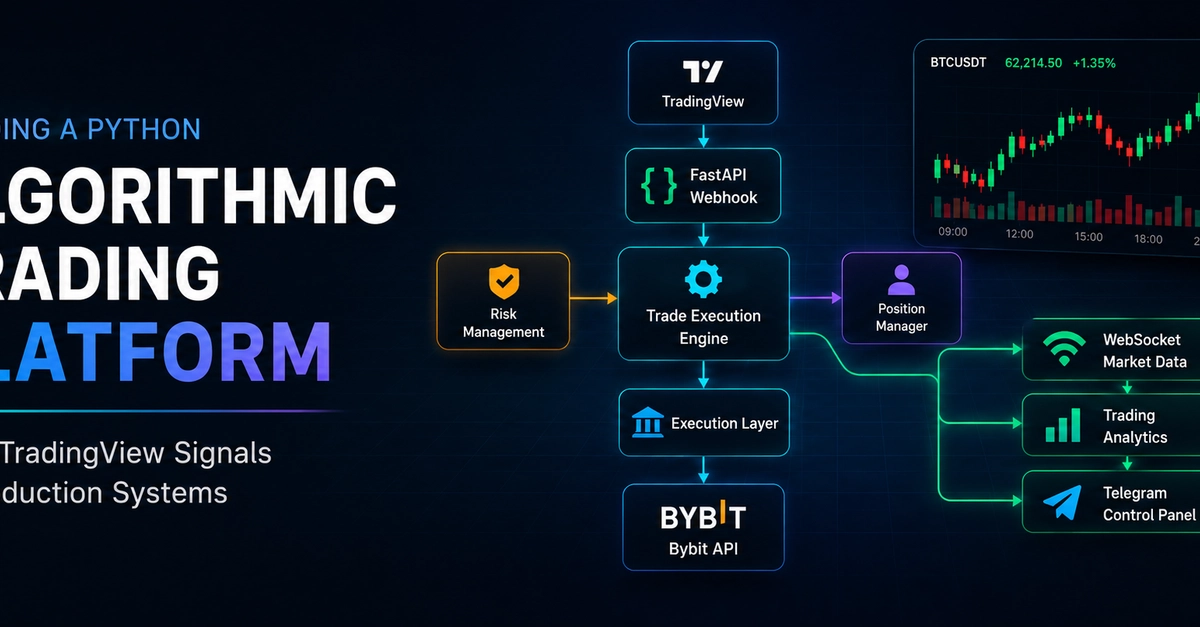
The journey into algorithmic trading often begins with a seemingly straightforward concept: connect TradingView to an exchange API, receive webhook signals, and execute market orders. This basic architecture, a Python script acting as the intermediary between TradingView alerts and a brokerage like Bybit, appears deceptively simple on paper. However, scaling this to a production-ready system capable of handling real-time data, managing risk, and ensuring reliability involves a complex interplay of software engineering principles far beyond a basic script. This series, documented in 18 parts, focuses not on proprietary trading strategies, but on the robust engineering decisions required to build a system that can withstand the demands of live trading.
The fundamental components often envisioned are:
- TradingView: The source of trading signals, typically via alerts.
- Webhook: The communication channel from TradingView to the trading platform.
- Python Script: The core logic engine that interprets signals and interacts with the exchange.
- Exchange API: The interface for placing orders, fetching market data, and managing accounts (e.g., Bybit API).
While this diagram illustrates the basic flow, it omits critical considerations for a production environment: latency, error handling, state management, data persistence, and security. A real-world system requires a more sophisticated architecture to ensure that signals are processed accurately, orders are executed reliably, and the system can recover from failures gracefully.
Designing for Reliability and Scalability
Moving beyond the initial concept, the engineering challenges multiply. A production-grade platform must be designed with reliability and scalability as core tenets. This means considering:
Real-time Data Processing
Algorithmic trading thrives on timely market data. Webhooks from TradingView, while useful for triggering trades, are not a substitute for a continuous, low-latency data feed. Integrating with exchange WebSocket APIs is crucial for receiving real-time price updates, order book changes, and trade executions. This data forms the backbone for sophisticated strategy execution, risk assessment, and performance monitoring. The challenge lies not just in receiving data, but in processing it efficiently. High-frequency data streams require optimized data structures and asynchronous processing to avoid bottlenecks. Think of it less like reading a daily newspaper and more like trying to drink from a firehose – you need specialized equipment to manage the flow.
Trade Execution Logic
Executing trades is more than just calling an API endpoint. A robust system needs to handle various order types (market, limit, stop-loss, take-profit), manage partial fills, account for slippage, and ensure that orders are placed and cancelled correctly. The interaction with the Bybit API, for instance, involves understanding rate limits, authentication, and error responses. Implementing a resilient order management system is paramount. This includes tracking order status, retrying failed orders under specific conditions, and maintaining a consistent view of open positions and P&L. The system must also be able to gracefully handle exchange downtime or API disruptions.
Risk Management Framework
No trading system is complete without a comprehensive risk management layer. This involves setting predefined risk parameters, such as maximum position size, daily loss limits, and acceptable drawdown. The platform must actively monitor these parameters and automatically halt trading or adjust positions when thresholds are breached. This layer acts as a circuit breaker, protecting capital from catastrophic losses due to strategy malfunctions or adverse market conditions. Integrating real-time P&L calculations and position sizing based on account equity is essential for dynamic risk control.
System Architecture and State Management
The overall architecture of the platform significantly impacts its performance and maintainability. A monolithic script, while easy to start with, quickly becomes unmanageable as complexity grows. Decoupling components – such as data ingestion, signal generation, order execution, and risk management – into separate services or modules allows for independent development, testing, and scaling. State management is critical: the system must maintain an accurate, persistent record of its current state, including open orders, positions, account balances, and historical trades. This state must be resilient to restarts and failures, often requiring a database or a robust in-memory store with persistence mechanisms.
Observability and Monitoring
For a production system, visibility is key. Comprehensive logging, metrics collection, and alerting are non-negotiable. Developers need to understand what the system is doing at all times, identify performance bottlenecks, and be notified immediately of any critical failures. This includes tracking API call success rates, execution latencies, data processing times, and the status of risk management rules. Dashboards displaying key performance indicators (KPIs) provide a high-level overview, while detailed logs allow for in-depth debugging when issues arise.
Leveraging TradingView Webhooks and Bybit API
While TradingView webhooks are a convenient way to initiate actions, they are best suited for triggering simpler tasks or serving as an entry point rather than the sole source of market intelligence. For a serious algorithmic trading platform, integrating directly with the Bybit WebSocket API for real-time market data is essential. This provides a continuous stream of tick data, order book updates, and trade information, enabling more sophisticated strategy logic and faster reaction times than relying solely on webhook intervals.
The Bybit API offers endpoints for:
- Account Information: Fetching balances, P&L, and trading permissions.
- Order Management: Placing, cancelling, and querying orders.
- Market Data: Accessing historical and real-time kline data, order books, and recent trades via REST and WebSocket.
- Position Management: Querying and updating current positions.
Effectively managing API rate limits is crucial. Implementing exponential backoff and retry mechanisms for failed requests ensures that the platform remains functional even under high load or temporary network issues. The choice of libraries for interacting with the Bybit API (e.g., official SDKs or community-developed wrappers) also impacts development speed and robustness.
The Path Forward: Beyond the Basics
Building a production-ready algorithmic trading platform is an iterative process. It requires a deep understanding of financial markets, software engineering best practices, and the specific intricacies of the chosen exchange APIs. The initial