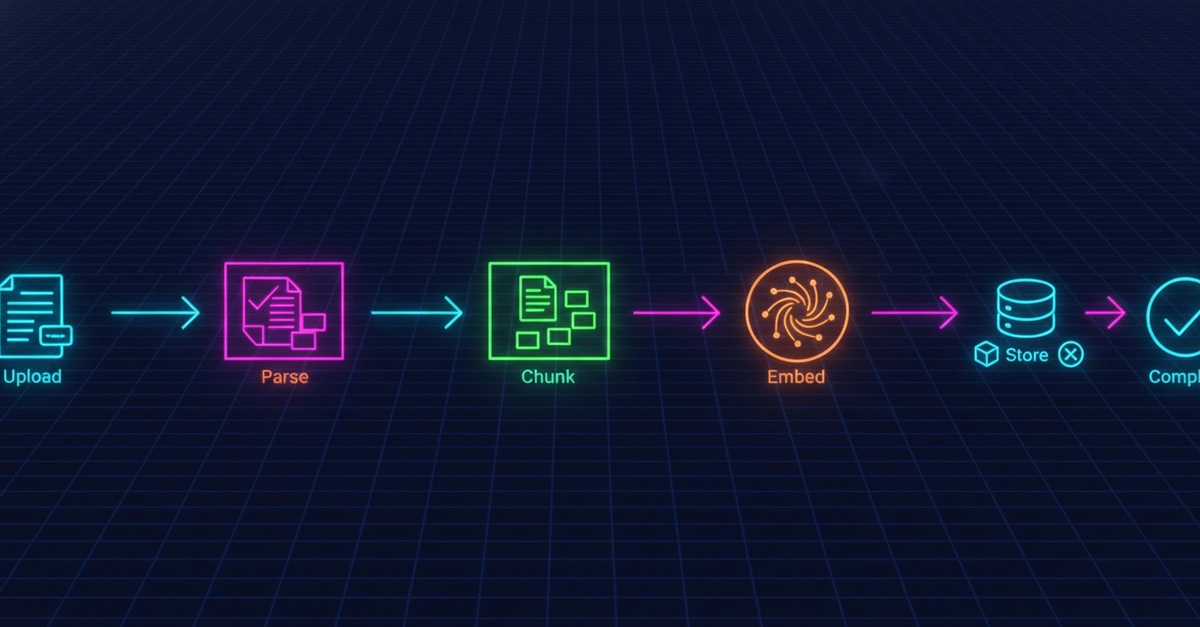
The Core RAG Flow is Deceptively Simple
At its heart, Retrieval-Augmented Generation (RAG) is straightforward. A basic demo involves embedding documents, retrieving the most semantically similar chunks to a user's query, stuffing these chunks into a prompt, and asking a Large Language Model (LLM) to generate an answer. This four-step process forms the foundation. However, transforming this demo into a production-ready API introduces significant complexity, making the LLM call the least of your worries.
Beyond Basic Embeddings: The Hybrid Search Imperative
A common pitfall is relying solely on semantic search. While effective for capturing meaning, it struggles with precise keyword matching or when users ask for specific terms. To address this, a hybrid approach is crucial. This involves combining vector-based semantic search with traditional keyword search. Vector databases like Qdrant excel at semantic retrieval, finding documents based on conceptual similarity. For exact matches or when users employ specific jargon, a BM25 or similar keyword-based index is necessary. Integrating these two search modalities ensures that queries are handled with both conceptual understanding and literal accuracy. This dual approach is vital for a robust RAG system, preventing missed information that a single method might overlook.
Handling Real-World Documents: PDF Processing Challenges
Production systems rarely deal with clean text files. PDFs are ubiquitous, but parsing them is a non-trivial task. Documents can contain complex layouts, tables, images, and varying text encodings, all of which can break simple text extractors. A library like PyMuPDF (MuPDF) is essential for robust PDF parsing, capable of handling these complexities. However, processing large documents or many PDFs can be I/O bound and time-consuming. To prevent API requests from blocking, asynchronous processing is a must. This means offloading the PDF parsing and embedding tasks to background workers, allowing the API to respond quickly to the user while the data is processed. Redis can serve as a message queue for this asynchronous workflow, managing tasks and their status.
Refining the Signal: Reranking and Metadata Preservation
Even with hybrid search, the retrieved chunks can be noisy. Some might be relevant but not the most relevant, while others might be tangential. This is where reranking becomes critical. After the initial retrieval from both semantic and keyword indices, a cross-encoder reranker can be employed. Unlike bi-encoders used for initial embedding, cross-encoders process the query and each retrieved document chunk *together*, allowing for a much more nuanced assessment of relevance. This step significantly improves the quality of the context provided to the LLM. Furthermore, preserving source metadata (like document name, page number, or specific section) is paramount for grounding the LLM's answer and allowing users to verify information. This metadata must be stored alongside the embedded chunks and passed through the retrieval and reranking stages.
The LLM Integration: Scalability and Flexibility with LiteLLM
While the LLM itself is often the easiest component to swap out, managing LLM calls in production requires careful consideration. Different LLMs have different APIs, token limits, and performance characteristics. Using a library like LiteLLM provides a unified interface to numerous LLM providers (OpenAI, Anthropic, Cohere, etc.) and models. This abstraction layer allows for easy experimentation with different LLMs, fallback strategies, and cost management. It simplifies prompt engineering by providing a consistent way to format prompts, including the retrieved context and metadata, before sending them to the chosen LLM.
Caching for Performance and Cost
Repeated queries should yield consistent answers. Implementing a caching layer, such as Redis, is essential for both performance and cost savings. When a query is received, the system first checks the cache. If a matching answer exists and is still considered valid, it's returned immediately, bypassing the entire RAG pipeline. Cache invalidation strategies need to be considered, especially if documents are updated or added frequently. This can range from time-based expiration to event-driven invalidation triggered by document ingestion or modification.
Security and API Management
Exposing a RAG system as an API necessitates robust security measures. This includes authentication and authorization to control access, rate limiting to prevent abuse, and input validation to guard against prompt injection attacks. Storing API keys and user credentials securely is non-negotiable. PostgreSQL can serve as a reliable datastore for user management, API keys, and potentially for storing document metadata that isn't part of the vector index.
Putting It All Together: A Hybrid RAG Architecture
The complete architecture involves several asynchronous components. Document ingestion workers handle PDF parsing, chunking, embedding (using FastEmbed for efficiency), and indexing into Qdrant (for semantic search) and PostgreSQL (for keyword search and metadata). User queries are processed by the FastAPI application. The query first hits the cache. If not found, it triggers a hybrid retrieval from Qdrant and PostgreSQL. The results are then reranked by a cross-encoder. Finally, the reranked context is formatted and sent to an LLM via LiteLLM. The generated answer, along with source metadata and potentially a cache key, is returned to the user and stored in Redis for future queries. This layered approach, from ingestion to response, turns a simple LLM call into a complex, resilient, and performant API.