The Problem: A Fragmented Medical Past
Our medical histories are rarely neat. They exist as a chaotic collection of disparate documents: PDF lab results, scanned prescriptions, and cryptic entries from various Electronic Medical Records (EMR) systems. Trying to recall specific symptom onset dates, track long-term health trends like cholesterol levels, or correlate seemingly unrelated past conditions becomes an exercise in digital archaeology. This fragmentation means we often rely on imperfect memory or incomplete data when discussing our health with providers, leading to potential gaps in care and understanding.
The current state of personal health data management is fundamentally broken for actionable insight. We have the data, but it's siloed, unstructured, and unsearchable in any meaningful way. This makes proactive health management and informed discussions with healthcare professionals incredibly difficult.
The Solution: A Personal Health Knowledge Base
Quantified Self 2.0 means moving beyond simple file folders and embracing modern data science techniques to build a truly intelligent personal health knowledge base. The core idea is to transform your scattered medical documents into a structured, queryable system that can provide insights previously locked away in jargon and PDF formatting. This involves leveraging two key technologies: Vector Databases and Retrieval-Augmented Generation (RAG).
A Vector Database stores data not as raw text, but as numerical representations called embeddings. These embeddings capture the semantic meaning of the text. When you query the database, it doesn't just look for keywords; it looks for conceptual similarity. This means you can ask questions like "When did I start experiencing persistent joint pain?" and the database can find relevant entries even if they don't use those exact words. This is crucial for medical data, where symptoms can be described in many ways.
Retrieval-Augmented Generation (RAG) combines the power of large language models (LLMs) with your personal data. Instead of relying solely on the LLM's general knowledge, RAG first retrieves relevant information from your vector database and then uses that information to ground the LLM's response. This ensures that the answers you get are specific to your medical history, not just generic medical information.
Building Your Health Knowledge Base: The Stack
Creating this system requires a specialized toolkit. The approach outlined here uses a combination of powerful open-source and accessible tools:
1. Document Ingestion and Parsing: Unstructured.io
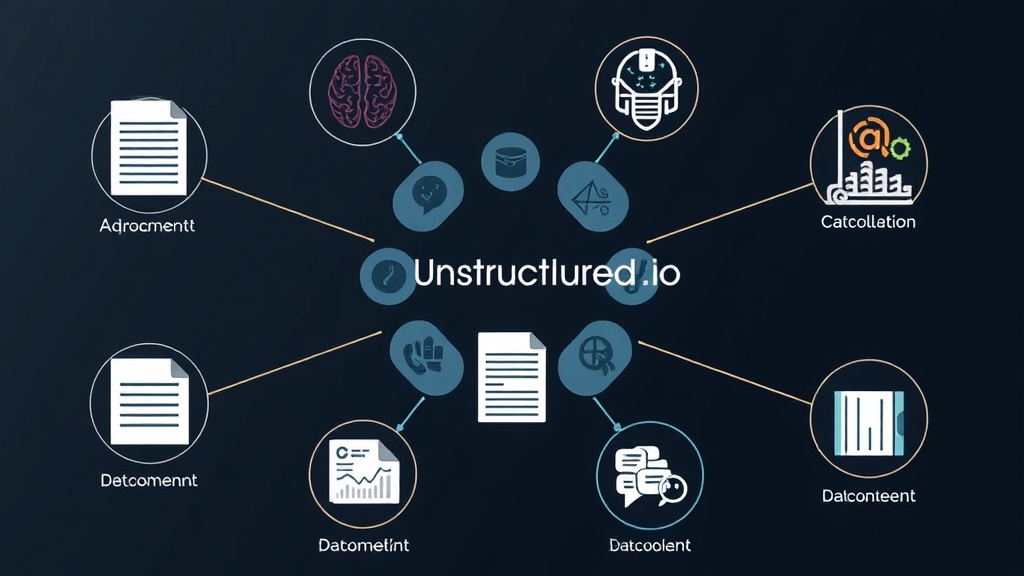
The first hurdle is getting your diverse medical documents into a usable format. This is where Unstructured.io shines. It's designed to handle a wide variety of document types—PDFs, HTML, Word documents, images (via OCR)—and extract clean, structured text. For medical records, this means pulling out lab values, doctor's notes, and prescription details, stripping away the formatting noise that makes manual parsing a nightmare.
Unstructured.io acts as the crucial first step, transforming your messy collection of files into a clean stream of text data ready for further processing. It handles the heavy lifting of document deconstruction.
2. Text to Embeddings: Sentence-Transformers
Once the text is extracted, it needs to be converted into numerical vectors that a vector database can understand. This is the role of Sentence-Transformers. This library provides pre-trained models that can take sentences or paragraphs and generate dense vector embeddings. These embeddings capture the semantic meaning of the text, allowing for similarity searches. For medical data, this means that notes about "knee pain" and "arthralgia" might generate embeddings that are close together in the vector space, reflecting their conceptual similarity.
Choosing the right Sentence-Transformer model is important; models fine-tuned on scientific or medical text can yield even better results for this specific domain.
3. Vector Storage and Search: Qdrant
The generated embeddings need to be stored and queried efficiently. This is where a Vector Database like Qdrant comes in. Qdrant is an open-source vector similarity search engine. It's optimized for storing and searching high-dimensional vectors, making it ideal for handling potentially millions of text chunks from years of medical records. Its key advantage is speed and scalability, allowing for near real-time retrieval of relevant medical information based on semantic similarity.
Unlike traditional databases that rely on exact keyword matches, Qdrant uses algorithms like Approximate Nearest Neighbor (ANN) search to find vectors that are conceptually closest to your query vector. This is the engine that powers the