Bridging the Gap: Natural Language to SQL
Data analysis often begins with simple, human-language questions like "Which customers spent the most?" or "How many orders are pending?". Traditionally, translating these into SQL queries requires technical expertise, leading to delays waiting for developers, analysts, or dashboard updates. This friction point limits direct data exploration for many users.
A new Python example, leveraging Telnyx AI Inference, offers a practical solution by demonstrating how to build a lightweight Natural Language to SQL API. This API acts as a translator, converting everyday language into executable SQL statements, thereby democratizing data access and accelerating insights.
API Endpoints and Functionality
The provided Flask application exposes several key API endpoints designed for querying and managing natural language to SQL translations:
POST /query
POST /query/sample
VALIDATE /validate
GET /queries
GET /queries/<id>
GET /health
The core functionality resides in the POST /query endpoint. This endpoint accepts a natural-language question as input and, through the underlying AI model, generates the corresponding SQL query. This allows users to input questions like "What products generated revenue last month?" and receive a SQL query that can be directly executed against a database.
POST /query/sample provides sample queries, useful for testing or demonstrating the API's capabilities without requiring real-time inference. The POST /validate endpoint allows for the verification of generated SQL queries, ensuring their syntactic correctness and potential adherence to schema rules before execution. This is a critical step for preventing errors and protecting the database.
For tracking and auditing purposes, GET /queries retrieves a list of all historical queries processed by the API, while GET /queries/<id> fetches details of a specific query by its unique identifier. Finally, the GET /health endpoint offers a simple way to check the operational status of the API service.
Technical Implementation and AI Inference
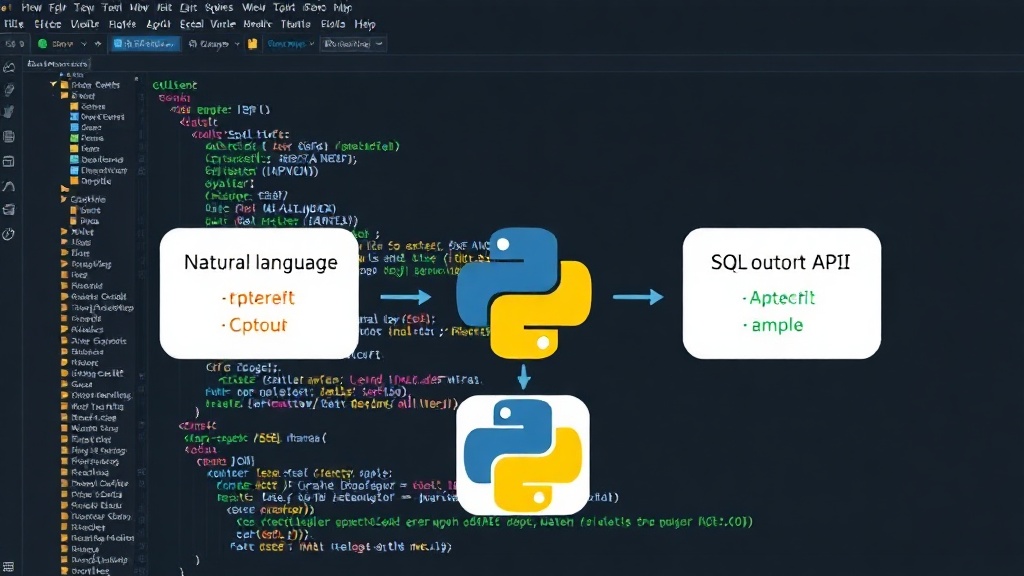
Building such an API involves integrating a natural language processing (NLP) model capable of understanding user intent and mapping it to SQL syntax. The example utilizes Telnyx AI Inference, a service that provides access to pre-trained models or allows for custom model deployment for specific tasks. The choice of Telnyx suggests a focus on leveraging existing, robust AI infrastructure rather than building an NLP model from scratch.
The process typically involves several steps within the API's backend:
- Input Processing: The natural language question is received by the
/queryendpoint. - Intent Recognition and Entity Extraction: The AI model analyzes the input to identify the user's intent (e.g., retrieve data, count records) and extract key entities (e.g., customer names, product types, date ranges).
- SQL Generation: Based on the recognized intent and extracted entities, the model constructs a syntactically correct SQL query. This often involves mapping natural language terms to database table and column names.
- Query Validation (Optional but Recommended): The generated SQL is checked for validity, potentially against a predefined schema or using a SQL parser.
- Output: The generated SQL query is returned to the user.
The underlying AI model needs to be trained or fine-tuned on a dataset of natural language questions paired with their corresponding SQL queries. The effectiveness of the API directly correlates with the quality and breadth of this training data and the sophistication of the AI model used for inference.
Potential Applications and User Benefits
The implications of a readily accessible Natural Language to SQL API are significant across various roles:
- Business Analysts: Can perform ad-hoc data exploration without waiting for data teams, enabling faster decision-making.
- Product Managers: Can quickly pull user engagement metrics, feature adoption rates, or sales performance data.
- Sales Teams: Can inquire about customer spending patterns, order statuses, or lead conversions directly.
- Developers: Can integrate data querying capabilities into applications or internal tools without needing to write complex SQL themselves.
By abstracting away the complexities of SQL, this API empowers a broader range of users to interact with data directly. This fosters a more data-driven culture within organizations and reduces the bottleneck often associated with traditional data access methods. The ability to ask data questions in plain English is akin to having a universal translator for your database, making information accessible to anyone, regardless of their technical SQL proficiency.
Considerations for Production Deployment
While the provided example offers a functional blueprint, deploying such an API into a production environment requires careful consideration of several factors:
- Security: Ensuring that generated SQL queries are safe and do not introduce vulnerabilities like SQL injection is paramount. Robust validation and sanitization mechanisms are essential.
- Scalability: The underlying AI inference service and the Flask application must be able to handle the expected query volume.
- Accuracy and Performance: The AI model's accuracy in translating natural language to SQL directly impacts the utility of the API. Continuous monitoring and potential retraining are necessary. Performance, especially for complex queries, needs to be acceptable for user experience.
- Database Schema Awareness: The AI model needs to be aware of the specific database schema (tables, columns, relationships) to generate accurate queries. This might require providing schema information to the inference service or fine-tuning the model on schema-specific examples.
- Error Handling and Feedback: Providing clear error messages and potentially allowing users to refine their queries based on feedback is crucial for usability.
The open-source code example provides a strong starting point. If you run a team that frequently needs to query databases but lacks deep SQL expertise, this approach offers a pathway to empower them. The key challenge lies in configuring the AI inference correctly for your specific database schema and ensuring the security of the generated queries.