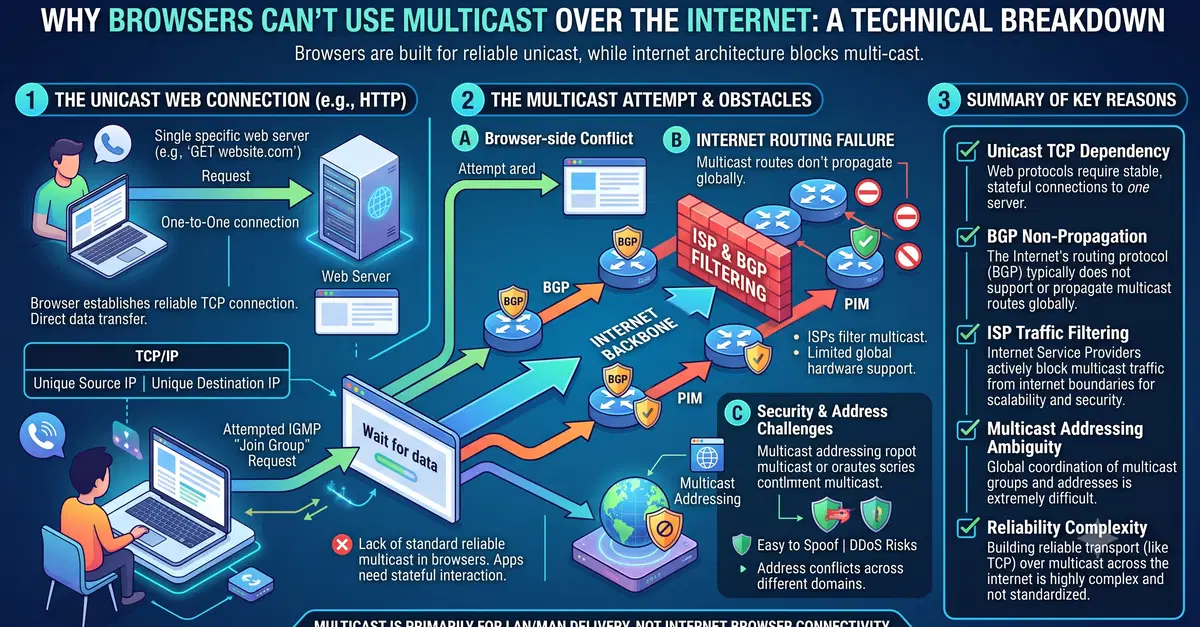
How Web Browsing Works Today
Every browser interaction with a web server relies on unicast communication. This means a dedicated, point-to-point connection is established for each user request. When you load a webpage, your browser opens a TCP connection to the server. If a million users access the same page simultaneously, the server must manage a million individual connections and send a million identical responses. This model, while robust and well-understood, is inherently inefficient for distributing identical content to many recipients.
The current web architecture prioritizes reliability and ordered delivery, which TCP provides through features like acknowledgments, retransmissions, and congestion control. While this ensures data integrity and a smooth user experience for individual connections, it creates significant overhead and scalability challenges when serving large audiences. The server's resources are consumed by maintaining these numerous distinct connections, rather than by the actual data transfer.
The Fundamental Roadblocks to Multicast in Browsers
The primary obstacle to browsers using multicast lies in the transport layer protocol: TCP. HTTP/1.1 and HTTP/2, the foundational protocols of the modern web, are built upon TCP. TCP's design is fundamentally point-to-point. It mandates a unique connection for every sender-receiver pair, requiring per-client state management, acknowledgments for received packets, retransmissions of lost packets, congestion control to manage network traffic, and strictly ordered delivery of data. These features are essential for reliable one-to-one communication but are incompatible with the many-to-many nature of multicast.
Multicast, by contrast, is designed for efficient one-to-many or many-to-many communication. A single data packet can be sent once and routed to multiple interested receivers simultaneously. This drastically reduces network traffic and server load. However, TCP's built-in mechanisms for connection state, acknowledgments, and ordered delivery break down in a multicast scenario. A sender cannot maintain individual TCP states for thousands or millions of receivers, nor can it effectively manage acknowledgments or retransmissions in a broadcast-like environment.
Replacing TCP with UDP: A Necessary but Insufficient Step
To enable multicast in browsers, the transport layer must shift from TCP to UDP (User Datagram Protocol). UDP is a connectionless protocol that offers a much simpler, faster, and more lightweight alternative to TCP. It does not require connection setup, acknowledgments, retransmissions, congestion control, or ordered delivery. This lack of overhead makes UDP an ideal candidate for multicast, as it allows a single datagram to be sent to a group of receivers without the sender needing to track each one individually.
However, the transition to UDP is not a silver bullet. While UDP can support multicast, it sacrifices the reliability guarantees that TCP provides. In a UDP-based multicast system, packets can be lost, arrive out of order, or be duplicated. For web browsing, where data integrity is paramount, these issues would need to be addressed. This implies the need for new application-layer protocols or extensions that can handle packet loss, reordering, and deduplication at the browser or server level, effectively re-implementing some of TCP's reliability features in a multicast-aware manner.
New Network Protocols and Browser APIs
Beyond the transport layer, enabling multicast in browsers would necessitate the development and standardization of new network protocols and browser APIs. Current web protocols like HTTP are designed with unicast in mind. Adapting them for multicast would be a significant undertaking, likely requiring a complete redesign or the introduction of entirely new protocols that are multicast-native.
Consider the implications for how web content is requested and delivered. Instead of a browser requesting a resource via HTTP GET to a specific server IP address, it would need to join a multicast group. The server would then send the content to that group. This fundamentally changes the client-server interaction model. Furthermore, browsers would need new APIs to manage multicast group subscriptions, handle incoming multicast streams, and process potentially unordered or lost data. These APIs would need to be carefully designed to maintain security and prevent abuse, as multicast can be exploited for denial-of-service attacks if not properly managed.
The current web security model is also heavily reliant on unicast connections and TLS/SSL encryption, which are designed for point-to-point communication. Securing multicast traffic presents unique challenges. While protocols like IPsec can secure IP multicast, integrating this seamlessly and efficiently into the browser's security model, alongside existing HTTPS infrastructure, would require considerable innovation. Developers would need new tools and frameworks to build multicast-aware applications that are both performant and secure.
What Would Have to Change: A Summary
In essence, making browsers multicast-capable requires a paradigm shift. It's not a simple software update or a minor protocol tweak. The core components of the web stack would need to be re-engineered:
- Transport Layer: Replace TCP with UDP as the primary transport for web traffic intended for multicast distribution.
- Application Layer Protocols: Redesign or create new protocols (e.g., multicast-aware HTTP) to handle content delivery and request/response mechanisms over UDP multicast.
- Browser APIs: Introduce new browser APIs for managing multicast group memberships, receiving and processing multicast data streams, and handling reliability concerns.
- Network Infrastructure: Ensure that network infrastructure (routers, firewalls) supports IP multicast routing efficiently and securely.
- Security Models: Develop robust security mechanisms for multicast web traffic, addressing encryption, authentication, and access control in a many-to-many context.
The effort involved is substantial, akin to building a new internet protocol suite for a specific use case. While the efficiency gains for certain applications, like live streaming or large-scale content distribution, could be immense, the complexity and the need for widespread standardization mean that browsers will likely continue to rely on unicast for the foreseeable future.