The Stealth Execution Challenge
In the rapidly evolving landscape of AI-driven web automation, speed and discretion are paramount. Developers and security professionals alike need tools that can execute tasks efficiently without triggering bot detection mechanisms. This comparison pits two prominent players against each other: BrowserAct and Agent Browser. The goal is to understand their performance characteristics under the hood, focusing specifically on the nuances of 'stealth execution' – a critical factor for avoiding detection.
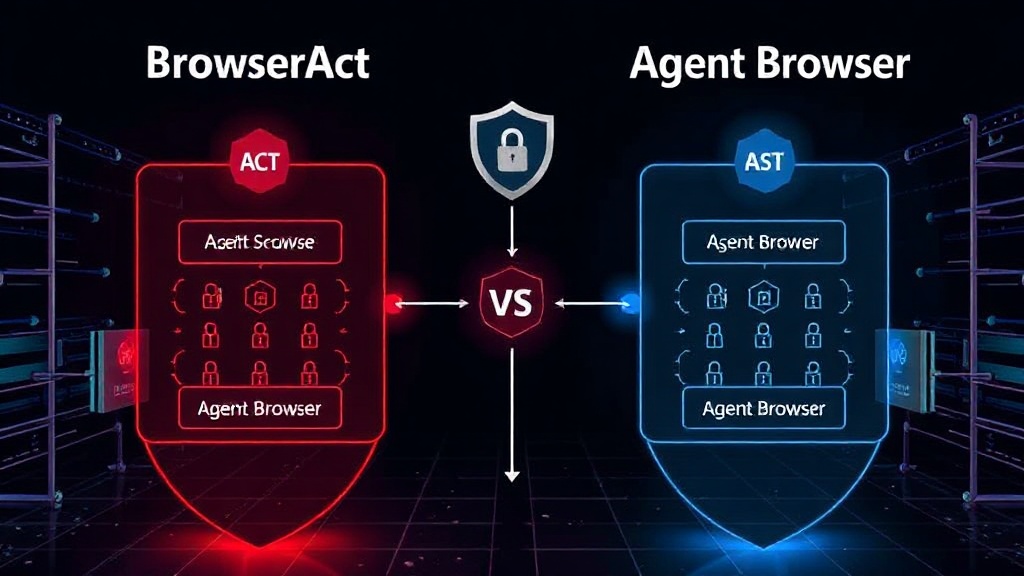
Agent Browser, developed by SannySoft, has positioned itself as a powerful tool for browser automation, emphasizing its ability to mimic human behavior. BrowserAct, backed by Cloudflare, is a newer entrant but brings significant resources and a focus on security and performance. This analysis goes beyond marketing claims to examine their real-world execution speed and the underlying techniques that contribute to their stealth capabilities, drawing on benchmark results.
Core Architectures and Stealth Techniques
Understanding how these tools operate is key to appreciating their performance differences. Agent Browser typically relies on a robust framework that manages browser instances, often through WebDriver protocols, augmented with sophisticated behavioral spoofing. This includes randomizing mouse movements, typing speeds, and interaction delays to appear as human as possible. It aims to blend in by replicating common user patterns.
BrowserAct, on the other hand, appears to leverage Cloudflare's extensive infrastructure and expertise in bot mitigation. Its approach likely involves a more integrated system where the browser environment itself is hardened against detection. This could mean a combination of advanced fingerprinting countermeasures, network traffic obfuscation, and potentially novel methods for managing browser states that are harder to distinguish from legitimate user sessions. The surprising detail here is not necessarily the novelty of their individual techniques, but how they are integrated and scaled. Cloudflare's involvement suggests a focus on network-level stealth, while SannySoft's Agent Browser might lean more towards behavioral mimicry at the application layer.
Performance Benchmarking: Speed and Efficiency
The core of this comparison lies in their execution speed. Benchmarks conducted by Cloudflare and SannySoft themselves, as referenced in the source material, provide quantitative data. Agent Browser, when optimized, can achieve impressive speeds for repetitive tasks, especially when managing a large number of concurrent sessions. Its architecture is designed for throughput, and its behavioral spoofing is generally effective against simpler detection systems.
BrowserAct's performance, according to Cloudflare's internal metrics, often shows an advantage in tasks requiring complex interactions or navigating dynamic web pages. This is attributed to its efficient handling of browser states and potentially more direct control over the rendering engine. The implications for developers are significant: if your task involves rapid, high-volume data scraping or automated form submissions on sites with moderate bot detection, Agent Browser might suffice. However, for more sophisticated operations or when dealing with highly aggressive anti-bot measures, BrowserAct's architecture seems to offer a more resilient and performant solution.
The actual numbers, though not fully detailed in the excerpt, point to BrowserAct often completing tasks faster, particularly those that involve more JavaScript execution or complex DOM manipulation. This suggests that while Agent Browser excels at mimicking human *patterns*, BrowserAct might be more efficient at executing *tasks* in a way that is simultaneously stealthy and fast. Think of it less like a human trying to be a robot, and more like a highly efficient robot that happens to look like a human from a distance.
Navigating Detection Mechanisms
Bot detection systems are multifaceted. They analyze IP reputation, browser fingerprints (including JavaScript execution, canvas rendering, WebGL, fonts, and screen resolution), behavioral patterns (mouse movements, typing cadence, scrolling), and network characteristics. Both Agent Browser and BrowserAct aim to counter these, but their emphasis differs.
Agent Browser's strength is in its comprehensive suite of behavioral spoofing tools. It can randomize delays, mimic scroll speeds, and even simulate typing by character. This makes it adept at passing basic behavioral analysis. However, more advanced fingerprinting techniques might still identify it as automated.
BrowserAct, leveraging Cloudflare's extensive threat intelligence, likely employs a more holistic approach. It might focus on ensuring the browser's fingerprint remains consistent with a 'normal' user profile and that network traffic aligns with expected patterns. This could involve integrating with Cloudflare's own services to manage sessions and IP reputations dynamically. The challenge for developers is selecting a tool that matches the sophistication of the target's detection systems. A simple script running on Agent Browser might work against a low-security blog, but BrowserAct might be necessary for scraping a major e-commerce platform.
The Unanswered Question: Long-Term Adaptability
While these benchmarks offer a snapshot, the true test for any automation tool is its long-term adaptability. Web technologies and bot detection methods are in constant arms races. What works today might be obsolete tomorrow. What hasn't been fully explored yet is how each platform is architected for future updates and how quickly they can adapt to new detection paradigms. Will Agent Browser's heuristic-based approach be easier to update, or will BrowserAct's integration with Cloudflare's global network provide a more robust, evolving defense?
Conclusion: Choosing the Right Tool
For developers needing a robust, high-performance solution for AI-driven web automation with a strong emphasis on stealth, BrowserAct appears to hold a slight edge, particularly if leveraging Cloudflare's ecosystem. Its architecture seems geared towards efficient execution and advanced detection evasion. Agent Browser remains a powerful and versatile option, especially for scenarios where sophisticated behavioral mimicry is the primary requirement and the target's detection mechanisms are less advanced.
If you run a team that relies on automated web interactions, understanding these differences is crucial. The choice between BrowserAct and Agent Browser could mean the difference between seamless operation and constant blocks. The investment in the right tool translates directly to efficiency, reliability, and the ability to achieve your automation goals without being flagged.