Quantifying Chaos: The 0.057° Difference
The term "chaotic" is often used loosely, but a recent experiment by LK Forge aims to put a number on it. By leveraging real physics integrators running directly in the browser, the LK Forge physics labs have demonstrated how rapidly order can devolve into unpredictability. The experiment focuses on two specific simulations: the double pendulum and the bifurcation diagram. The core of the investigation lies in measuring the divergence of identical systems when subjected to an infinitesimal initial difference.
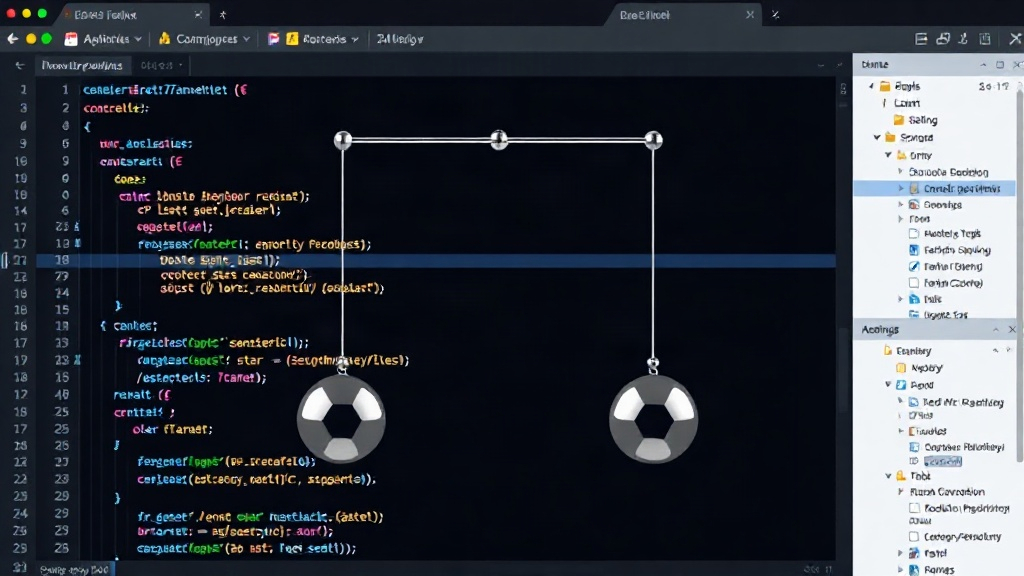
The setup involves releasing two identical double pendulums from nearly the same starting position. The default starting configuration for the simulator places the pendulums at 173.12° and 178.85° from their hanging point. The experiment then introduces a minuscule nudge to one of these pendulums – just 0.001 radian, which translates to a mere 0.057 degrees. The question is: how long does it take for this almost imperceptible difference to cause the two pendulums to completely desynchronize?
The results are stark. The experiment found that within approximately seven seconds, the two identical double pendulums, initiated with only a 0.057° difference, diverge to the point where their chaotic motion is entirely out of sync. This rapid amplification of a tiny initial condition is a hallmark of chaotic systems. The methodology is designed for reproducibility: a dependency-free script was used, directly copying the simulators' own code to ensure that every computed number is verifiable.
The Bifurcation Diagram: Visualizing Instability
Complementing the double pendulum experiment, the research also examines the bifurcation diagram. While the double pendulum visually demonstrates chaos through physical motion, the bifurcation diagram offers a mathematical representation of how a system’s behavior changes as a parameter is varied. In essence, it shows points where a system transitions from stable equilibrium to oscillatory or chaotic states.
The experiment measures the speed at which order dissolves into unpredictability across these simulations. For the double pendulum, this is the seven-second divergence. For the bifurcation diagram, it relates to how quickly the iterative process reveals complex, unpredictable patterns rather than settling into a simple, repeating sequence. The reproducibility of these browser-based simulations is crucial. By using identical codebases and starting parameters, the experiment removes variables that could obscure the fundamental behavior of chaotic dynamics.
Reproducibility in Browser Physics
The significance of running these complex physics simulations directly in the browser lies in accessibility and reproducibility. Unlike traditional desktop applications that might require specific installations or hardware, browser-based tools are readily available to anyone with an internet connection and a modern web browser. LK Forge's approach ensures that the underlying computational engines are not abstracted away or simplified for web delivery; they are the actual engines used in their physics labs.
This means developers and researchers can observe and interact with these phenomena directly. The script used for measurement is designed to be transparent. It mirrors the simulator's logic, allowing anyone to inspect the code and verify the calculations. This is critical for scientific demonstrations and educational purposes, where understanding the mechanics behind the observed phenomena is as important as the phenomena themselves. The experiment effectively turns the browser into a small, accessible physics laboratory.
Implications for Understanding Chaos
This experiment provides a concrete, quantifiable example of a core principle in chaos theory: sensitive dependence on initial conditions. The double pendulum, a classic example of a chaotic system, illustrates this vividly. A difference so small it's practically immeasurable – a thousandth of a radian – can lead to vastly different outcomes in a very short period. This has implications beyond pure physics.
In fields ranging from meteorology (the butterfly effect) to economics and even biology, understanding how small perturbations can cascade into large, unpredictable changes is fundamental. By demonstrating this phenomenon in a readily accessible browser environment, LK Forge makes abstract concepts more tangible. The seven-second timeframe for the double pendulum’s divergence serves as a memorable benchmark. It's a practical demonstration that even systems governed by deterministic laws can exhibit behavior that is practically unpredictable over time due to their inherent sensitivity.
The bifurcation diagram further reinforces this by showing where such unpredictability emerges mathematically. It’s a visual map of system stability and instability. The fact that these complex calculations can be performed efficiently in a browser, thanks to modern JavaScript engines and WebAssembly, opens new avenues for interactive learning and scientific exploration. The experiment is not just about measuring chaos; it's about making the measurement and understanding of chaos accessible to a broader audience.
What Lies Ahead?
The LK Forge experiment successfully bridges the gap between theoretical chaos theory and practical, observable demonstration. By using real physics engines within a browser environment and focusing on quantifiable metrics like the time to divergence, the project offers a clear, reproducible example of sensitive dependence on initial conditions. The 0.057° difference in the double pendulum, leading to complete desynchronization in just seven seconds, provides a powerful, memorable illustration of chaotic behavior.
This work highlights the potential for web-based tools to serve as robust platforms for scientific simulation and education. The emphasis on dependency-free, reproducible scripts ensures that the findings are not artifacts of specific environments but fundamental properties of the systems being modeled. As browser technology continues to advance, we can expect more sophisticated scientific tools to emerge, making complex phenomena like chaos theory more accessible and understandable to a global audience.