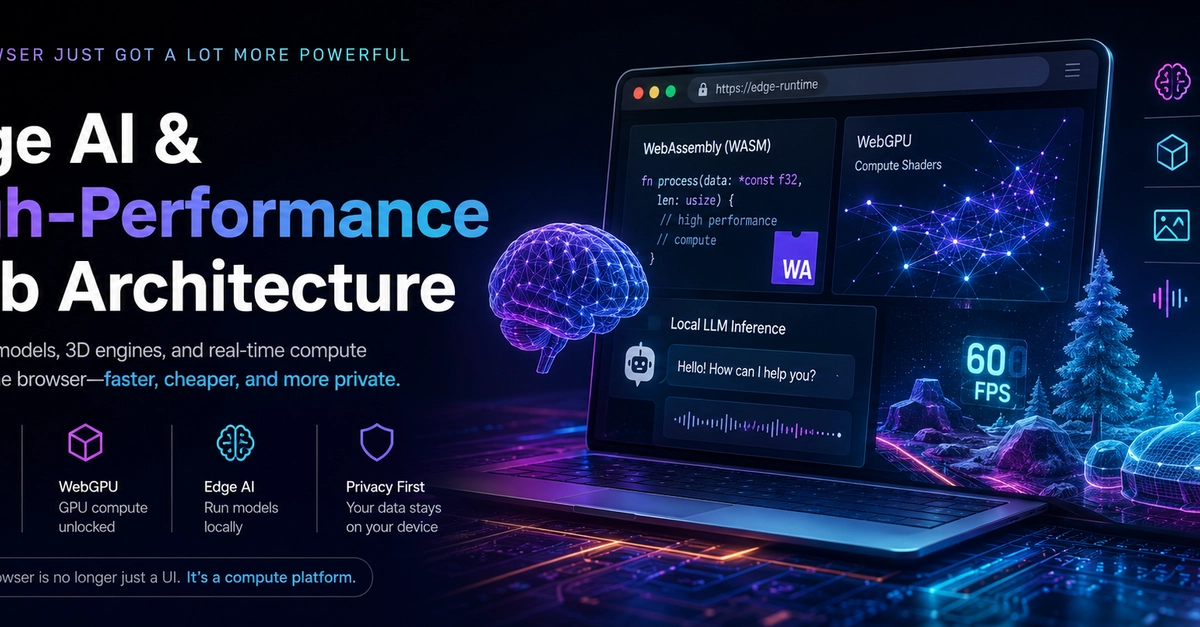
The Browser's Ascent: From Presentation to Powerful Compute
For decades, the web browser served a singular purpose: rendering HTML and executing JavaScript for user interfaces. Computationally intensive tasks were offloaded to powerful backend servers. This paradigm is rapidly dissolving. Modern web applications now handle workloads previously unimaginable within a browser, pushing the boundaries of what's possible on the client side.
Consider the range of applications now thriving in the browser environment: local Large Language Model (LLM) inference, real-time image and video processing, sophisticated CAD and design tools, dynamic digital twins and 3D visualizations, immersive spatial computing experiences, intelligent AI assistants, and complex, high-density data visualizations. The browser is no longer merely a viewport; it's a robust, high-performance execution environment capable of directly harnessing the processing power of local CPU cores and GPU accelerators.

The Pillars of Browser Computation: WebGPU, WASM, and Edge AI
This transformation is underpinned by several key technologies:
WebGPU: Unlocking GPU Power
WebGPU represents a significant leap forward, offering web developers low-level access to the graphics processing unit (GPU). Unlike its predecessor, WebGL, which was primarily designed for graphics rendering, WebGPU is a modern API built from the ground up for general-purpose GPU computation. It provides a more direct and efficient way to leverage the parallel processing capabilities of GPUs for tasks beyond rendering, such as machine learning inference, scientific simulations, and complex data analysis.
The API design of WebGPU is inspired by modern native graphics APIs like Vulkan, Metal, and DirectX 12. This allows for more explicit control over the GPU, reducing overhead and enabling higher performance. Developers can now write shaders that run directly on the GPU, performing massively parallel computations. This is critical for accelerating AI models, which often involve large matrix multiplications and other operations that map perfectly to GPU architectures.
WebAssembly (WASM): Beyond JavaScript's Limits
WebAssembly (WASM) provides a binary instruction format that acts as a compilation target for high-level languages like C, C++, Rust, and Go. This allows developers to run code written in these languages in the browser at near-native speeds. WASM is not a replacement for JavaScript but a powerful complement. It excels at performance-critical tasks, enabling the porting of existing desktop-class applications and libraries to the web.
WASM's role in the modern browser compute platform is multifaceted. It can be used to implement the core logic of complex applications, handle heavy data processing, and even serve as the runtime for AI models compiled from frameworks like TensorFlow or PyTorch. Its sandboxed execution environment ensures security, and its predictable performance makes it ideal for deterministic computations. The integration of WASM with WebGPU further amplifies its potential, allowing computationally intensive WASM modules to offload work to the GPU.
Edge AI: Bringing Intelligence to the Client
The rise of Edge AI signifies a paradigm shift where artificial intelligence models are executed directly on the user's device, rather than relying solely on cloud-based servers. This trend is particularly enabled by the advancements in browser compute capabilities. Running AI models locally offers several compelling advantages:
- Reduced Latency: Processing data on the client eliminates the round-trip time to a server, enabling real-time interactions and responsiveness. This is crucial for applications like live video analysis or interactive AI assistants.
- Enhanced Privacy: Sensitive user data can be processed locally without ever leaving the device, significantly improving user privacy and data security.
- Offline Capabilities: Applications can function even without a stable internet connection, expanding accessibility and usability.
- Cost Efficiency: Offloading computation to the client can reduce the significant costs associated with cloud-based AI inference.
Frameworks like TensorFlow.js and ONNX Runtime Web are instrumental in bringing these AI models to the browser. They allow developers to load and run pre-trained models, or even train models directly within the browser environment, democratizing AI development and deployment.
Reshaping Modern Web Architecture
The convergence of WebGPU, WASM, and Edge AI is fundamentally reshaping modern web architecture. Applications are no longer monolithic entities dependent on a distant backend. Instead, they are becoming distributed systems where significant processing occurs at the edge – on the user's browser.
This shift enables a new class of web applications that were previously confined to native desktop environments. Think of sophisticated photo editing suites running entirely in the browser, advanced 3D modeling tools accessible via a URL, or real-time collaborative design platforms with minimal latency. The capabilities unlocked by these technologies are blurring the lines between web and native applications.
For developers, this means a new skillset is becoming essential. Understanding how to leverage WebGPU for compute, how to compile performance-critical code to WASM, and how to integrate AI models for edge inference are now key competencies. The web platform is evolving into a versatile and powerful computing environment, offering developers unprecedented control and performance directly within the user's browser.
The Unanswered Question: Scalability and Developer Tooling
While the potential is immense, a significant challenge remains: the complexity of developer tooling and the seamless integration of these powerful, low-level APIs. Currently, effectively harnessing WebGPU and WASM for complex computations requires a deep understanding of GPU architecture and systems programming. What nobody has fully addressed yet is how to abstract this complexity to make these powerful capabilities accessible to a broader range of web developers without sacrificing performance or control. The future of the browser as a compute platform hinges not just on the underlying technologies, but on the development of intuitive, high-level abstractions and robust development tools that simplify the creation of these next-generation web applications.
Implications for the Future
The browser's transformation into a compute platform has profound implications. It democratizes access to powerful computing resources, potentially reducing the hardware barrier for advanced applications. It fosters innovation by enabling developers to build richer, more interactive, and more intelligent experiences directly on the web. As these technologies mature and tooling improves, we can expect to see an explosion of new applications that leverage the full power of the user's device, making the web an even more ubiquitous and capable computing environment.