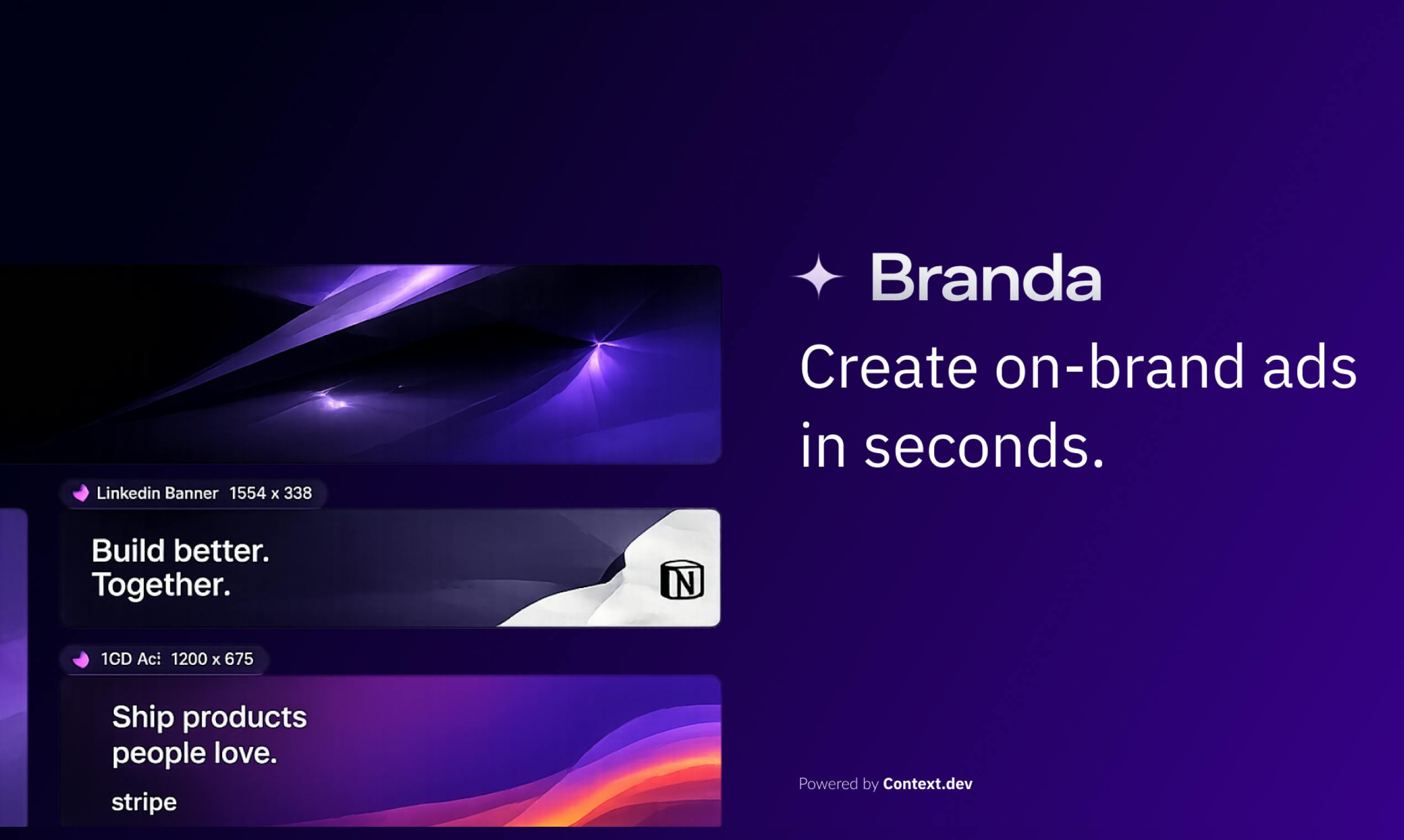
Branda: Automating Ad Creation with Open Source Intelligence
In a move that could significantly streamline marketing efforts for small businesses and individual creators, a new MIT-licensed open-source tool named Branda has emerged, promising to turn any domain into on-brand advertisements. Developed with the goal of making sophisticated ad generation accessible, Branda analyzes a given website to extract its branding elements and then automatically generates relevant ad copy and visuals.
The core innovation behind Branda lies in its ability to interpret the essence of a website. Instead of requiring users to manually input brand guidelines, color palettes, or specific messaging, Branda scans the target domain. It looks for visual cues like color schemes, typography, and even the overall tone of the content. This information is then used as a foundation to produce advertisements that are not only visually consistent with the brand but also thematically aligned with the website’s offerings.
This approach offers a compelling alternative to traditional ad creation workflows, which often involve extensive design time, copywriting, and brand strategy discussions. For startups and small businesses with limited resources, Branda could represent a substantial time and cost saving. The tool essentially acts as an automated junior marketing assistant, capable of producing a first draft of ad creatives with minimal user input.
How Branda Works: From Domain to Display Ad
The process begins with a user providing a website URL. Branda then employs a combination of web scraping and natural language processing (NLP) techniques to parse the site’s content and structure. It identifies primary and secondary brand colors, dominant fonts, and key phrases or value propositions. This extracted data is then fed into a generative model that crafts ad headlines, body copy, and suggests visual elements that echo the source website’s identity.
Consider Branda less like a rigid template engine and more like a digital intern who has spent hours studying your company’s website. It’s designed to capture the subtle nuances of your brand’s presentation and translate them into ad formats. The output is intended to be a starting point, allowing users to refine and customize the generated ads, but the initial heavy lifting of brand interpretation and creative generation is handled by the tool.

The open-source nature of Branda is a significant factor. By making the code freely available under the MIT license, the project encourages community contribution and adaptation. Developers can inspect the codebase, identify areas for improvement, and even build upon Branda’s capabilities. This collaborative approach often leads to faster innovation and a more robust, adaptable toolset compared to proprietary solutions.
The Open Source Advantage and Potential Applications
The decision to release Branda as MIT Open Source is strategic. It lowers the barrier to entry for any individual or organization looking to leverage automated ad creation. This democratizes a powerful marketing capability that was previously more accessible to larger companies with dedicated marketing teams and budgets. The implications are broad:
- Small Businesses: Generate consistent, on-brand ads for social media, search engines, or display networks without needing a dedicated designer or copywriter.
- Freelancers and Agencies: Use Branda as a rapid prototyping tool to quickly generate ad concepts for clients, speeding up the initial brainstorming phase.
- Content Creators: Quickly create promotional material for blog posts, podcasts, or online courses that align with their existing website's aesthetic.
- Developers: Contribute to an open-source project, learn about web scraping and generative AI for marketing, or integrate Branda’s functionality into other applications.
The tool's ability to adapt to any domain means it’s not limited to specific industries. Whether it’s a local bakery, a SaaS startup, an e-commerce store, or a personal portfolio website, Branda can theoretically generate relevant advertising collateral. The key is the tool’s analytical capability – its power to abstract brand identity from raw web content.
Challenges and Future Directions
While Branda offers a promising solution, its effectiveness will ultimately depend on the sophistication of its analysis and generation models. The nuance of brand identity can be complex, involving not just colors and fonts but also tone of voice, target audience, and competitive positioning. Early iterations of such tools often require significant fine-tuning by users to achieve truly polished results.
What remains to be seen is how Branda handles websites with inconsistent branding or those that rely heavily on abstract concepts rather than clear visual cues. Furthermore, the ethical implications of automated ad generation, particularly concerning potential misuse or the creation of misleading advertisements, will be an ongoing consideration for the open-source community and its users.
The project's future development will likely focus on enhancing its AI models for more nuanced brand interpretation, expanding the range of ad formats it can generate, and potentially incorporating user feedback mechanisms for continuous improvement. As an open-source project, its trajectory is in the hands of its contributors and the broader developer community. The promise is clear: democratizing effective, on-brand advertising for everyone.