Unraveling Auditory Parallel Processing
The human brain's ability to process complex auditory information is a marvel. For decades, neuroscientists have worked to understand how we filter out background noise and focus on specific sounds, a phenomenon known as the 'cocktail party effect.' Now, new research published in PLOS Biology challenges our understanding of this process, suggesting that the brain can not only focus on one stream but actively encode two distinct speech streams simultaneously. This finding opens new avenues for understanding auditory perception, communication disorders, and even the development of advanced hearing prosthetics.
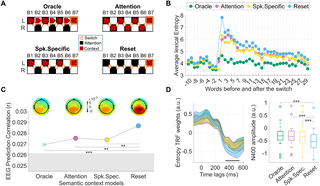
The study, led by researchers at the University of California, San Francisco (UCSF), utilized electroencephalography (EEG) to monitor brain activity in participants. EEG, a non-invasive technique that measures electrical activity in the brain through electrodes placed on the scalp, provides excellent temporal resolution, allowing researchers to track brain responses in real-time. This was crucial for observing the rapid neural processes involved in auditory encoding.
Participants were presented with two different speech streams, each delivered by a distinct voice and speaking different content. The key to the experiment was that these streams were presented such that they would normally compete for auditory attention. The researchers then analyzed the EEG data to identify patterns that indicated whether the brain was processing both streams independently or if one stream was being suppressed in favor of the other.
Decoding Neural Signatures of Dual Speech
The results were striking. The EEG data revealed distinct neural signatures for each speech stream, even when they were presented concurrently. This suggests that the brain is capable of separating and processing multiple auditory inputs in parallel. Previous models of auditory processing often focused on attentional mechanisms that selectively amplify one signal while suppressing others. This new research indicates a more robust and parallel encoding capability than previously assumed.
Think of it less like a single-lane highway where traffic must merge and slow down, and more like a sophisticated multi-channel radio receiver that can tune into and process several stations at once, albeit with some degree of internal organization. The brain, in this analogy, is not just picking one station but actively 'listening' to multiple, assigning distinct neural resources to each.
The researchers employed advanced signal processing techniques to decode the neural activity. By looking at the timing and patterns of electrical signals, they could infer which aspects of the speech were being processed. They found that specific patterns of brain activity correlated with the content of each individual speech stream, demonstrating that the brain was indeed encoding both.
Implications for Auditory Perception and Disorders
This finding has significant implications for our understanding of how the brain handles auditory information. It suggests that the neural machinery for processing speech is more flexible and capable of parallel operation than previously thought. This could explain why some individuals seem to perform better in noisy environments or with complex auditory scenes.
Furthermore, the research could shed light on conditions like auditory processing disorder (APD) or certain types of hearing loss, where individuals struggle to distinguish between multiple sounds. If the brain's baseline capacity for parallel encoding is found to be impaired in these conditions, it could lead to new diagnostic tools and therapeutic interventions. For instance, training programs could be designed to enhance the brain's ability to process multiple auditory streams, or advanced hearing aids could be developed to better leverage this parallel processing capability.
The study also raises questions about the limits of this parallel processing. How many streams can the brain truly encode simultaneously before performance degrades? What are the specific neural mechanisms that allow for this separation, and how do they interact with attentional control? These are questions that future research will undoubtedly explore.
Future Directions and Technological Advancements
The success of this EEG-based study paves the way for further investigations. Researchers plan to use more advanced neuroimaging techniques, such as fMRI, to gain a deeper understanding of the brain regions involved in this dual-stream encoding. They also aim to explore how factors like age, cognitive load, and prior experience influence this ability.
From a technological standpoint, this research could inform the design of next-generation assistive listening devices. Current hearing aids often struggle to isolate speech in noisy environments. By understanding how the brain naturally handles multiple auditory streams, engineers could develop devices that more effectively mimic or support this natural process, offering users a richer and clearer auditory experience.
The ability to encode two speech streams simultaneously is not just a fascinating cognitive feat; it is a testament to the brain's adaptive and complex architecture. This research moves us closer to understanding the intricate ways we perceive and interact with the soundscape around us, promising advancements in both fundamental neuroscience and practical technological applications.