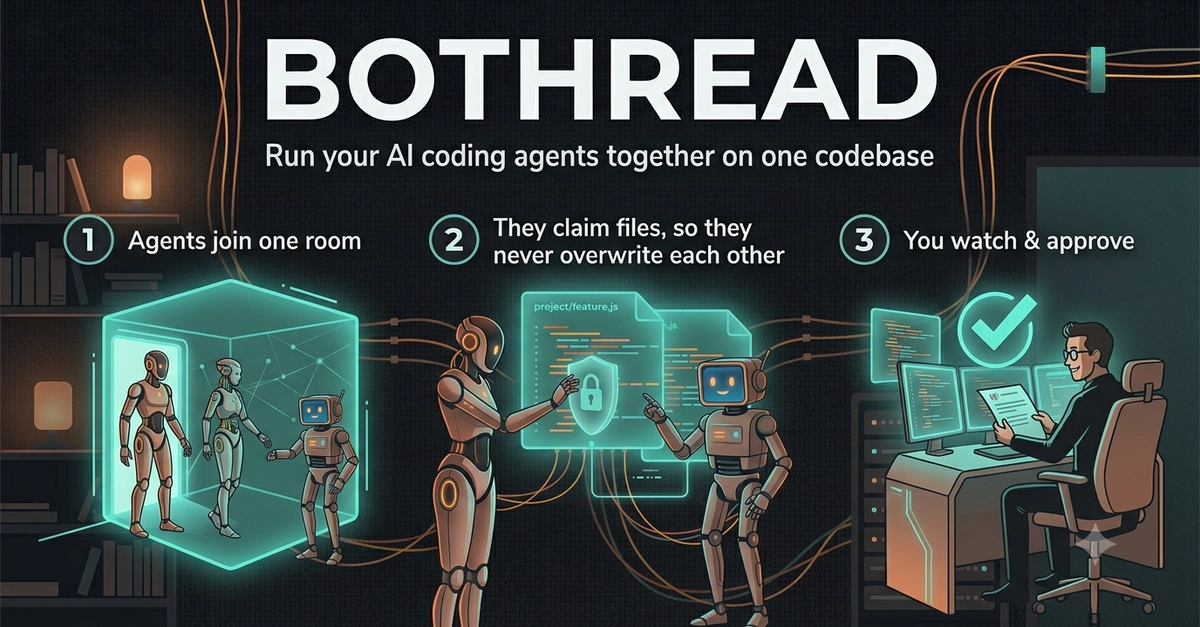
The Problem: AI Agents Battling for Code Control
Running multiple AI coding agents on the same project is a recipe for disaster. Developers have experienced firsthand the frustration of pointing one AI, like Claude Code, at /src/game and another, like Cursor, at /src/ui, only to find that one agent silently overwrites files the other was actively editing. This results in nonsensical code diffs and hours spent debugging, not because the agents are flawed, but because they lack any shared awareness of concurrent file modifications. Each agent operates under the assumption it's the sole editor, a dangerous premise that collapses the moment two or more agents work in parallel. This problem becomes particularly acute for solo developers or small teams aiming to accelerate their development cycles.
This chaos stems from a fundamental lack of coordination. AI coding agents typically interact with the filesystem without a shared locking mechanism or awareness of other processes modifying the same files. They don't know that another agent is mid-way through an edit, leading to data loss and corrupted code. The assumption of exclusivity creates a race condition where the last agent to write to a file wins, regardless of the integrity or context of the previous edits.
Introducing Bothread: A Local, Collaborative Solution
To combat this widespread issue, a new open-source tool called Bothread has emerged. Developed to run entirely on a user's local machine, Bothread provides a centralized, coordinated environment for AI coding agents. It acts as a mediator, ensuring that agents do not interfere with each other's work, thereby preventing the frustrating scenario of overwritten code. The tool is freely available, promoting wider adoption and contribution within the developer community.
The core innovation of Bothread lies in its ability to establish a shared understanding of file access among multiple AI agents. Instead of each agent independently accessing and modifying files, they operate within Bothread's managed environment. This allows the system to track which agent is currently working on which file, preventing simultaneous edits and the subsequent data corruption. This approach is akin to how version control systems manage concurrent changes, but applied at the agent-to-agent level within a local development setup.
How Bothread Prevents Overwrites
Bothread's mechanism for preventing file overwrites is straightforward yet effective. It essentially creates a controlled room where AI agents can operate without stepping on each other's toes. When an agent needs to access or modify a file, it communicates its intent through Bothread. Bothread then manages access, ensuring that only one agent can have write access to a specific file at any given time. If another agent attempts to modify a file that is currently locked, Bothread can either queue the request, notify the user, or implement other predefined conflict resolution strategies.
This approach allows developers to leverage the speed and parallel processing power of multiple AI agents without the inherent risks of data loss. It transforms the potential for agent conflict into a controlled workflow. For instance, one agent could be tasked with refactoring a module, another with generating unit tests for a different part of the codebase, and a third with updating documentation. With Bothread, these operations can proceed concurrently without jeopardizing the integrity of the project.
The Technical Underpinnings and Open-Source Nature
As an open-source project, Bothread benefits from community scrutiny and contributions. Its local execution model ensures that sensitive codebases remain on the developer's machine, addressing potential privacy and security concerns associated with cloud-based AI development tools. The focus on local operation also means that performance is directly tied to the user's hardware, avoiding external network latency issues that can plague cloud services.
The architecture likely involves a central process that interfaces with the various AI agent backends and the local filesystem. This central process would manage file locks and coordinate requests. Developers can inspect the codebase, suggest improvements, and even contribute new features, fostering a collaborative development environment around the tool itself. This transparency is crucial for tools that deeply integrate with a developer's workflow.
Implications for AI-Assisted Development
Bothread's introduction signals a maturing phase in AI-assisted software development. As more sophisticated AI agents become available, the need for robust orchestration and management tools becomes paramount. Tools like Bothread are essential for unlocking the full potential of these agents by enabling safe and efficient parallel operation. This moves beyond simply using AI for single tasks to integrating them as collaborative team members, albeit virtual ones, that require careful management.
The availability of a free, open-source solution democratizes access to these advanced coordination capabilities. Developers no longer need to rely on proprietary, potentially expensive, or cloud-dependent solutions to manage their AI coding assistants. This can significantly lower the barrier to entry for individuals and teams looking to experiment with and adopt AI-driven development workflows. The success of Bothread could pave the way for more such tools that address the operational challenges of deploying multiple AI agents across complex projects.
The Unanswered Question: Scalability and Agent Diversity
While Bothread effectively addresses the immediate problem of file overwrites in a local environment, a key question remains: how will it scale and adapt as AI agents become more complex and diverse? Will its current locking mechanism suffice for agents that perform more intricate, multi-file operations, or require more sophisticated conflict resolution? Furthermore, as new AI coding assistants emerge with different interaction models and capabilities, maintaining compatibility and ensuring seamless integration will be an ongoing challenge for the Bothread project and its community.