The Genesis: Zero Budget, One GPU
Two weeks ago, João Paulo had precisely zero dollars, a gaming PC equipped with an RTX 3060 Ti, and a bold hypothesis: could the operational cost of a small, useful LLM-backed API be pushed to near-zero by self-hosting the model?
This wasn't about revolutionary AI; it was a deep dive into the economics of running a service entirely on consumer-grade hardware. The goal was to prove that with careful engineering and a reliance on open-source models, a functional, revenue-generating API could be launched without external funding or significant upfront investment.
The core idea was to create an API that translates natural language prompts into specific code artifacts. This targeted a common pain point for developers: the repetitive, often tedious task of generating boilerplate code, regular expressions, SQL queries, commit messages, and schema definitions.
Core API Functionality
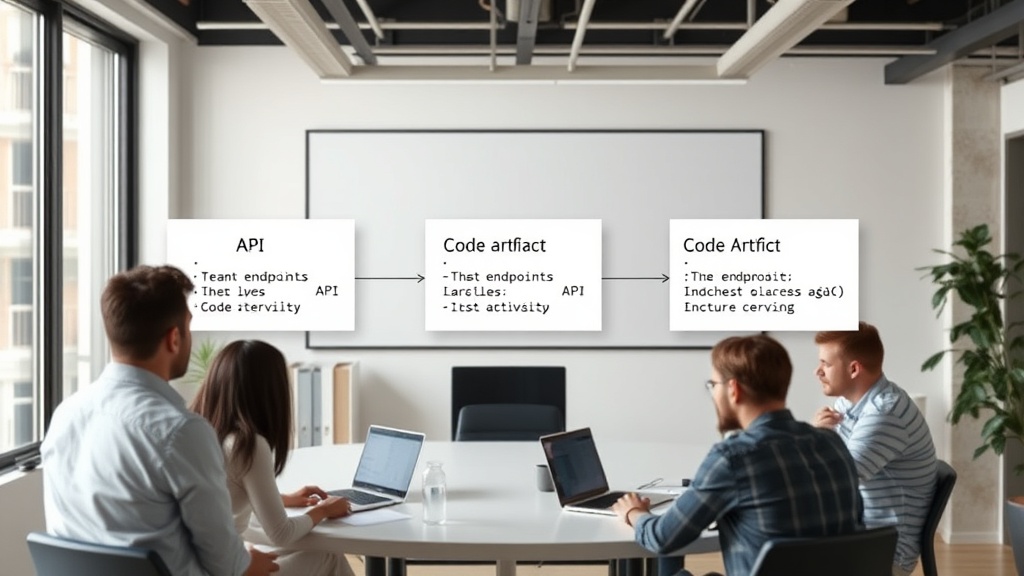
The API was designed with several distinct endpoints, each addressing a specific code generation need:
/v1/regex: This endpoint takes a natural language description, such as "validate a Brazilian CEP," and returns a working regular expression, a clear explanation of its components, and examples of strings that would match or not match. This is invaluable for form validation and data sanitization tasks./v1/sql: Prompts like "list the 10 customers who bought the most last month" are translated into executable SQL queries. This saves developers time in data analysis and reporting, allowing them to focus on interpreting the results rather than writing the query syntax./v1/commit-message: Given a description of code changes (e.g., a Git diff summary), this endpoint generates a conventional commit message. Adhering to commit message standards improves repository history readability and can automate changelog generation./v1/json-schema: For descriptions like "an e-commerce product with name, price, category," the API generates a corresponding JSON Schema. This is crucial for data validation, API contract definition, and frontend/backend data synchronization.
The choice of these specific functions was deliberate. They represent common, small-scale code generation tasks that, while not groundbreaking, are frequently needed and can be handled effectively by smaller, fine-tuned language models. The crucial factor was finding models that were efficient enough to run on the RTX 3060 Ti without excessive inference times.
The Hardware Constraint: RTX 3060 Ti and Model Selection
The entire operation hinged on the capabilities of a single RTX 3060 Ti. This GPU, while a capable gaming card, is not a data center-grade piece of hardware. This constraint dictated the choice of Large Language Models (LLMs). Instead of opting for massive, state-of-the-art models that require extensive VRAM and computational power, the focus shifted to smaller, highly optimized open-source models. Quantization techniques, such as GGML or GPTQ, were essential to reduce the memory footprint and computational requirements of these models, making them runnable on the consumer GPU.
The selection process involved extensive benchmarking. Models were tested for their ability to perform the specific tasks outlined for the API endpoints, balancing accuracy with inference speed. The goal was to find a sweet spot where the output was sufficiently accurate for the intended use cases, and the response times were acceptable for an API service. Anything slower than a few seconds per request would render the API impractical for real-time use.
Running the model locally meant a significant departure from typical cloud-based API deployments. There were no managed services, no auto-scaling, and no distributed infrastructure. The entire stack, from the web server handling requests to the LLM inference engine, had to run on that single machine. This presented unique challenges in terms of reliability, error handling, and resource management.
Engineering Challenges and Failures
The path from idea to a functional API was paved with numerous failures, which proved to be the most valuable learning experiences. One of the primary challenges was managing the VRAM. Even with quantized models, fitting the model weights and handling the intermediate computations within the 8GB of VRAM on the RTX 3060 Ti was a constant battle. This often led to out-of-memory errors, especially during peak usage or when processing longer prompts.
Another significant hurdle was optimizing the inference pipeline. Simply loading a model and running it was not enough. Techniques like batching (though limited by the single-GPU setup), efficient prompt engineering, and careful memory management were critical. The Python environment itself, with its GIL (Global Interpreter Lock), presented concurrency challenges. Using asynchronous frameworks like FastAPI helped manage I/O-bound operations, but CPU-bound LLM inference still required careful threading or multiprocessing strategies to avoid blocking the entire application.
The deployment strategy was equally fraught with difficulty. Setting up a robust web server (like Nginx or Caddy) to proxy requests to the Python application, managing dependencies, and ensuring the server could restart gracefully after a crash were all non-trivial tasks. Containerization with Docker was considered but ultimately deemed too resource-intensive for the single machine, forcing a more manual setup. The system had to be resilient enough to recover from model crashes or GPU driver issues, which were more frequent than anticipated.
The surprising detail here is not the technical feasibility, but the sheer number of small, interconnected failures that had to be debugged. It wasn't a single catastrophic event, but a cascade of memory leaks, driver crashes, and subtle concurrency bugs that required meticulous attention to detail to resolve. Each fix, however small, contributed to a more robust system.
The Economics: Near-Zero Cost
The core economic proposition was validated. With the exception of the initial cost of the RTX 3060 Ti (which was already owned for gaming), the ongoing operational costs were minimal. Electricity consumption was the primary recurring expense. By optimizing the models and inference process, the GPU was not running at 100% utilization constantly, reducing power draw during idle periods. The API was hosted on the same machine used for development, eliminating the need for separate server costs.
Software costs were also zero. All the LLMs used were open-source, and the operating system and all supporting libraries were free. The choice of FastAPI for the API framework and Uvicorn as the ASGI server kept dependencies light and efficient.
This approach stands in stark contrast to cloud-based LLM APIs, which can incur significant costs based on token usage or compute time. By owning the hardware and the model, the engineer bypassed these per-request fees. The trade-off is the significant engineering effort required to build and maintain such a system, but for a bootstrapped venture, this is often a more palatable cost than immediate, high operational expenses.
Lessons Learned and Future Implications
The experiment successfully demonstrated that it's possible to build and run a functional, specialized API service powered by LLMs on consumer hardware without a budget. The key takeaways are:
- Model Optimization is Paramount: Quantization and careful model selection are critical for running LLMs on limited hardware.
- Engineering Rigor Pays Off: Robust error handling, efficient resource management, and a deep understanding of the underlying stack are essential for reliability.
- Failures Are Instructive: Debugging numerous small failures builds a more resilient system and provides invaluable practical knowledge.
- The Economics Work: For specific, well-defined tasks, self-hosting can drastically reduce operational costs.
This approach opens doors for developers and small teams looking to offer AI-powered features without the prohibitive costs of cloud APIs. It democratizes access to LLM technology, enabling experimentation and product development on a shoestring budget. The success of this venture suggests that more specialized, niche APIs built on open-source models and consumer hardware could become a viable business model.
What nobody has addressed yet is the scalability ceiling. While this proves viability for a single-user or low-traffic API, scaling beyond a few concurrent requests on a single GPU remains a significant engineering challenge. The next step for such ventures might involve carefully orchestrated multi-GPU setups or exploring federated learning approaches, but the foundational economic proof is now established.