
The Challenge of Data Flow in Modern Applications
As applications grow in complexity, managing data flow becomes a significant challenge. Developers often grapple with understanding how data moves through their systems, where transformations occur, and what dependencies exist between different parts of the codebase. This opacity can lead to bugs, performance issues, and difficulties in refactoring or extending the application. Traditional debugging methods, while essential, often fall short when trying to grasp the holistic picture of data propagation across numerous functions, classes, and modules. This is where explicit data flow graphing comes into play.
Many existing solutions rely on implicit assumptions or runtime introspection, which can be brittle and incomplete. Developers need a way to define and visualize these flows upfront, making them a first-class citizen in the development process. This proactive approach allows for better design, easier debugging, and improved maintainability. The goal is to move beyond simply writing code to understanding the intricate web of data interactions that power an application.
Consider a scenario in a web application where user input from a form is processed, validated, transformed, and then used to update a database record, which in turn triggers a UI refresh and potentially an API call to a backend service. Without explicit tracking, understanding the exact path of that user input, how it's modified at each step, and what other parts of the system might be affected by changes to that data can be a daunting task. This is akin to navigating a city without a map; you might eventually reach your destination, but the journey is inefficient and prone to getting lost.
Introducing Transferum: Explicit Data Flow Graphs
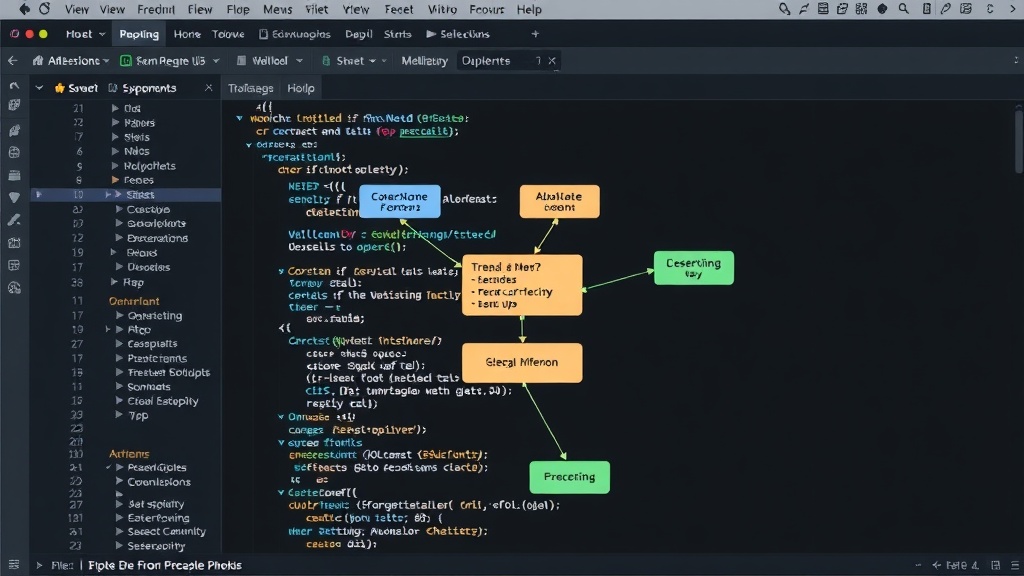
To address these challenges, Boost has introduced Transferum, a new library designed to build explicit data-flow graphs in TypeScript. Transferum allows developers to define data transformations and their dependencies in a clear, declarative manner. This shifts the paradigm from implicit data handling to explicit, traceable data pipelines. The library aims to provide a robust framework for visualizing and managing the complex relationships that data has within a TypeScript project.
At its core, Transferum operates by allowing developers to define nodes in a graph, where each node represents a data transformation or a data source. These nodes are then connected by edges, signifying the flow of data. This structured approach makes it immediately clear how data originates, where it travels, and how it is modified. Developers can define these graphs using TypeScript's type system, ensuring that the defined flows are type-safe and that the transformations adhere to expected data shapes.
The benefits are manifold. Firstly, it enhances code readability and understanding. By visualizing the data flow, new team members can quickly grasp how data moves through the system. Secondly, it aids in debugging. When an issue arises, developers can trace the problematic data back to its source or identify the specific transformation that introduced the error. Thirdly, it facilitates refactoring. Understanding data dependencies makes it easier to modify or replace parts of the system without introducing unintended side effects. Finally, it can serve as living documentation, providing an up-to-date representation of the application's data architecture.
Key Features and Usage
Transferum provides a set of primitives for defining data graphs. Developers can create sources, transformations, and sinks. A source might represent an initial piece of data, like user input or a configuration value. A transformation is a function that takes data from one or more sources, processes it, and outputs new data. A sink typically represents the final destination of the data, such as updating a state variable or making an API call.
The library leverages TypeScript's generics and type inference to ensure that the data flowing between nodes is correctly typed. This means that if a transformation expects a number and receives a string, TypeScript will catch this error at compile time, preventing runtime bugs. This type safety is a crucial aspect of Transferum, as it integrates seamlessly with the existing TypeScript development workflow.
Here’s a simplified example of how one might define a data flow with Transferum:
import { Source, Transform, Sink, buildGraph } from 'transferum';

// Define a source for user input (a string)
const userInput = new Source<string>();

// Define a transformation that converts a string to uppercase
const toUpperCase = new Transform<string, string>(
  (input: string) => input.toUpperCase()
);

// Define a transformation that checks if a string starts with 'HELLO'
const startsWithHello = new Transform<string, boolean>(
  (input: string) => input.startsWith('HELLO')
);

// Define a sink to log the results
const logger = new Sink<string | boolean>(
  (data) => console.log('Processed data:', data)
);

// Build the graph by connecting the nodes
buildGraph([
  userInput.pipe(toUpperCase).pipe(startsWithHello).to(logger)
]);

// Provide initial data to the source
userInput.next('hello world'); // This will trigger the transformations and log 'Processed data: true'
userInput.next('goodbye');     // This will trigger the transformations and log 'Processed data: false'
This example demonstrates how `userInput` flows into `toUpperCase`, then into `startsWithHello`, and finally to the `logger` sink. The `pipe` method elegantly chains transformations, creating a clear and readable sequence. The `buildGraph` function then finalizes the graph structure, enabling the execution of the defined data flow.
Implications for Developers and Teams
Transferum offers a compelling solution for developers working on projects where data management is complex. For individual developers, it provides a structured way to think about and implement data pipelines, reducing cognitive load and the likelihood of errors. For teams, it serves as a shared language and visualization tool for data flow, improving collaboration and onboarding. The explicit nature of the graphs makes architectural decisions more transparent and easier to communicate.
The library's integration with TypeScript means that it fits naturally into existing workflows. Developers don't need to learn entirely new paradigms or tools; they can apply these concepts within their familiar environment. This lowers the barrier to adoption and encourages the use of explicit data flow management as a standard practice. The potential for automated generation of documentation or even visual diagrams from these graphs is also significant, further enhancing understanding and maintainability.
What remains to be seen is how Transferum scales with extremely large and intricate graphs. While the concept is powerful, the practicalities of managing thousands of nodes and complex interdependencies will be a key area for future development and community feedback. The ability to prune, optimize, or dynamically load parts of the graph could become critical for performance in massive applications.