The Core Problem: Agent Coordination Chaos
Modern AI applications often require multiple agents to collaborate. Think of a customer support system where one agent identifies the issue, another retrieves relevant information from a knowledge base, and a third drafts a response. Coordinating these agents, passing state between them, and handling errors is a significant engineering challenge. Existing frameworks often rely on complex state machines or explicit message passing, which can become brittle and difficult to manage as the number of agents and interactions grows.
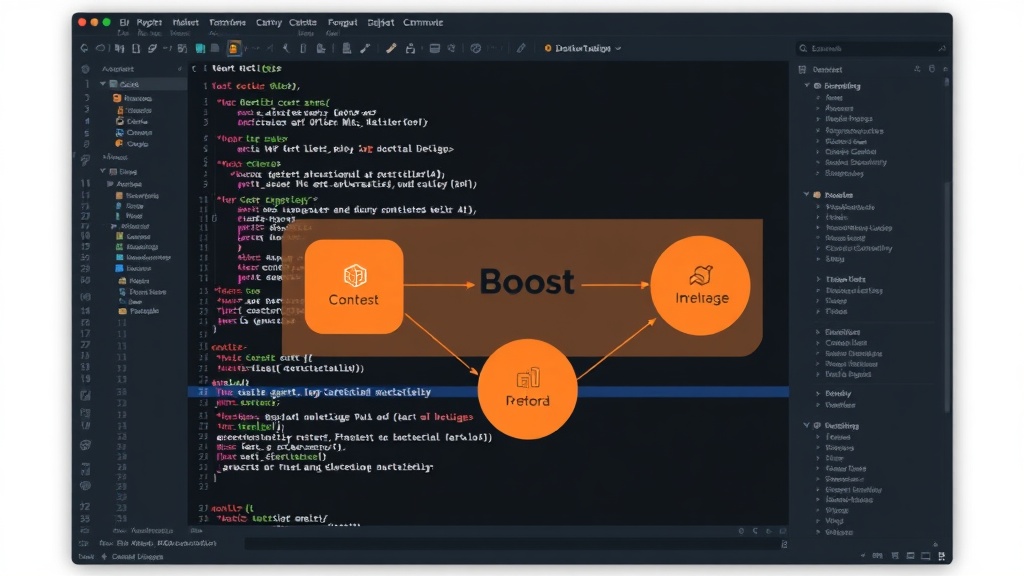
This is where Boost aims to make a difference. Instead of focusing on explicit communication protocols between agents, Boost introduces a log-centric architecture. The central idea is that the log itself becomes the primary mechanism for coordination and state management. Each agent observes the log, performs its task, and then writes its output back to the log. This is a subtle but powerful shift.
Boost's Log-Centric Architecture Explained
Imagine a shared journal where each agent can read what others have written and add their own entries. Boost formalizes this concept. At its heart is a persistent, append-only log. Agents subscribe to specific events or patterns in this log. When an agent detects a relevant entry, it triggers its logic. Upon completion, the agent appends its own entry to the log, effectively communicating its results and its current state to all other observing agents.
This approach offers several advantages:
- Decoupling: Agents don't need direct knowledge of each other. They only need to understand the log format and the events they are interested in. This makes it easier to add, remove, or modify agents without cascading changes throughout the system.
- Resilience: If an agent fails, the log persists. When the agent restarts, it can resynchronize by replaying the log from its last known state, ensuring continuity and preventing data loss.
- Observability: The log provides a complete, auditable history of all agent actions and state transitions. This is invaluable for debugging, monitoring, and understanding complex AI workflows.
The log acts as a single source of truth. It's less like a database and more like a very organised historical record that every participant can read and contribute to. This architectural choice significantly simplifies the mental model for building and reasoning about multi-agent systems.
Key Components and Concepts
Boost is designed with developer experience in mind. It abstracts away much of the low-level log management, allowing developers to focus on agent logic.
Agents
An agent in Boost is essentially a function or a class that:
- Defines its inputs: What patterns or events in the log it listens for.
- Defines its outputs: What kind of entries it will append to the log.
- Contains its core logic: The computation or action it performs.
Boost handles the execution of these agents, ensuring they are triggered appropriately based on log events and that their outputs are correctly appended.
The Log
The log is the backbone of Boost. It’s an ordered sequence of events, where each event typically includes:
- A timestamp.
- An event type or identifier.
- Associated data or state.
- The identifier of the agent that produced the event.
Boost can leverage various underlying storage mechanisms for the log, from in-memory structures for development to distributed commit logs for production environments. The key is the append-only, ordered nature.
Event Processing
Boost provides mechanisms for agents to react to events. This can be as simple as a polling loop that checks the log for new entries, or more sophisticated event-driven triggers. The framework manages the lifecycle of these event handlers.
Use Cases and Potential
The log-centric approach makes Boost suitable for a wide range of complex AI orchestration tasks:
- Complex Workflows: Orchestrating multi-step processes like data ingestion, transformation, and analysis where each step is an agent.
- Autonomous Systems: Building systems where agents can dynamically adapt to changing conditions by observing and reacting to log events.
- Robotics and IoT: Coordinating multiple robotic agents or sensor networks where a shared log can represent the state of the environment and actions taken.
- Simulations: Running complex simulations involving numerous interacting entities, each represented by an agent.
The surprising detail here is not just the simplicity of the core concept, but its power in managing emergent behavior. By allowing agents to communicate implicitly through a shared log, Boost can facilitate more organic and adaptive system designs compared to rigid, explicit communication patterns.
The Future of Agent Orchestration?
Boost represents a compelling alternative to traditional multi-agent system architectures. Its log-centric design offers a path towards more scalable, resilient, and observable AI applications. As AI systems grow in complexity, the need for robust orchestration frameworks will only increase. Boost appears well-positioned to address this growing demand.
What nobody has addressed yet is how Boost scales to hundreds or thousands of agents writing to a single log concurrently. The performance characteristics and potential bottlenecks of such a high-throughput log become critical in enterprise-scale deployments.