
The Forge: From Idea to Operation with AI Assistance
Bob's Workshop, a name not yet widely recognized in the developer tool landscape, has launched a new product called The Forge. The core promise of The Forge is ambitious: to enable teams to describe their application idea, and have the platform handle the subsequent building, deployment, and ongoing operation. This positions The Forge as a comprehensive, AI-driven development and operations platform, aiming to abstract away much of the complexity traditionally associated with software engineering.
The product's tagline, "Describe your idea & your team builds, deploys & operates it," succinctly captures its intended user experience. This suggests a paradigm shift from manual coding and infrastructure management to a more declarative, intent-driven approach. The implications for development velocity and team composition could be significant if The Forge delivers on its promise. Instead of developers meticulously writing code, configuring servers, and setting up CI/CD pipelines, the system would interpret a natural language description and translate it into a functional, deployed, and managed application.
This approach taps into the growing trend of AI-assisted development, where large language models and other AI technologies are increasingly being integrated into the software development lifecycle. While tools like GitHub Copilot assist with code generation, and platforms like Vercel or Netlify streamline deployment, The Forge appears to aim for a more holistic solution, encompassing the entire lifecycle from conception to live operation.
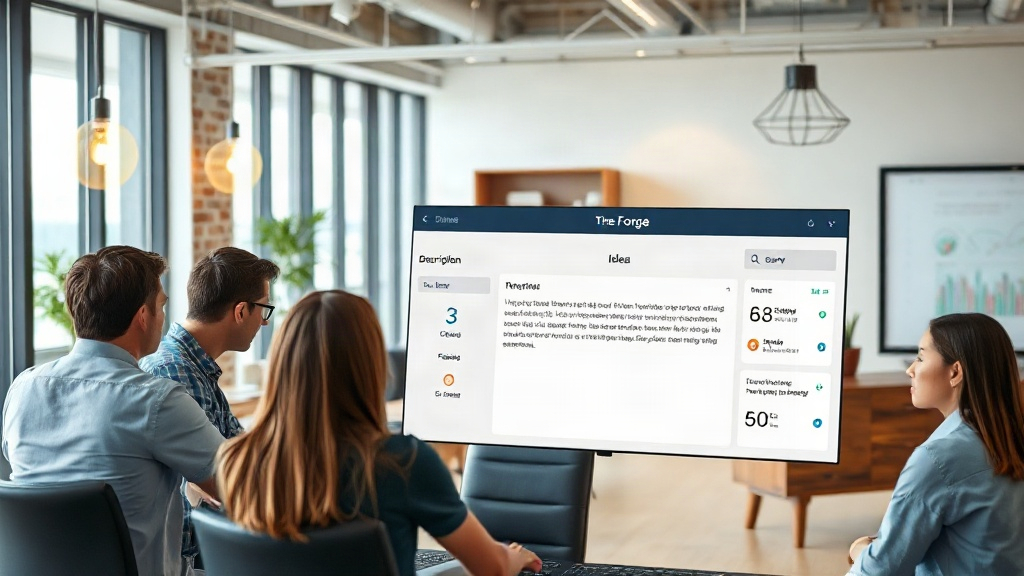
Unpacking the Development Lifecycle Abstraction
The Forge's promise to handle building, deploying, and operating applications implies a sophisticated underlying architecture. For the "build" phase, this likely involves AI-powered code generation, potentially leveraging advanced LLMs trained on vast code repositories. The system would need to not only write code but also understand dependencies, architecture patterns, and best practices to produce functional software. This is a monumental task, as translating abstract ideas into concrete, efficient, and secure code is the very essence of software engineering.
The "deploy" aspect suggests that The Forge will manage infrastructure provisioning, containerization, and CI/CD pipelines. Users would not need to worry about choosing cloud providers, setting up Kubernetes clusters, or writing deployment scripts. The platform would abstract these concerns, likely offering a managed environment or integrating with existing cloud services seamlessly. This could democratize application deployment, making it accessible to individuals or teams with limited DevOps expertise.
Perhaps the most challenging part of the promise is "operates." This implies ongoing monitoring, scaling, security patching, and incident response. A system that can autonomously operate applications would need robust observability tools, automated remediation capabilities, and a sophisticated understanding of system health and performance. This is akin to offering a fully managed PaaS (Platform as a Service) with an AI-driven operational layer, a significant undertaking.
Potential Impact and Unanswered Questions
If The Forge can successfully deliver on its core value proposition, it could dramatically lower the barrier to entry for creating and managing software. Startups could potentially bring Minimum Viable Products (MVPs) to market much faster, and established companies could experiment with new ideas with significantly reduced overhead. The demand for traditional software development roles might shift, with a greater emphasis on product ideation, prompt engineering, and high-level system design rather than granular coding and infrastructure management.
However, several critical questions remain unanswered. The technical feasibility of accurately translating any arbitrary idea into a production-ready application is a major hurdle. How does The Forge handle complex business logic, unique UI/UX requirements, or integrations with legacy systems? What level of customization is possible? If a generated application has a bug or a security vulnerability, who is responsible, and how is it debugged and fixed? The initial description is broad, and the depth of its capabilities will determine its ultimate utility.
Furthermore, the security implications of such an automated platform are profound. If the entire development and deployment process is abstracted, how can teams ensure the security and integrity of the generated code and infrastructure? Relying on an AI to build and operate systems introduces new attack vectors and requires a robust security framework within The Forge itself. The model's training data, its decision-making processes, and its operational protocols will all be critical points of scrutiny.
The Broader AI in Development Landscape
The Forge by Bob's Workshop enters a rapidly evolving market where AI is increasingly seen as a co-pilot, if not an autonomous agent, in software development. Tools like GitHub Copilot have already changed how many developers write code, reducing the time spent on boilerplate and repetitive tasks. Other platforms are integrating AI for code review, test generation, and even architectural suggestions.
The Forge's approach, however, appears to be more opinionated and all-encompassing. It's not just assisting; it's aiming to *do*. This makes it a bold experiment. It forces us to consider what the future of software creation looks like when the act of coding and infrastructure management becomes a secondary concern, superseded by the ability to clearly articulate intent. What nobody has addressed yet is what happens to the thousands of developers who built entire careers on the meticulous craft of coding and system administration if platforms like The Forge become truly ubiquitous and capable.
For now, The Forge remains a product of Bob's Workshop, offering a glimpse into a potential future where software development is more accessible and driven by natural language. Its success will depend on its ability to move beyond a compelling tagline to deliver robust, reliable, and secure application development and operation capabilities that can meet the diverse needs of modern software projects.