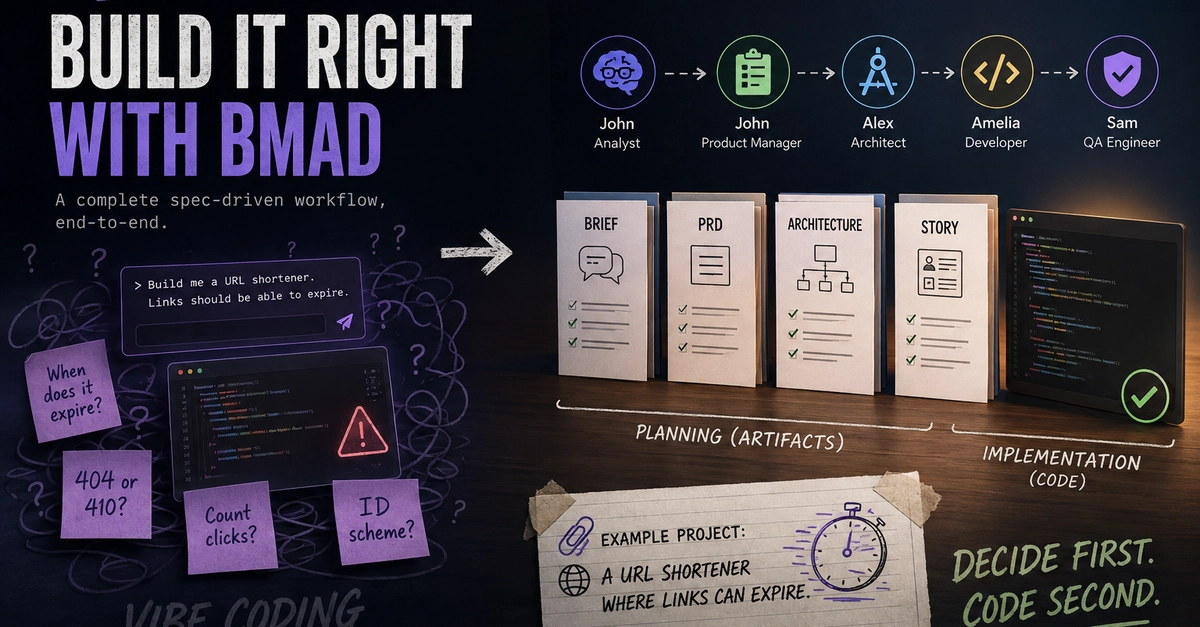
The Problem with 'Vibe Coding' AI Features
Many developers working with AI fall into a pattern best described as 'vibe coding.' This means opening an editor, typing a prompt, and iterating until the output looks roughly acceptable. While this approach can yield quick results for simple tasks, it lacks rigor and scalability. It's difficult to reproduce, hard to manage, and offers little assurance of quality or adherence to specific requirements. This post details a complete, end-to-end workflow designed to replace this ad-hoc method: the BMAD workflow.
BMAD stands for Brainstorm, Spec, Architecture, Story, Implementation, and Review. It’s a structured methodology for developing AI-powered features, ensuring a clear path from a vague idea to reviewed, production-ready code. Unlike approaches that focus on arguing the merits of spec-driven development, this guide offers a practical walkthrough of the entire process, complete with actual commands and steps. The goal is to demystify the end-to-end journey, making it tangible for developers accustomed to less structured methods.

Stage 1: Brainstorm – Defining the Core Idea
Every feature starts with an idea. In the Brainstorm phase, the objective is to flesh out this initial concept into a concrete problem statement and a high-level solution. This isn't about deep technical details yet; it’s about understanding *what* you’re trying to achieve and *why*. For example, if the idea is to build an AI-powered summarization tool for customer feedback, the brainstorm would focus on the target users, the desired outcome (e.g., faster insights, identification of key pain points), and the general scope of the feature.
Key outputs of this stage include:
- A clear problem statement.
- The primary goal of the feature.
- Target user(s) and their needs.
- High-level constraints or considerations.
Stage 2: Spec – Detailing Requirements
The Spec phase translates the brainstormed idea into specific, measurable, achievable, relevant, and time-bound (SMART) requirements. This is where you define the feature’s behavior in detail. For the summarization tool, this might include:
- Input: What format will the feedback data take (e.g., text snippets, transcripts)? What are the maximum lengths?
- Output: What should the summary look like? (e.g., bullet points, a paragraph, sentiment analysis alongside summary). What is the desired length of the summary?
- Functionality: Should it handle multiple languages? Should it be able to identify specific themes or keywords?
- Performance: What is the acceptable latency for generating a summary?
- Edge Cases: How should it handle empty input, irrelevant feedback, or extremely long inputs?
This stage often involves iterative refinement, potentially using tools or frameworks that help articulate these specifications. The output is a comprehensive document or set of definitions that leaves little room for ambiguity.
Stage 3: Architecture – Designing the Solution
With clear specifications, the Architecture phase focuses on *how* the feature will be built. This involves selecting the right AI models, data pipelines, APIs, and infrastructure. For our summarization tool, this might mean:
- Model Selection: Choosing a pre-trained summarization model (e.g., T5, BART) or deciding if a custom model is necessary.
- Data Processing: Designing the pipeline for ingesting, cleaning, and preparing customer feedback data.
- API Design: Defining the endpoints for interacting with the summarization service.
- Infrastructure: Deciding where the model will be hosted (e.g., cloud ML platform, on-premise) and the associated compute requirements.
- Integration Points: How will this feature integrate with existing systems (e.g., CRM, support ticketing)?
This phase is critical for ensuring the solution is technically feasible, efficient, and maintainable. It lays the groundwork for the implementation phase.
Stage 4: Story – Breaking Down Tasks
The Story phase breaks down the architectural design into discrete, actionable tasks or user stories. These are typically small enough to be completed within a single development cycle (e.g., a day or two). For the summarization feature, stories might include:
- “As a developer, I want to set up a basic data ingestion pipeline for raw feedback text so that I can feed it into the model.”
- “As a developer, I want to integrate the chosen summarization model via its API so that I can generate summaries for test data.”
- “As a developer, I want to implement sentiment analysis alongside the summary so that users can gauge the tone of the feedback.”
- “As a developer, I want to build the API endpoint for requesting summaries so that the frontend can interact with the service.”
Each story should have clear acceptance criteria, ensuring that when it's completed, it meets a specific requirement defined in the spec. This phase is crucial for agile development and project management.
Stage 5: Implementation – Writing the Code
This is where the actual coding happens, guided by the stories and architectural design. Developers work through the backlog of tasks, writing code for data processing, model integration, API development, and any necessary frontend components. The BMAD methodology emphasizes writing code that directly addresses the defined specifications and architectural choices. Version control (like Git) is essential here, with clear branching strategies and commit messages that reference the specific stories being addressed.
For example, a developer might write Python code to interact with a Hugging Face model, define a Flask or FastAPI endpoint for the API, and implement error handling based on the spec’s edge case definitions. The key is to implement *what was specified*, not to deviate based on immediate intuition.
Stage 6: Review – Ensuring Quality and Compliance
The final stage is the Review, which encompasses code reviews, testing, and validation against the original spec. Code reviews by peers ensure code quality, catch potential bugs, and verify adherence to architectural standards. Automated tests (unit, integration, end-to-end) confirm that the feature works as expected and meets the acceptance criteria for each story.
Crucially, validation against the spec ensures that the implemented feature actually solves the problem defined at the outset. This might involve manual testing by product managers or QA engineers, or automated checks that compare output against predefined examples or metrics. The review process ensures that the feature is not just functional but also correct, reliable, and meets the business objectives. Only code that passes review and validation is merged and shipped.
Why BMAD Matters
The BMAD workflow moves AI development from a craft into an engineering discipline. It provides structure, accountability, and a clear path to delivering high-quality AI features. By systematically moving through Brainstorm, Spec, Architecture, Story, Implementation, and Review, teams can avoid the pitfalls of 'vibe coding' and build AI applications with confidence and predictability. This structured approach is essential for any team serious about integrating AI capabilities effectively into their products.