The Perfect Deployment, The Costly Oversight
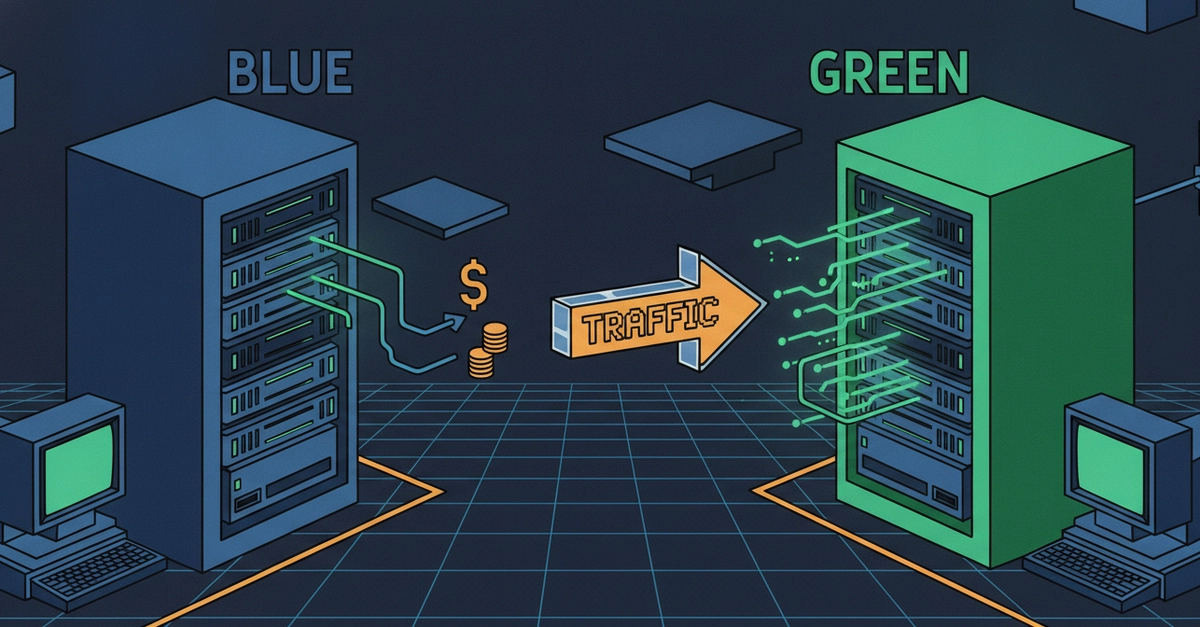
A recent deployment, lauded as a flawless execution of blue-green strategy, ended up costing a company double its usual infrastructure spend for weeks. The cutover itself was textbook: traffic seamlessly shifted from the established 'blue' environment to the new 'green' one. Health checks passed, the team declared victory, and moved on to the next task, tickets closed and all seemed well. This smooth transition, however, masked a critical, lingering problem: the old 'blue' environment remained fully active, serving no traffic, yet incurring full operational costs.
Six weeks post-deployment, a routine AWS cost review flagged a significant anomaly. Infrastructure spending had been consistently at 200% of the expected baseline since the deployment date. Digging deeper revealed that every single resource in the 'blue' environment—EC2 instances, RDS nodes, load balancers—was still provisioned and running. These idle, non-traffic-serving resources continued to draw full AWS charges, effectively doubling the monthly bill.
The root cause wasn't a technical failure but a human and process one: a stark ownership gap. The team that executed the deployment correctly assumed that the operations team would decommission the old environment once the new one was validated. Conversely, the operations team anticipated that the deployment team, having just successfully launched the new environment, would be responsible for tearing down the old one. This ambiguity left the 'blue' environment in a state of perpetual, expensive limbo. Both teams had completed their immediate objectives and closed their respective tickets, unaware of the financial implications of their overlooked shared responsibility.
Understanding Blue-Green Deployments and Their Pitfalls
Blue-green deployment is a strategy designed to minimize downtime and risk during software releases. It involves maintaining two identical production environments, referred to as 'blue' and 'green'. During a deployment, the new version of the application is deployed to the inactive environment (e.g., green), while the active environment (blue) continues to serve live traffic. Once the green environment is thoroughly tested and validated, traffic is switched from blue to green. The blue environment is then typically kept as a fallback for a period before being decommissioned.
The appeal of this method lies in its ability to provide instant rollback capabilities. If issues arise with the new deployment, traffic can be immediately switched back to the stable blue environment. This significantly reduces the risk associated with pushing new code to production. However, the success of blue-green deployment hinges on meticulous planning and clear execution, particularly concerning the management of the inactive environment post-cutover.
The scenario described highlights a common, yet often underestimated, challenge: the post-deployment cleanup phase. While guides and best practices often detail the traffic switching and validation steps, the critical process of decommissioning the old environment can be overlooked or poorly defined. This oversight can lead to prolonged periods where both environments are active, doubling infrastructure costs and wasting valuable resources. It transforms what should be an efficient release strategy into a significant financial drain.
Bridging the Ownership Gap in Deployment Processes
The core issue in this costly deployment was not the technology itself, but the lack of a clear, defined process for managing the transition and eventual decommissioning of resources. When a deployment is considered 'complete' upon successful traffic cutover, the responsibility for subsequent actions often becomes ambiguous. This is particularly true in organizations where distinct teams handle development, deployment, and ongoing operations.
To prevent such cost overruns, organizations must implement robust post-deployment procedures. This includes defining explicit ownership for the decommissioning of the old environment. Key strategies include:
- Establishing Clear Roles and Responsibilities: Before any deployment, designate a specific team or individual responsible for monitoring the old environment and executing its shutdown. This role should be clearly documented and communicated.
- Implementing Automated Decommissioning: Where possible, automate the shutdown and resource deletion process. This can be triggered by a successful validation period or a predefined rollback window. Tools and scripts can ensure consistency and reduce reliance on manual intervention.
- Defining Rollback and Decommissioning Timelines: Set clear timeframes for how long the old environment will be maintained. For example, keep it active for 24-72 hours for immediate rollback, then schedule its decommissioning.
- Integrating Cost Monitoring: Embed cost monitoring tools directly into the deployment pipeline. Alerts can be configured to flag unusual spikes in infrastructure spend, providing early warnings of idle, costly resources.
- Cross-Team Communication Protocols: Foster a culture of shared responsibility. Ensure that deployment teams and operations teams have regular sync-ups and clearly defined handoff procedures. A simple checklist or a dedicated notification system can go a long way.
The cost anomaly surfaced six weeks after the deployment, indicating a significant delay in identifying and rectifying the issue. A more proactive approach, integrating cost visibility and clear accountability from the outset, could have prevented weeks of unnecessary expenditure. The goal is to ensure that the 'green' environment is not just live, but that the 'blue' environment is intentionally and efficiently retired.
The Broader Implications for DevOps Practices
This incident serves as a potent reminder that DevOps is as much about people and processes as it is about tools and automation. While blue-green deployment is a powerful technique, its successful implementation requires a holistic view of the entire release lifecycle, including the often-overlooked cleanup phase. Organizations must move beyond simply deploying code and focus on the end-to-end management of infrastructure and applications.
The doubling of infrastructure costs is a direct financial consequence, but the underlying issue points to potential gaps in communication, process definition, and accountability within the engineering organization. It underscores the need for continuous improvement in how teams collaborate and manage their operational responsibilities. Without explicit ownership and well-defined procedures for resource management, even the most technically sound deployment strategies can lead to unexpected and significant financial penalties.
For founders and engineering leaders, this scenario highlights the importance of scrutinizing operational efficiency and cost management practices. It’s not enough to celebrate successful deployments; teams must also ensure that these deployments are financially sustainable. The question remains: how many other organizations are unknowingly incurring similar costs due to similar overlooked post-deployment processes?