The Invisible Interface: Beyond Overt Health Tracking
Imagine smart glasses that don't bombard you with step counts, stress notifications, or bedtime reminders. Instead, picture a device that discreetly adjusts your surroundings in response to your physiological state. This is the core concept behind Bio-Tuning Glasses, an experimental vision for an 'Invisible Biofeedback Interface.' The fundamental principle is user-centric: rather than forcing the user to adapt to technology, the environment should adapt to the user. This approach aims to bridge the gap between human biology and unconscious behavior, creating a seamless, integrated experience.
Most current wearable health devices operate on a model of data aggregation and user interpretation. They collect metrics like heart rate, activity levels, and sleep patterns, presenting this information through dashboards, apps, and notifications. While valuable for awareness, this often leads to a reactive and sometimes overwhelming user experience. Bio-Tuning Glasses propose a paradigm shift. They leverage biofeedback not for direct reporting, but for implicit environmental modulation. The goal is to influence behavior and well-being through subtle, non-intrusive environmental changes, making the technology feel like an extension of the user's own state rather than an external monitor.
Leveraging Edge AI for Real-time Environmental Adaptation
The intelligence behind Bio-Tuning Glasses resides at the edge. By processing physiological data directly on the device, these glasses can achieve near-instantaneous environmental adjustments without relying on cloud connectivity. This edge AI capability is crucial for an 'invisible' interface; delays or latency would break the illusion of seamless adaptation. The system would continuously monitor biometric signals – potentially including electroencephalography (EEG) for brain activity, electrooculography (EOG) for eye movements, and galvanic skin response (GSR) for emotional arousal. These inputs are fed into AI models trained to recognize specific physiological states and correlate them with desired environmental responses.
Consider a scenario where the glasses detect rising stress levels through subtle physiological cues. Instead of a notification, the system might automatically adjust the ambient light temperature in the user's field of view, perhaps shifting towards warmer tones known to promote relaxation. Or, if the system detects signs of fatigue during a work session, it could subtly alter the visual contrast or brightness of the displayed information to reduce eye strain. The key is that these adjustments are subtle, designed to guide the user towards a more optimal state without conscious awareness of the intervention itself. This is akin to how a thermostat quietly maintains room temperature; the Bio-Tuning Glasses would aim to maintain an optimal internal state through environmental micro-adjustments.
Adaptive Optics: Sculpting the Visual Environment
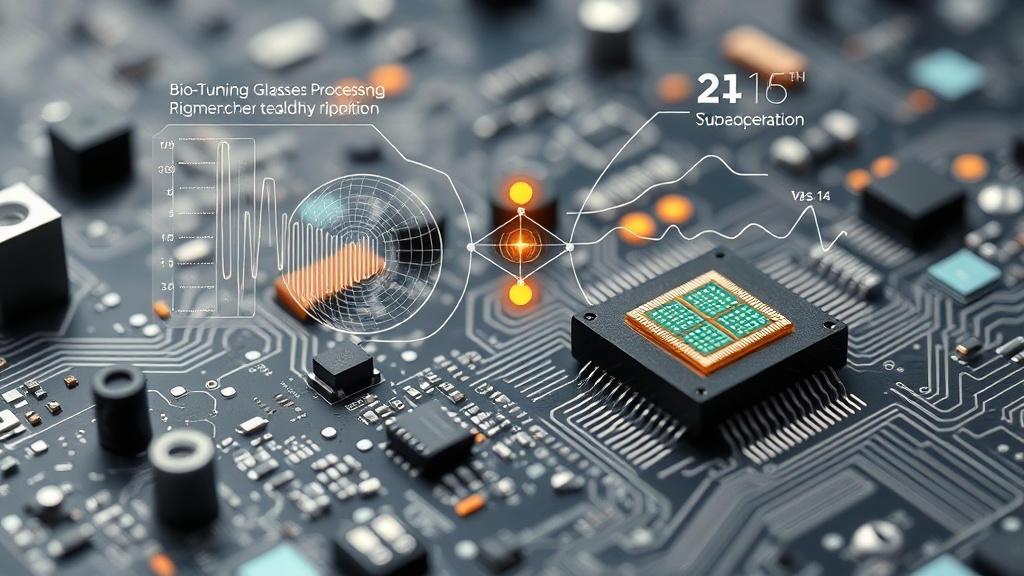
The 'adaptive optics' component of the Bio-Tuning Glasses is where the environmental intervention becomes tangible, particularly within the visual domain. Unlike traditional smart glasses that might overlay digital information, these glasses use adaptive optics to actively modify the light entering the user's eyes. This could involve micro-LED displays or liquid crystal layers capable of dynamically altering brightness, contrast, color temperature, and even focus. The system could, for instance, subtly shift the focus plane to reduce accommodative effort if it detects signs of visual fatigue, or enhance contrast in low-light conditions to improve clarity and reduce strain.
The integration of adaptive optics with edge AI creates a powerful closed-loop system. The AI interprets the user's physiological state, and the adaptive optics hardware enacts the necessary visual adjustments in real-time. This goes beyond simple augmented reality overlays; it's about actively sculpting the user's perception of their environment to promote comfort, focus, or relaxation. For example, if the system detects the onset of a migraine aura through subtle visual processing changes (perhaps inferred from EOG data or pupil dilation), it could immediately adjust light intensity and color spectrum to mitigate the trigger before it fully manifests. This level of proactive, personalized environmental control represents a significant departure from current wearable technology paradigms.
The Challenge of Unconscious Behavior and Ethical Considerations
Building an truly 'invisible' biofeedback interface presents significant challenges. The primary hurdle is understanding the complex interplay between physiological states, environmental stimuli, and human behavior. Developing AI models that can accurately infer a user's state and predict the optimal environmental response requires extensive data and sophisticated algorithms. Furthermore, the effectiveness of such subtle interventions needs rigorous validation. What one person perceives as calming, another might find distracting. Personalization will be key, with the system learning and adapting to individual responses over time.
Beyond the technical challenges lie significant ethical considerations. If technology can subtly influence our mood, focus, and behavior without our explicit awareness, what are the implications for autonomy and free will? Transparency about the system's operations, even if the interventions are invisible, will be paramount. Users must have control over the system, with clear mechanisms to opt-out or adjust sensitivity. The potential for misuse, such as subtle manipulation or the creation of dependencies, necessitates careful design and robust ethical guidelines. The Bio-Tuning Glasses concept, while futuristic, prompts a critical discussion about the future of human-computer interaction and the boundaries of personalized technology.
Future Directions and Broader Implications
The Bio-Tuning Glasses concept is still in its nascent stages, representing a conceptual exploration rather than a commercial product. However, it points towards a future where wearable technology becomes less about explicit data display and more about seamless integration with our physical and cognitive states. The principles of edge AI for real-time processing and adaptive optics for environmental control could find applications beyond eyewear, influencing everything from smart home devices to personalized workspaces. The ultimate goal is a harmonious relationship between humans and technology, where devices support our well-being by subtly adapting the world around us, making technology truly invisible and intuitive.