Securing the Enterprise AI Frontier
As artificial intelligence permeates every facet of the modern enterprise, from developer workflows to customer interactions, the need for robust security and governance becomes paramount. Developers leverage AI coding assistants, support teams deploy AI-powered chatbots, and analysts rely on AI for data insights. This widespread adoption, however, introduces complex security challenges. Managing who can access what, and under what conditions, across a diverse range of AI tools and services is no longer a trivial task. Bifrost Enterprise aims to address this critical gap by introducing a unified approach to Data Access Control (DAC) and Role-Based Access Control (RBAC), specifically tailored for enterprise AI governance.
The core problem Bifrost tackles is the fragmentation of security controls. Traditionally, organizations might employ separate systems for managing user permissions (RBAC) and data access (DAC). However, when these systems are applied to AI applications, which often involve dynamic data flows and third-party integrations, this separation can lead to blind spots. Bifrost Enterprise proposes a solution that layers these controls, ensuring that access is not only role-appropriate but also contextually aware of the data being accessed and the specific AI service being utilized. This integrated approach is designed to provide granular visibility and control, essential for maintaining compliance and preventing unauthorized data usage or model manipulation.
Integrating Access Control Mechanisms
Bifrost Enterprise’s architecture is built upon several key components designed to work in concert. The platform combines traditional DAC and RBAC with what it terms 'Access Profiles' and 'Bifrost Edge'.
- Data Access Control (DAC): This layer focuses on governing access to the data itself. In an AI context, this means controlling which datasets can be used by which models, or which data can be fed into specific AI applications. Bifrost’s DAC implementation aims to provide fine-grained permissions, ensuring that sensitive information remains protected even as it’s processed by AI systems.
- Role-Based Access Control (RBAC): This is a more traditional security mechanism that grants permissions based on a user's role within the organization. For AI governance, RBAC ensures that only authorized personnel, such as data scientists or compliance officers, can perform specific actions, like model training or policy configuration.
- Access Profiles: These are custom configurations that define specific access policies for different AI use cases or teams. For instance, a marketing team using an AI content generation tool might have a different Access Profile than a research team using an AI for complex data analysis. Profiles allow for tailored security settings that align with specific departmental needs and risk tolerances.
- Bifrost Edge: This component likely refers to an on-premise or edge deployment option, allowing organizations to maintain greater control over data and access policies at the network perimeter or within their own infrastructure, which is crucial for highly regulated industries or those with strict data residency requirements.
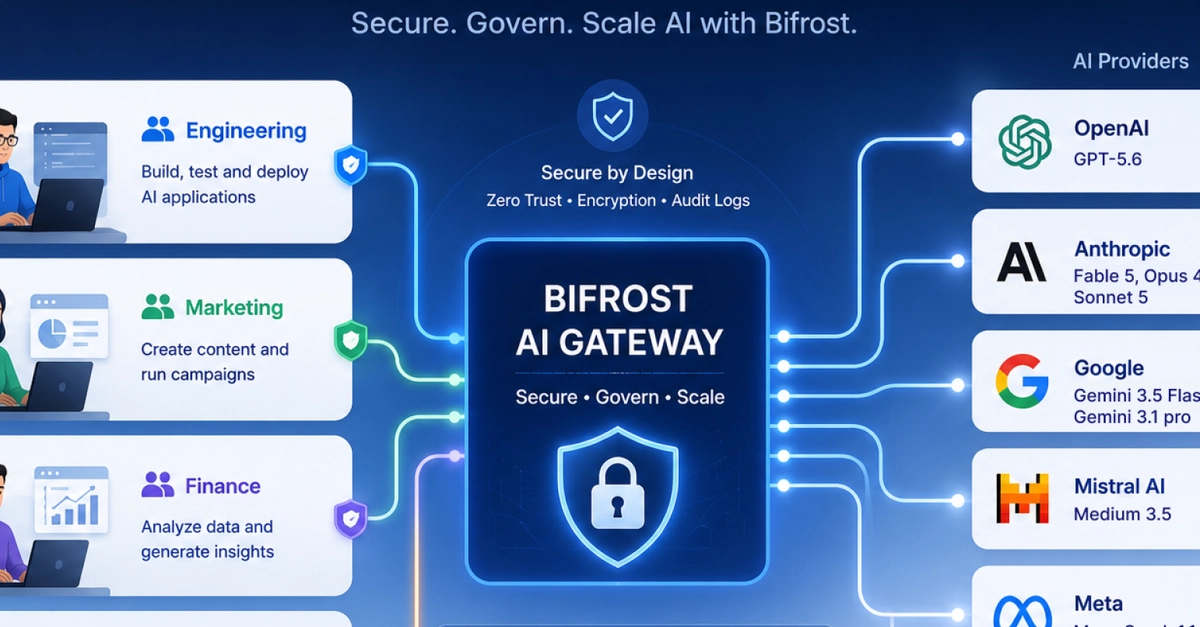
By integrating these elements, Bifrost Enterprise creates a cohesive security framework. Instead of managing disparate access control lists and user groups across various AI tools, organizations can leverage Bifrost to define and enforce policies centrally. This unification is particularly important for team-level visibility. It allows administrators to understand precisely which teams have access to which AI resources and data, and to audit these permissions effectively. This is not merely about restricting access; it's about enabling secure, compliant, and efficient utilization of AI capabilities across the enterprise.
The Bifrost Gateway Concept
Central to Bifrost's strategy is the concept of a 'Bifrost Gateway'. This acts as a central point of control and monitoring for all AI application access. Think of it less like a traditional firewall and more like a highly intelligent concierge for your AI resources. When a user or an application requests access to an AI service or data, the request is routed through the Bifrost Gateway. This gateway then evaluates the request against the configured DAC, RBAC, and Access Profiles. If the request meets all policy requirements, it is granted; otherwise, it is denied. This single point of control simplifies management and provides a comprehensive audit trail of all access activities.
The "So What?" Perspective
Developers can leverage Bifrost Enterprise to integrate secure access controls into their AI application development lifecycle. The platform provides a unified API for managing data and role-based permissions, simplifying the implementation of AI governance policies. This allows for the creation of AI tools that automatically adhere to organizational access standards, reducing the burden of manual security configurations.
For security professionals, Bifrost Enterprise offers a consolidated view of access across diverse AI applications. It helps mitigate risks associated with data leakage and unauthorized model access by enforcing granular DAC and RBAC policies. The ability to define custom Access Profiles and utilize Bifrost Edge for on-premise control enhances the overall security posture for enterprise AI deployments.
This offering positions Bifrost Enterprise as a critical enabler for AI adoption in regulated industries. By providing a scalable and unified governance framework, it reduces the perceived risk for enterprises, potentially accelerating their AI investment. The integration of DAC and RBAC into a single platform offers a competitive advantage by simplifying complex security requirements for AI.
Creators building AI-powered applications can benefit from a clearer understanding of how their tools will be secured within enterprise environments. Bifrost’s Access Profiles allow for tailored security configurations that can be pre-defined for specific use cases, simplifying deployment and ensuring compliance for their end-users within larger organizations.
Data scientists and analysts gain more confidence in using sensitive datasets with AI tools through Bifrost’s granular DAC. The platform ensures that data access is restricted to authorized users and specific AI applications, preventing unintended exposure or misuse of valuable information. This facilitates more secure experimentation and deployment of AI models on critical data.
Sources synthesised
- 8% Match