
Code as Data, Now Navigable
Clojure, a Lisp dialect renowned for its embrace of code-as-data, gains a powerful new tool with Biff.graph. This library, developed by Jacobobryant, transforms a Clojure codebase into a first-class, queryable graph. Instead of treating code as static text or abstract syntax trees (ASTs) that require custom parsers for analysis, Biff.graph represents the entire project as a graph data structure. This allows developers to ask complex questions about their code, uncover hidden relationships, and build sophisticated tooling with unprecedented ease.
The core idea is to move beyond simple static analysis. Traditional tools often rely on regular expressions or basic AST traversal, which can be brittle and limited. Biff.graph, by contrast, builds a rich semantic graph. Each node in the graph represents a distinct element of the codebase – functions, variables, namespaces, macros, types, etc. Edges represent the relationships between these elements: function calls, variable bindings, macro expansions, type dependencies, and more. This graph can then be traversed and queried using standard graph database techniques, or even Clojure's own powerful data manipulation functions.
Consider the implications for understanding large, complex Clojure projects. Developers often struggle to map out dependencies, identify dead code, or understand the impact of a change across the system. Biff.graph provides a concrete, queryable model that can illuminate these aspects. Imagine being able to ask: "Show me all functions that directly or indirectly call this deprecated API," or "List all namespaces that depend on this specific library version." This level of introspection was previously difficult, requiring custom scripts or specialized, often language-specific, static analysis tools. Biff.graph aims to standardize and simplify this process for the Clojure ecosystem.
Querying the Code Graph
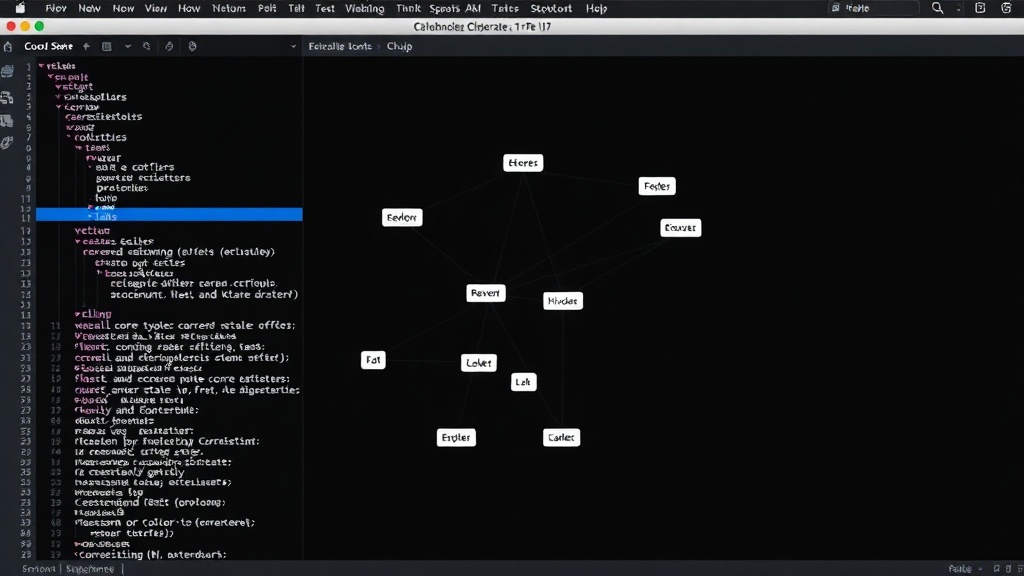
The library exposes a Clojure API for building and querying the graph. Developers can load their project, generate the graph representation, and then use functions like graph/query to traverse and filter nodes and edges. This means that complex code analysis tasks, which might have taken hours of custom scripting, can be reduced to concise graph queries. For example, identifying all the places a particular macro is used, and how those uses expand, becomes a tractable problem.
The graph structure isn't just for introspection; it's a foundation for building powerful developer tools. Think about code completion that understands semantic relationships beyond simple symbol lookups, refactoring tools that can accurately assess the scope of a change, or documentation generators that can automatically map out dependencies and usage patterns. The ability to query the codebase as a graph opens up a new frontier for IDE integration, automated code review, and even security analysis, where understanding the flow of data and control is paramount.
One of the surprising details is how readily Biff.graph integrates with Clojure's existing strengths. Because Clojure itself treats data structures as first-class citizens, representing code as a graph is a natural extension. The library doesn't require a separate query language or a complex setup; it uses Clojure's native capabilities. This lowers the barrier to entry for developers already familiar with the language and its ecosystem. It’s less like learning a new database system and more like gaining a new, incredibly detailed map of your existing project.
Beyond Static Analysis
While Biff.graph performs static analysis, its graph-based approach offers a richer semantic understanding than traditional AST walkers. By capturing relationships like macro expansion, function calls, and namespace dependencies, it provides a more complete picture of how code elements interact. This is particularly valuable in Lisp-family languages where macros can dynamically alter code structure, making static analysis more challenging.
The library's design allows for extensibility. Developers can add custom node types and edge types to represent domain-specific concepts or project-specific conventions. This means Biff.graph can be tailored to analyze not just the syntax and structure of Clojure code, but also its logical and architectural patterns. For instance, a team could extend the graph to model data flow, performance bottlenecks, or security vulnerabilities, creating a custom analysis engine tailored to their specific needs.
What remains to be seen is how widely this approach will be adopted. While the benefits are clear for large or complex projects, the initial overhead of graph generation might seem significant for smaller, simpler codebases. However, the potential for building advanced, context-aware tooling could eventually make it an indispensable part of the Clojure developer workflow, regardless of project size. The question is whether the ecosystem will embrace this graph-centric view of code as the next evolution in static analysis and developer productivity.