The Evolving Role of Architecture in AI-Assisted Development
The rapid advancement of AI coding tools is fundamentally altering the software development landscape. While these tools excel at generating code snippets and even entire functions, they introduce a new class of architectural challenges. The core question shifts from 'Can AI write this code?' to 'How much of the system does the AI need to understand to make safe, effective changes?' This is where architectural patterns, particularly the Backend for Frontend (BFF), are proving increasingly valuable.
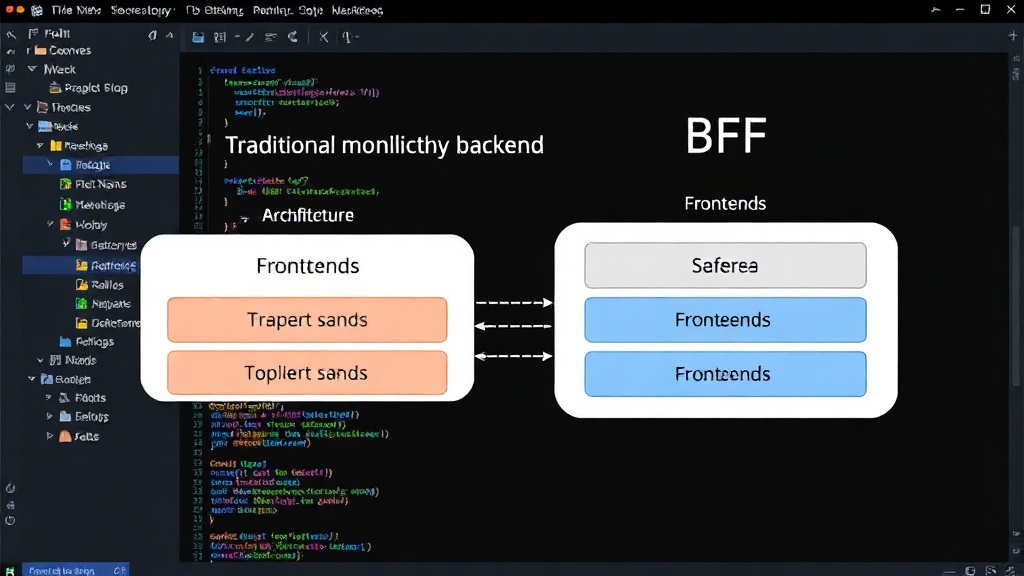
Traditionally, BFF architecture was adopted to tailor API endpoints specifically for the needs of individual frontend applications. This approach decouples frontends from a monolithic backend, allowing each frontend (web, mobile, IoT) to consume data in a format optimized for its display and interaction requirements. However, in the context of AI-assisted development, the BFF serves a more profound purpose: it establishes a critical boundary that simplifies AI's scope of understanding and enhances the safety of AI-driven code modifications.
Defining Boundaries for AI Comprehension
AI coding agents, despite their increasing sophistication, operate within a defined context. When an AI is tasked with modifying or generating code, its effectiveness and safety are directly proportional to the amount of relevant system information it can process. A monolithic backend, where business logic, data access, and cross-cutting concerns are tightly interwoven, presents a vast and complex context for any AI. Understanding the implications of a single change across such a system is a Herculean task, even for advanced AI.
A BFF pattern inherently breaks down this complexity. By creating a dedicated layer that sits between the frontend and the core backend services, the BFF acts as an intermediary. It translates frontend requests into backend calls and aggregates/transforms backend responses into a frontend-friendly format. This explicit translation layer serves as a natural containment zone for AI interventions. When an AI agent is tasked with enhancing a user interface or adapting to new frontend requirements, its scope can be limited primarily to the BFF layer. The AI doesn't need to comprehend the intricacies of the entire microservices ecosystem or the deep business logic of the core backend. It only needs to understand the specific API contracts and data transformations handled by its assigned BFF.
Reducing the Blast Radius of AI Errors
The introduction of AI into the development workflow, while promising increased velocity, also introduces new risks. A poorly understood change, or a subtle bug in AI-generated code, can have far-reaching consequences. In a monolithic architecture, a mistake within the core logic could cascade through multiple services or impact numerous features unexpectedly. The 'blast radius' of such an error is unacceptably large.
The BFF architecture significantly mitigates this risk. Because the BFF is a distinct service with a well-defined responsibility – serving a specific frontend – any errors introduced by AI within the BFF are largely contained. The BFF's API contract acts as a contract with the frontend; if the BFF breaks, the impact is immediately visible on the frontend it serves. This isolation allows for more focused debugging and rollback strategies. Developers can identify that the issue lies within the BFF, and potentially with the AI-generated code therein, without needing to scrutinize the entire backend infrastructure. This containment is crucial for building trust in AI-assisted development workflows, enabling teams to iterate faster with greater confidence.
Enhancing Testability and Reviewability
Explicit API contracts are the bedrock of robust software development, and AI-assisted development is no exception. A key benefit of the BFF pattern is its inherent creation of such contracts. The BFF defines clear, testable interfaces between the frontend and the backend. These contracts become the explicit specification that AI agents can target.
When an AI is asked to implement a new feature or modify existing behavior that impacts the frontend, it can work against the BFF's API contract. This contract serves as a precise guide, ensuring the AI understands the expected input and output formats. Furthermore, these contracts are amenable to automated testing. Unit tests, integration tests, and contract tests can be written specifically for the BFF, verifying that AI-generated code adheres to the agreed-upon interfaces. This makes the review process for AI-generated code much more manageable. Instead of sifting through potentially thousands of lines of code spread across multiple services, reviewers can focus on the changes within the BFF and validate them against the established API contract. This targeted review process is essential for maintaining code quality and security as AI involvement increases.
BFF as a Strategic Abstraction Layer
In essence, the BFF architecture provides a strategic abstraction layer that becomes even more critical in the age of AI. It acts as a buffer, translating high-level frontend requirements into concrete, actionable API specifications. For AI, this means a more manageable and understandable context. For developers, it means a clearer boundary for code generation and modification, more focused review processes, and a significantly reduced risk of cascading failures.
Consider it like this: if the core backend is a bustling city with complex infrastructure, the BFF is a well-organized, dedicated shipping port for a specific district. AI developers don't need to understand the city's entire power grid or traffic system; they just need to know how to load and unload cargo at the specific port designed for their district's needs. This specialization makes the entire operation more efficient and less prone to city-wide gridlock from a single mistake at the docks.
As AI coding assistants become more integrated into development pipelines, the architectural choices made today will determine the scalability, maintainability, and safety of tomorrow's applications. The BFF pattern, with its inherent ability to create clear boundaries and explicit contracts, offers a compelling solution for navigating the complexities introduced by AI-assisted development, ensuring that innovation can proceed without compromising stability or security.