
The Evolving Interface Paradigm
The traditional keyboard and mouse, staples of human-computer interaction for decades, are increasingly being augmented and, in some cases, superseded by more intuitive input methods. As artificial intelligence systems become more sophisticated, the demand for richer, more natural interaction modalities grows. This shift is driving innovation in areas like voice and gesture recognition, moving beyond simple command-and-control to nuanced, context-aware 'vibing' – a concept that encapsulates a more fluid, almost symbiotic relationship between human intent and AI response. Architecting these systems requires a fundamental rethinking of how we capture, process, and interpret human signals.
Voice vibing, for instance, is not merely about speech-to-text. It involves understanding prosody, tone, emotion, and subtle vocal inflections that convey meaning far beyond the literal words spoken. Similarly, gesture vibing aims to interpret the intent behind physical movements, from broad arm sweeps to minute hand twitches, translating them into actionable commands or contextual cues for AI. The underlying architecture must be robust enough to handle the high dimensionality and temporal nature of these data streams, while remaining responsive enough for real-time interaction. This necessitates a layered approach, integrating advanced signal processing, machine learning models, and real-time data fusion.
Voice Vibing: From Phonemes to Emotion
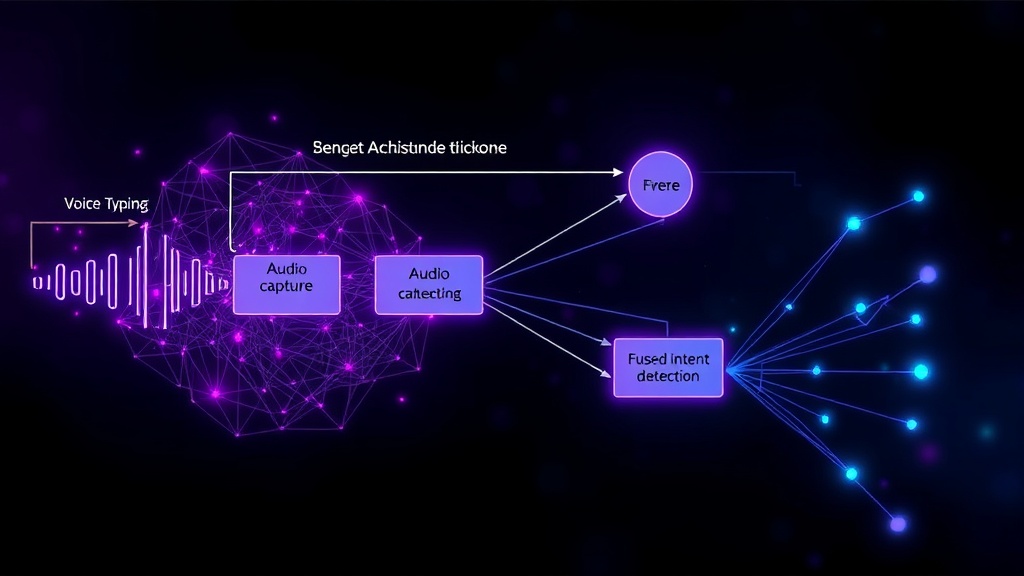
At its core, voice vibing begins with capturing audio. High-fidelity microphones and advanced acoustic preprocessing are crucial to isolate human speech from background noise. The subsequent stages involve transforming raw audio into meaningful representations. This starts with traditional Automatic Speech Recognition (ASR) to convert spoken words into text. However, for voice vibing, this is just the first step. Advanced models must then analyze the acoustic features of the speech: pitch, energy, speaking rate, and spectral characteristics. These features are then fed into separate models trained to detect emotional states (e.g., happiness, frustration, confusion), intent (e.g., request, affirmation, negation), and even personality traits.
The architecture often employs a multi-modal fusion strategy. While ASR provides the textual content, acoustic analysis provides the emotional and intentional context. Recurrent Neural Networks (RNNs), particularly Long Short-Term Memory (LSTM) or Gated Recurrent Unit (GRU) variants, are well-suited for processing sequential audio data. More recently, Transformer architectures, adapted for audio processing, are showing promise in capturing long-range dependencies within speech. The challenge lies in fusing these disparate signals – text, pitch contours, energy envelopes – into a coherent understanding of the user's 'vibe'. This might involve attention mechanisms that allow the model to weigh the importance of different features at different times, or a late-fusion approach where probabilities from individual models are combined.
One of the key architectural considerations is handling ambiguity. Human speech is inherently imprecise. A sigh could mean boredom, exhaustion, or even playful exasperation. The AI must learn to disambiguate these signals based on prior context, the ongoing conversation, and potentially other sensory inputs. This requires sophisticated state-tracking mechanisms and memory within the AI system. Furthermore, the system must be able to adapt to individual users' vocal patterns and idiosyncrasies over time, a process that often involves online learning or continuous fine-tuning of models.
Gesture Vibing: Interpreting Movement with AI
Gesture vibing leverages a different set of sensory inputs, primarily visual data from cameras or depth sensors, and sometimes inertial measurement units (IMUs) embedded in wearables. The goal is to capture the nuances of human movement and translate them into meaningful commands or contextual information. Unlike voice, which is a continuous stream, gestures can be discrete (like a wave) or continuous (like pointing). The architecture must accommodate both.
For visual gesture recognition, Convolutional Neural Networks (CNNs) are foundational for feature extraction from images or video frames. However, to understand the dynamics of movement, these visual features must be combined with temporal modeling. 3D CNNs or CNN-RNN hybrid architectures are commonly used. These models can process sequences of frames, learning to identify patterns of motion. Pose estimation techniques, such as OpenPose or MediaPipe, play a critical role in extracting skeletal keypoints from individuals, providing a structured representation of body posture and movement that is more robust to variations in lighting and background than raw pixel data.
The complexity arises in interpreting the *intent* behind gestures. A hand raised could be a greeting, a request to stop, or a signal of understanding. Context is paramount. The AI must consider the user's gaze direction, the objects they are interacting with, and the overall task being performed. This necessitates a tightly integrated system where gesture recognition modules work in tandem with other AI components, such as object recognition, scene understanding, and task planning. Reinforcement learning can be employed to train the system to associate specific gestures with desired outcomes in a given context.

Wearable IMUs offer an alternative or complementary approach. By measuring acceleration and angular velocity, they can directly capture the motion of limbs or the entire body. Sensor fusion techniques are then used to combine data from multiple IMUs or to integrate IMU data with visual information, providing a more comprehensive understanding of movement, especially in scenarios where visual tracking might be occluded.
System Architecture and Fusion
The true power of voice and gesture vibing lies in their combined potential. An architecture that supports multi-modal input can create a richer, more robust interaction experience. Imagine a user pointing at an object while verbally asking a question about it. The system needs to correlate the visual target of the gesture with the semantic content of the speech. This requires a unified data representation layer and sophisticated fusion algorithms that can handle temporal misalignment and differing data granularities.
At a high level, the architecture might look like this: Input Layer (microphones, cameras, IMUs) -> Signal Processing & Feature Extraction (ASR, acoustic feature extraction, pose estimation, IMU processing) -> Modality-Specific Models (emotion detection, intent recognition, gesture classification) -> Fusion Layer (combining modalities, context integration) -> Action/Response Generation (command execution, dialogue management, feedback). The Fusion Layer is the most critical and challenging part. Techniques like Bayesian networks, deep belief networks, or attention-based neural networks are employed to weigh the evidence from each modality and arrive at a unified interpretation. The surprising detail here is not the complexity of individual models, but the sheer difficulty in achieving seamless, low-latency fusion that feels natural to the user.
The system must also be designed for extensibility. As new sensors become available or new interaction paradigms emerge, the architecture should allow for the integration of new modules without requiring a complete overhaul. This implies a modular design with well-defined APIs between components. Real-time performance is non-negotiable; latency can break the illusion of natural interaction. This often means optimizing models for edge deployment or utilizing high-performance computing infrastructure for cloud-based processing.
The Unanswered Question: Ethical Implications and User Trust
As these systems become more adept at interpreting subtle human cues, a critical question emerges: how do we ensure user privacy and build trust? Voice and gesture data are deeply personal. The architecture must inherently incorporate privacy-preserving mechanisms, such as on-device processing for sensitive data, differential privacy, and transparent data usage policies. The 'vibing' concept, while powerful, also carries the risk of misinterpretation or over-interpretation, leading to user frustration or even unintended actions. What nobody has addressed yet is the robust framework for user feedback and correction when the AI misinterprets a 'vibe', and how to ensure the AI's interpretation remains aligned with the user's true intent over time.
Ultimately, the architecture of voice and gesture vibing represents a significant leap towards a more human-centric computing future. It moves beyond explicit commands to a more implicit, understanding-based interaction, where AI systems can better anticipate needs and respond with nuanced awareness. The technical challenges are substantial, but the potential for creating more accessible, efficient, and engaging user experiences is immense.