
The Siren Song of ARR
Annual Recurring Revenue (ARR) has become the undisputed king of SaaS metrics. Investors, founders, and analysts scrutinize it like a hawk, using it to benchmark growth, assess valuation, and predict future success. But what if the headline ARR number, often touted in funding announcements and earnings calls, is a misleading simplification? The reality, as many seasoned operators and investors are keenly aware, is that not all ARR is created equal. The underlying quality, predictability, and profitability of that revenue can vary dramatically, impacting a company's long-term health far more than a simple dollar figure suggests.
The increasing focus on ARR has led to a surge in its reporting, with many companies highlighting impressive growth figures. For instance, Sifted reports that while Google searches for "What is ARR?" have spiked, the actual reporting of ARR by companies often lacks a standardized, granular view. This ambiguity allows for a wide spectrum of what constitutes "ARR," from highly reliable, long-term contracts to more volatile, short-term, or even usage-based components that don't truly represent recurring stability. This is akin to a chef proudly announcing they've prepared 100 meals, without specifying if they were Michelin-star dishes or instant ramen packets.
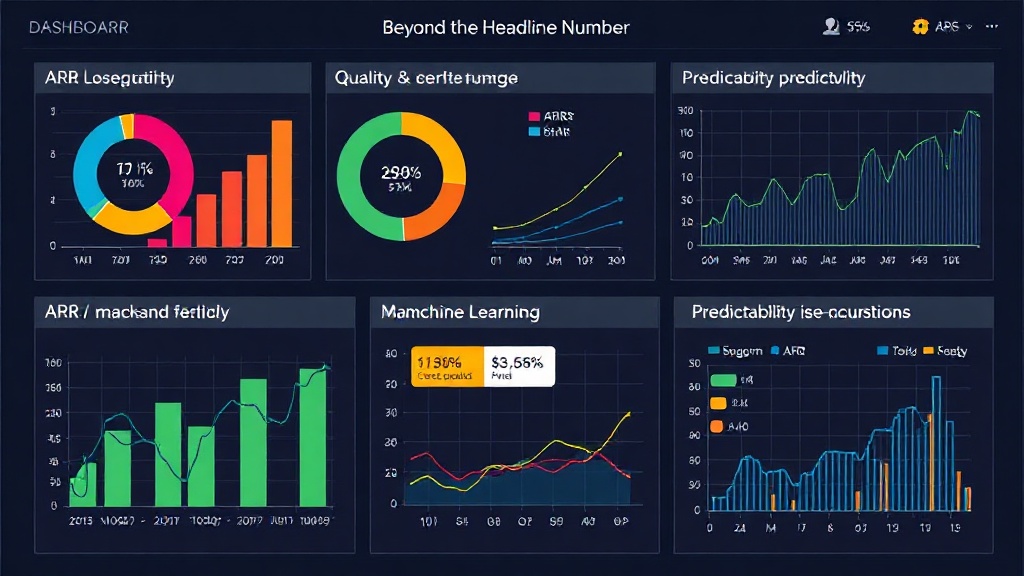
Deconstructing ARR: Quality Over Quantity
The fundamental issue lies in the definition and composition of ARR. While a core contractually obligated revenue is the gold standard, many companies aggregate different revenue streams under the ARR umbrella. This can include:
- Net New ARR: Revenue from new customers acquired.
- Expansion ARR: Revenue from existing customers increasing their spend (upsells, cross-sells).
- Net Negative ARR: When churn and downgrades exceed new and expansion revenue, resulting in a contraction.
The problem arises when companies don't clearly delineate these components or include revenue streams that are not truly recurring. For example, one-time professional services, implementation fees, or even highly variable usage-based components that fluctuate significantly month-to-month are sometimes folded into ARR. This inflates the headline number but masks underlying churn or a lack of predictable revenue, making the business appear healthier than it is. A company with $10 million in ARR from long-term, multi-year contracts with high retention is in a fundamentally different, and stronger, position than a company with $10 million in ARR composed of many small, month-to-month contracts with high churn, or significant one-time setup fees.
The Investor's Lens: What Matters Most
Sophisticated investors look beyond the top-line ARR figure. They are keenly interested in the quality of that revenue, which is often reflected in several key sub-metrics:
- Gross Revenue Retention (GRR): This measures the revenue retained from existing customers, excluding any upsells. A GRR of 100% or higher indicates that the company is not losing revenue from its existing customer base, even before accounting for expansion. This is a powerful indicator of product stickiness and customer satisfaction.
- Net Revenue Retention (NRR): This metric includes upsells and cross-sells from existing customers. An NRR above 100% signifies that the company is growing revenue from its existing customer base, effectively demonstrating product-market fit and customer value. Many investors view NRR as one of the most critical SaaS metrics.
- Churn Rate: Both gross churn (revenue lost from cancellations and downgrades) and net churn (gross churn offset by expansion revenue) are vital. High churn, especially gross churn, erodes the ARR base and requires constant, costly acquisition of new customers just to stand still.
- Contract Length and Terms: Longer-term contracts (e.g., multi-year deals) provide greater revenue predictability and reduce sales and marketing costs associated with frequent renewals. The presence of significant upfront payments or multi-year commitments further solidifies the recurring nature of the revenue.
The Sifted article highlights this nuance by mentioning how investors like DTCP look at metrics such as the proportion of ARR from enterprise customers versus SMBs, and the average contract length. Enterprise ARR, with its typically longer contracts and higher ACVs (Annual Contract Values), is generally considered more stable and valuable than SMB ARR, which can be more susceptible to churn and price sensitivity.
The CEO's Dilemma: Balancing Growth and Quality
For CEOs, the pressure to hit ARR targets can create a difficult balancing act. Aggressively pursuing growth by signing many small, short-term deals or including non-recurring revenue can boost the ARR number quickly. However, this can come at the expense of long-term customer lifetime value (CLTV) and increase the cost of customer acquisition (CAC). The temptation to include one-time professional services or setup fees in ARR, even if they aren't truly recurring, is strong when facing investor pressure. This practice, however, can mask underlying issues and lead to a valuation disconnect when the true economics are revealed.
The article points to a potential investor perspective: if a company claims $3 billion in ARR but only $1.5 billion is truly recurring after accounting for churn and non-recurring components, the perceived valuation and growth trajectory can be significantly skewed. Founders need to be transparent about their ARR composition. The question for founders is not just how much ARR they have, but how much of it is sticky, predictable, and profitable over the long term. Is the ARR a steady river or a series of flash floods?
Implications for the SaaS Ecosystem
Understanding the quality of ARR is crucial for everyone in the SaaS ecosystem. For founders, it means focusing on building sustainable, customer-centric businesses with products that customers love and are willing to pay for consistently. It means prioritizing retention and expansion over sheer acquisition volume. For investors, it means digging deeper, asking the right questions about revenue composition, and valuing companies based on predictable, high-quality recurring revenue streams. For developers and product teams, it underscores the importance of building products that deliver continuous value, driving customer loyalty and enabling upsell opportunities. Ultimately, a focus on high-quality ARR fosters more resilient, valuable, and sustainable SaaS companies.