The Prompt Engineering Dead End
The initial allure of generative AI for content creation was simple: type a prompt, get an article. Developers often start by asking an LLM to "write a technical guide about X." The result is typically a generic piece, riddled with hallucinations, that requires an hour of manual editing. This isn't a workflow; it's just a slightly faster way to produce a flawed first draft. Early attempts at automation, like crafting a 500-word system prompt, invariably fail. The fundamental limitation is that Large Language Models (LLMs) predict the next token. They lack inherent self-verification capabilities within a single pass, making it impossible to guarantee factual accuracy or coherence without external checks.
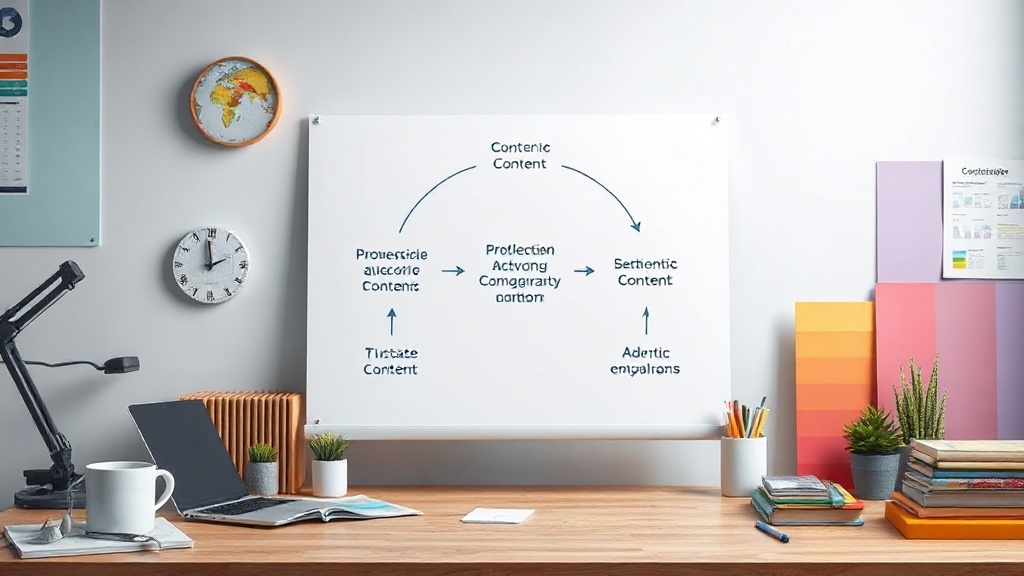
To achieve production-ready content, the paradigm must shift from a single, monolithic prompt to an agentic loop. This approach breaks down the complex task of content creation into discrete, specialized roles. Imagine a team of AI agents: one acts as a meticulous researcher, another as a fluent writer, and a third as a ruthless critic. Each agent performs a specific function, and their outputs are chained together, with each step validating the previous one.
The Architecture of an Agentic Content Loop
An agentic workflow treats content generation not as a linear process but as a state machine. Instead of a single, large API call, the process involves chaining multiple smaller, specialized calls. Each call is designed for a specific sub-task, and critically, each agent's output is reviewed or utilized by the next, creating a self-correcting mechanism. This is akin to a human editorial process, but executed by specialized AI agents.
1. The Researcher Agent
The first agent's role is to gather and verify information. Given a topic, the researcher agent scours reliable sources (e.g., academic papers, official documentation, reputable news sites) to collect relevant facts, data points, and context. It does not just collect; it attempts to synthesize this information, identify corroborating evidence, and flag potential contradictions or areas needing further investigation. This agent acts as the factual bedrock for the entire process.
2. The Writer Agent
Once the researcher has compiled verified information, the writer agent takes over. Its task is to transform the raw, factual data into coherent, engaging prose. This agent is specialized in style, tone, and structure. It can be instructed to write in a specific voice (e.g., technical, journalistic, marketing), adhere to a particular format (e.g., listicle, how-to guide, opinion piece), and ensure smooth transitions between ideas. The writer agent focuses on the craft of communication, using the researcher's output as its sole source of truth.
3. The Critic Agent
The final, and perhaps most crucial, agent in this loop is the critic. This agent's job is to rigorously evaluate the output of the writer agent. It checks for factual accuracy against the researcher's findings, identifies logical fallacies, points out awkward phrasing, checks for adherence to style guides, and flags any remaining hallucinations or unsubstantiated claims. The critic agent can also be tasked with suggesting specific improvements or revisions. This feedback loop can then send the output back to the writer agent (or even the researcher if factual gaps are found) for refinement, creating iterative improvements until a high standard is met.
Building the Agentic Loop
Implementing an agentic content loop requires a framework that can manage these distinct agents and their interactions. Tools like LangChain or LlamaIndex provide the foundational components for orchestrating such workflows. Developers can define custom agents with specific system prompts and tools, allowing them to interact with external APIs, databases, or search engines. The key is to abstract each step into a callable function or agent, enabling them to be chained sequentially or conditionally.
For instance, a technical blog post generation workflow might look like this: A user provides a topic. An 'information gathering' agent queries a vector database of previously published articles and then performs targeted web searches. The 'content generation' agent takes these verified snippets and drafts an outline and then sections. A 'fact-checking' agent cross-references claims against the initial search results and flags discrepancies. If errors are found, the draft is sent back to the 'content generation' agent with specific revision instructions. This cycle repeats until the 'fact-checking' agent is satisfied.

Beyond Simple Prompts: The Advantages
The benefits of this agentic approach are substantial. Firstly, it dramatically improves content quality and reliability. By segmenting the task and introducing verification steps, the likelihood of factual errors and hallucinations is significantly reduced. This means less manual editing and higher confidence in the output. Secondly, it enhances scalability. Once the loop is established, it can generate content on demand with consistent quality, freeing up human creators to focus on higher-level strategy, complex ideation, or final polishing.
Furthermore, agentic loops are more adaptable. Each agent can be swapped out or upgraded independently. If a better research model becomes available, only the researcher agent needs modification. This modularity allows for continuous improvement and optimization of the content pipeline. The process becomes less about crafting the perfect single prompt and more about designing a robust, self-correcting system.
The Future of AI-Assisted Content
The shift from prompt engineering to agentic loop design represents a maturation of AI content generation. It moves from a generative art experiment to a production-ready tool for knowledge work. For developers, founders, and creators, understanding and implementing these workflows is becoming essential. It's not just about faster drafting; it's about building systems that can reliably produce high-quality, verifiable content at scale. The prompt is a starting point, but the agentic loop is the engine that drives real-world application.
What remains to be fully explored is the optimal configuration of these agentic loops for vastly different content types – from creative fiction to highly specialized legal documents. The current frameworks provide the building blocks, but the nuanced interplay of agents for domain-specific accuracy and style requires further research and practical experimentation.