
The Problem: AI's Brittle Logic
Artificial intelligence, particularly deep learning, excels at pattern recognition but often operates as a black box. Its decision-making processes can be opaque, and its outputs are notoriously prone to subtle, hard-to-diagnose errors. These mistakes can range from nonsensical outputs to critical failures in safety-sensitive applications like autonomous driving or medical diagnosis. Traditional debugging methods, which rely on testing with vast datasets, can only catch errors that are present in the test data. They are ill-equipped to prevent errors stemming from logical flaws in the model's architecture or training process itself.
The core challenge lies in the probabilistic nature of current AI models. They learn to approximate functions, and this approximation inherently introduces uncertainty. While effective for many tasks, this uncertainty becomes a significant liability when absolute correctness or predictable behavior is required. Bend aims to address this fundamental limitation by introducing a paradigm shift: moving from probabilistic inference to verifiable computation for AI.
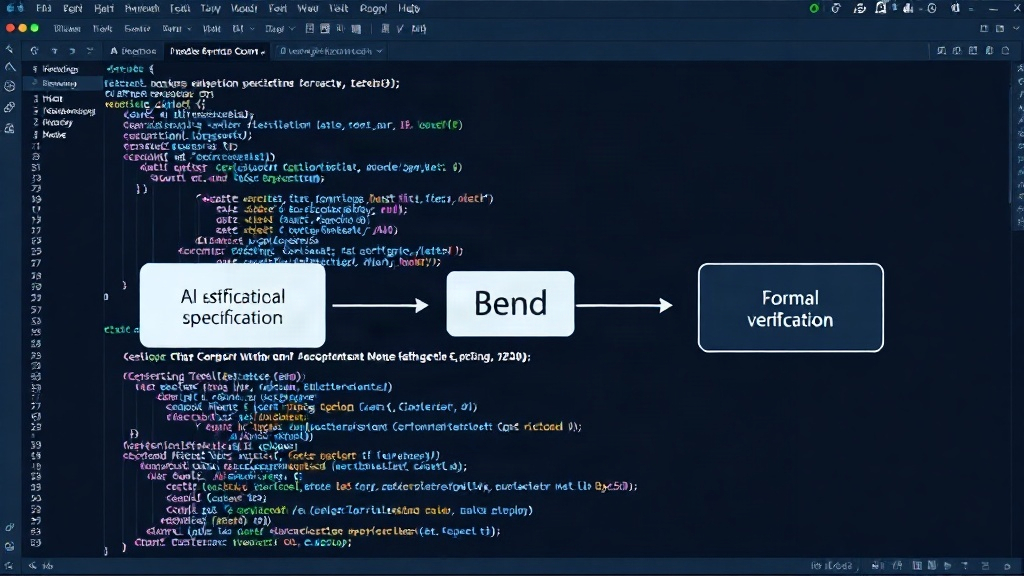
Introducing Bend: Verifiable AI from the Ground Up
Bend is a novel programming language designed from the outset to integrate formal verification techniques directly into the AI development lifecycle. Unlike existing languages where verification is often an afterthought, a separate toolchain, or limited to specific components, Bend makes it a first-class citizen. The language's syntax and semantics are engineered to allow developers to express AI computations in a way that can be mathematically proven correct.
At its heart, Bend leverages the power of proofs. Developers can write specifications or assertions about their AI models that the Bend compiler can then rigorously check. This isn't about testing; it's about mathematical deduction. If Bend can prove that a certain property holds for a model written in its language, then that property is guaranteed to be true, irrespective of input data or specific execution paths within the bounds of the proof.
This approach is analogous to how formal verification is used in critical software domains like aerospace or finance, where even a single bug can have catastrophic consequences. Bend applies these rigorous techniques to the unique challenges of AI, where the complexity and scale of models often make traditional verification intractable.
GPU Acceleration for Proofs
A significant hurdle for formal verification in complex systems, especially AI, is computational cost. Generating and checking proofs can be immensely resource-intensive. Bend tackles this by being designed to run on GPUs. Modern GPUs, with their massively parallel processing capabilities, are ideally suited for the types of computations involved in proof search and verification algorithms.
By offloading proof generation and checking to GPUs, Bend aims to make formal verification practical for AI workloads that were previously too large or too slow to verify. This means developers can iterate on AI models, incorporating formal guarantees at every step, without experiencing prohibitive delays. The language is engineered to efficiently map proof-related computations onto GPU architectures, allowing for a significant speedup compared to CPU-bound verification methods.
This GPU-first design is a critical differentiator. It signifies a commitment to performance, recognizing that AI development thrives on rapid iteration. By merging the logical rigor of formal proofs with the raw computational power of GPUs, Bend offers a path to building AI systems that are not only intelligent but also demonstrably reliable.
How it Works: From Code to Guaranteed Correctness
Bend's approach involves several key components. First, the language itself provides constructs for defining AI models that are amenable to verification. This might include specific types, functions, and ways of structuring computations that map well to both AI algorithms and proof systems.
Second, Bend incorporates a powerful theorem prover, optimized for GPU execution. When a developer writes a model and associated specifications (e.g., "this classifier will never output a positive result for inputs below threshold X," or "the error rate of this predictive model will not exceed Y%"), the Bend toolchain attempts to construct a mathematical proof demonstrating that these specifications hold true for the given model. If the prover succeeds, the model is certified correct with respect to those specifications. If it fails, it provides counterexamples or points to the specific logical flaw, guiding the developer toward a fix.
Consider a medical imaging AI designed to detect tumors. A developer could use Bend to specify that the AI must never flag a healthy tissue sample as cancerous (a false positive). Bend would then attempt to prove this property. If it can't, it might reveal that a particular pattern in the input data, under specific conditions, leads the AI to an incorrect conclusion. This is far more powerful than simply observing a false positive during testing; it's about preventing it at the source.
The surprising detail here is not just the integration of proofs, but the explicit design for GPU acceleration of the proof process itself. This suggests a future where the most complex AI models are not only trained on GPUs but also verified on them, blurring the lines between AI development and formal methods engineering.
What This Means for the Future of AI
Bend represents a potential paradigm shift for AI development, particularly in domains where safety, reliability, and trustworthiness are paramount. For industries like autonomous vehicles, healthcare, finance, and critical infrastructure, the ability to formally guarantee the behavior of AI systems could unlock new levels of adoption and trust.
Instead of relying solely on extensive testing and hoping for the best, developers can build AI with inherent guarantees. This could lead to AI systems that are more robust, predictable, and easier to audit. The opaque nature of many current AI models, often cited as a major barrier to deployment in regulated industries, could be significantly reduced.
However, the path forward is not without challenges. Formal verification is notoriously difficult to apply to the full spectrum of complex deep learning models. The expressiveness of AI models often pushes the boundaries of what current theorem provers can handle. Furthermore, adopting a new language and a fundamentally different development methodology requires significant investment in developer training and workflow integration.
What nobody has addressed yet is the long-term impact on the AI research landscape. Will Bend-like languages become the standard for new AI research, or will they remain niche tools for safety-critical applications? The success of Bend will likely hinge on its ability to balance rigorous verification with the flexibility and performance that have made current AI frameworks so powerful.