The Challenge of Benchmarking NPUs at Scale
Evaluating the performance of Neural Processing Units (NPUs) is a complex undertaking that extends far beyond simple benchmark execution. As NPUs become increasingly specialized and integrated into diverse hardware configurations, the need for comprehensive and scalable benchmarking methodologies becomes paramount. A critical aspect of this process involves recompiling and re-profiling the entire model zoo across a broad sweep of hardware configurations. This isn't a task for the faint of heart; it requires significant engineering effort and a deep understanding of both the NPU architecture and the machine learning models being tested.
The sheer diversity of neural network architectures, coupled with the varied hardware implementations of NPUs—from dedicated AI accelerators in data centers to embedded processors in edge devices—creates a sprawling test matrix. Each combination of model and hardware can yield vastly different performance characteristics. Simply running pre-compiled models on different hardware is insufficient. To truly understand an NPU's capabilities and limitations, its performance must be assessed with models optimized specifically for its architecture. This means the entire model zoo, encompassing a wide array of popular and emerging neural network architectures, must be recompiled and fine-tuned for each target hardware configuration.
Recompilation: The Necessary Evil for Accurate Benchmarking
The core of large-scale NPU benchmarking lies in the necessity of recompiling models. Neural network models are typically developed using high-level frameworks like TensorFlow, PyTorch, or ONNX. These frameworks abstract away many hardware-specific details. However, to harness the full potential of an NPU, models often need to be translated into a lower-level representation that can be directly executed by the NPU's specialized instruction set and memory hierarchy. This translation process, often referred to as compilation or optimization for a specific target, is crucial.
Consider a Convolutional Neural Network (CNN) designed for image recognition. When compiled for a general-purpose CPU, it might leverage SIMD instructions. When compiled for a GPU, it would be parallelized across thousands of cores. For an NPU, the compilation process might involve mapping convolutional layers to specialized matrix multiplication units, optimizing data movement between on-chip memory and external DRAM, and leveraging specific quantization schemes (e.g., INT8, FP16) that the NPU supports efficiently. Without this recompilation, the benchmark results would reflect the efficiency of the general-purpose compiler or runtime, not the NPU's native performance. This is akin to trying to race a Formula 1 car with street tires; you won't see its true potential.
Profiling and Optimization: Uncovering Performance Bottlenecks
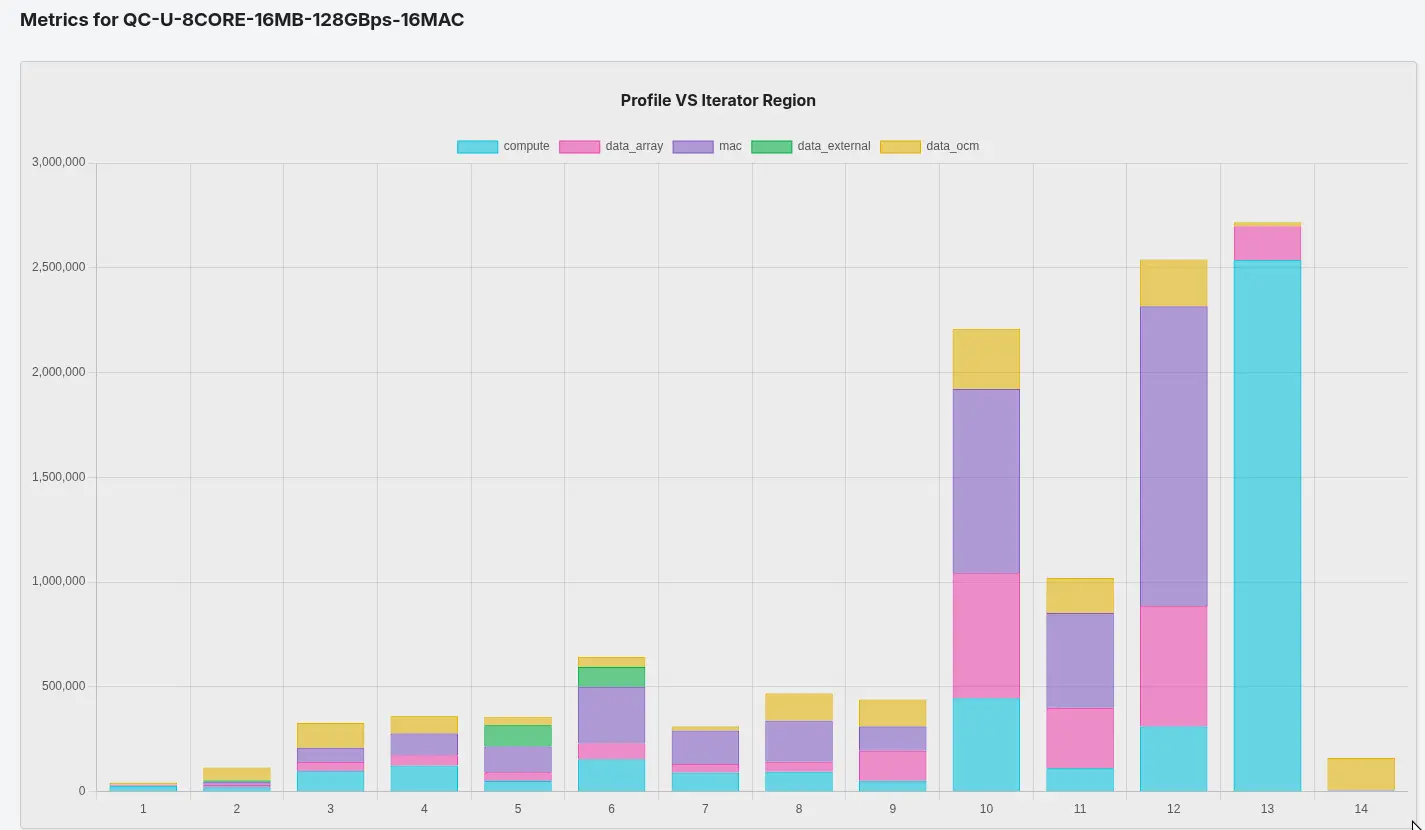
Once models are recompiled, the next critical step is profiling. This involves instrumenting the execution of the model on the target NPU to gather detailed performance metrics. Profiling reveals where the model spends its time, identifying computational bottlenecks, memory access patterns, and potential inefficiencies in the NPU's operation. Are certain layers taking disproportionately long? Is the NPU waiting for data from memory? Is the power consumption excessive during specific operations?
This profiling data is invaluable for optimization. Engineers can use it to refine the compilation process, adjust model parameters (like quantization levels), or even suggest architectural modifications to the NPU itself. For instance, if profiling reveals that the NPU's on-chip memory bandwidth is a recurring bottleneck for a particular class of models, it might prompt a redesign of the memory subsystem or a modification to the compilation strategy to better utilize available cache. This iterative cycle of recompilation, execution, and profiling is the engine that drives accurate NPU performance assessment at scale.
Hardware Configurations and the Scale of the Problem
The 'at scale' aspect of NPU benchmarking introduces another layer of complexity: the vast number of hardware configurations. NPUs are not monolithic. They appear in various forms: integrated into SoCs for mobile and edge devices, as discrete accelerators in servers, and within specialized AI chips. Each configuration may have different clock speeds, memory capacities and bandwidths, core counts, and interconnects.
Benchmarking across these diverse configurations means not just testing on one NPU, but potentially dozens or hundreds of variations. This necessitates a highly automated and robust testing infrastructure. Imagine managing the recompilation and execution of thousands of model variants across hundreds of hardware targets. This requires sophisticated test orchestration tools, version control for models and compilers, and a strategy for managing the hardware itself, whether through a fleet of physical devices or a cloud-based testing environment. The goal is to create a representative view of NPU performance that spans the landscape of its deployment, from high-performance data centers to resource-constrained edge environments.
The Unanswered Question: Standardization and Interoperability
While the process of recompiling and profiling is understood to be essential for accurate NPU benchmarking, what remains largely unaddressed is the development of standardized methodologies and interchange formats that simplify this Herculean task. Currently, each NPU vendor often provides its own proprietary toolchain for compilation and optimization. This fragmentation makes it incredibly difficult for developers and researchers to perform fair, cross-vendor comparisons. The effort required to adapt a model and its benchmarking suite from one NPU to another can be prohibitive, effectively locking users into specific vendor ecosystems. The future of AI hardware benchmarking hinges on finding a path toward greater standardization, enabling developers to truly understand and leverage the best NPU for their specific needs without being burdened by excessive recompilation overhead.
Implications for Developers and Researchers
For developers, understanding the nuances of NPU benchmarking means acknowledging that off-the-shelf performance numbers can be misleading. True performance gains come from models optimized for the target hardware. This often requires engaging with NPU vendor toolchains and investing in the recompilation process. For researchers, the challenge lies in developing more generalized optimization techniques and potentially contributing to standardization efforts that can abstract away some of this low-level complexity. The ongoing evolution of NPUs demands a continuous refinement of benchmarking practices, ensuring that performance claims are substantiated by rigorous, hardware-specific evaluation.