Introducing BaseRT: Optimized LLM Inference for Apple Silicon
A new inference engine named BaseRT has emerged, promising substantial performance improvements for running large language models (LLMs) on Apple's M-series chips. Early benchmarks indicate BaseRT significantly outperforms existing solutions like llama.cpp and MLX, positioning it as a compelling option for developers and enthusiasts looking to maximize LLM performance on macOS and iOS devices.
The core innovation behind BaseRT lies in its deep optimization for Apple's Metal Performance Shaders (MPS) framework. Unlike general-purpose inference engines that might offer broad compatibility but lack specific hardware tuning, BaseRT appears to have been built from the ground up with the unique architecture of Apple Silicon in mind. This includes leveraging the unified memory architecture, the Neural Engine, and the GPU cores of M-series processors to their fullest potential.
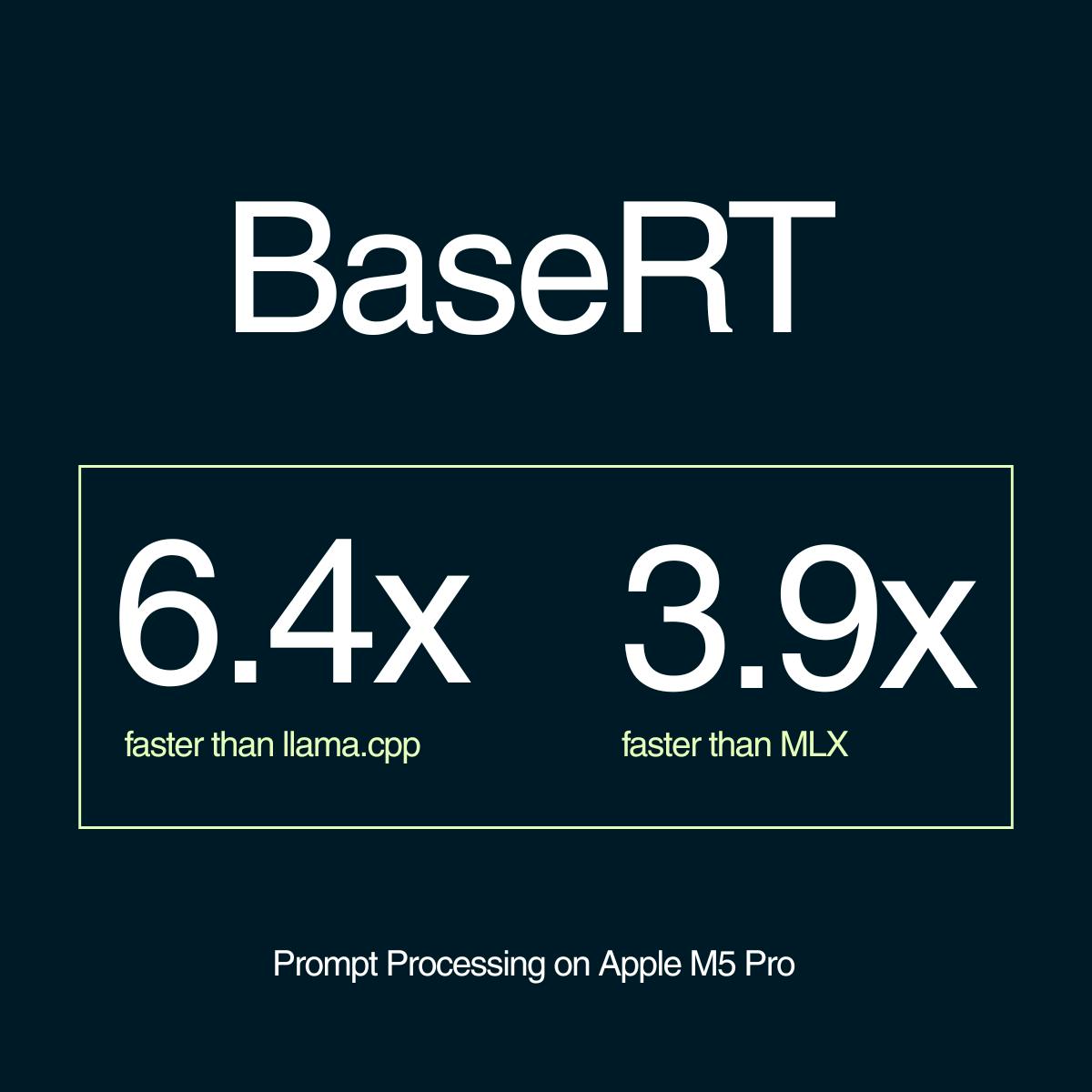
The reported performance metrics are striking. BaseRT claims to be 6.4 times faster than llama.cpp and 3.9 times faster than MLX. These figures suggest a fundamental difference in how BaseRT handles model execution. llama.cpp, while highly optimized for CPU and Metal, is a more general-purpose C++ library. MLX, developed by Apple itself, is designed to be a tensor library for end-to-end deep learning on Apple hardware, but BaseRT's claims suggest it has found a way to extract even more performance for inference tasks.
Consider the process of running an LLM as akin to a chef preparing a complex meal. llama.cpp might be a highly skilled general chef who can cook anything, adapting their technique to various kitchens. MLX is like a chef who has been trained exclusively in a state-of-the-art kitchen designed by the same architects as the restaurant chain, knowing all its quirks. BaseRT, on the other hand, is like a chef who has spent months meticulously studying the specific layout, tools, and unique appliances of *your* particular kitchen, optimizing every single movement and ingredient choice for that exact environment. This specialized focus allows for a level of efficiency that a more general approach cannot match.
Technical Underpinnings and Potential Architecture
While the exact technical details of BaseRT's implementation are not yet fully disclosed, its aggressive optimization for Apple Silicon suggests a few key areas of focus. Firstly, it likely employs highly efficient kernel implementations tailored for the specific GPU architectures found in M1, M2, and M3 (and presumably future M4/M5) chips. This could involve fine-tuning matrix multiplication, attention mechanisms, and other core LLM operations to minimize data movement and maximize parallel processing within the GPU cores.
Secondly, BaseRT probably makes extensive use of Apple's unified memory architecture. This allows the CPU and GPU to access the same memory pool, reducing the overhead associated with data transfers between separate CPU RAM and GPU VRAM. For LLMs, which involve loading large model weights into memory, efficient memory management is critical for both speed and capacity. BaseRT's ability to maintain such a significant performance lead implies it has mastered this aspect.
The role of Apple's Neural Engine (ANE) is also a crucial consideration. While GPUs are powerful for parallel computation, the ANE is specifically designed for accelerating machine learning tasks. A highly optimized inference engine would likely have strategies for intelligently offloading suitable operations to the ANE, further boosting efficiency, especially for tasks that map well to its specialized hardware.
The comparison to MLX is particularly interesting. MLX is designed to be a unified framework for machine learning on Apple hardware, aiming for ease of use and performance. If BaseRT is indeed significantly faster, it suggests that a dedicated inference engine, potentially with a narrower focus than a full ML framework, can achieve superior results for the specific task of running pre-trained models. This could imply that MLX, while versatile, might have layers of abstraction or a broader feature set that introduces overhead BaseRT avoids.
Implications for Developers and the Apple Ecosystem
The arrival of BaseRT has several important implications for the developer community working with LLMs on Apple platforms.
For developers building applications that embed LLMs, such as AI-powered writing assistants, code completion tools, or on-device chatbots, BaseRT could unlock new possibilities. Faster inference means more responsive user experiences, the ability to run larger and more capable models locally, and reduced battery consumption. If BaseRT can truly deliver on its performance claims, it might become the de facto standard for LLM inference on Apple hardware, pushing competitors to innovate further.
If you're a developer currently using llama.cpp or MLX for your Mac or iOS applications, you should absolutely benchmark BaseRT against your current setup. The potential gains are too significant to ignore, especially if your application's performance is bottlenecked by LLM inference speed. The question becomes whether BaseRT offers a simple drop-in replacement or requires significant code changes to integrate. Early adopters will be watching for detailed integration guides and API documentation.

Furthermore, BaseRT's success could spur further investment and development in specialized LLM inference engines for specific hardware architectures. While cloud-based inference remains dominant for massive models, the trend towards on-device AI processing is strong, driven by privacy concerns, lower latency requirements, and cost-effectiveness. Optimized local inference engines are crucial to this trend.
The broader Apple ecosystem stands to benefit. As more sophisticated AI capabilities become feasible on-device, it reinforces Apple's strategy of integrating powerful AI features deeply into its operating systems and hardware. This could lead to a richer set of AI-powered applications and experiences across iPhones, iPads, and Macs, differentiating Apple's platform from competitors.
What's Next for BaseRT?
The initial announcement and benchmark figures are promising, but the real test will be BaseRT's adoption and real-world performance across a wider range of models and tasks. Key questions remain:
- What is the exact range of LLMs BaseRT supports and optimizes for?
- How does its performance scale with model size and complexity?
- What is the licensing model and availability of the engine?
- How does its memory footprint compare to existing solutions?
- What level of developer support and documentation can users expect?
The surprising detail here is not just the claimed speedup, but the magnitude of it. Achieving over 6x performance improvement suggests a fundamental architectural advantage or a very specific set of optimizations that competitors have overlooked. If BaseRT can maintain these advantages and provide a robust, developer-friendly package, it could significantly reshape the landscape of local LLM inference on Apple hardware.