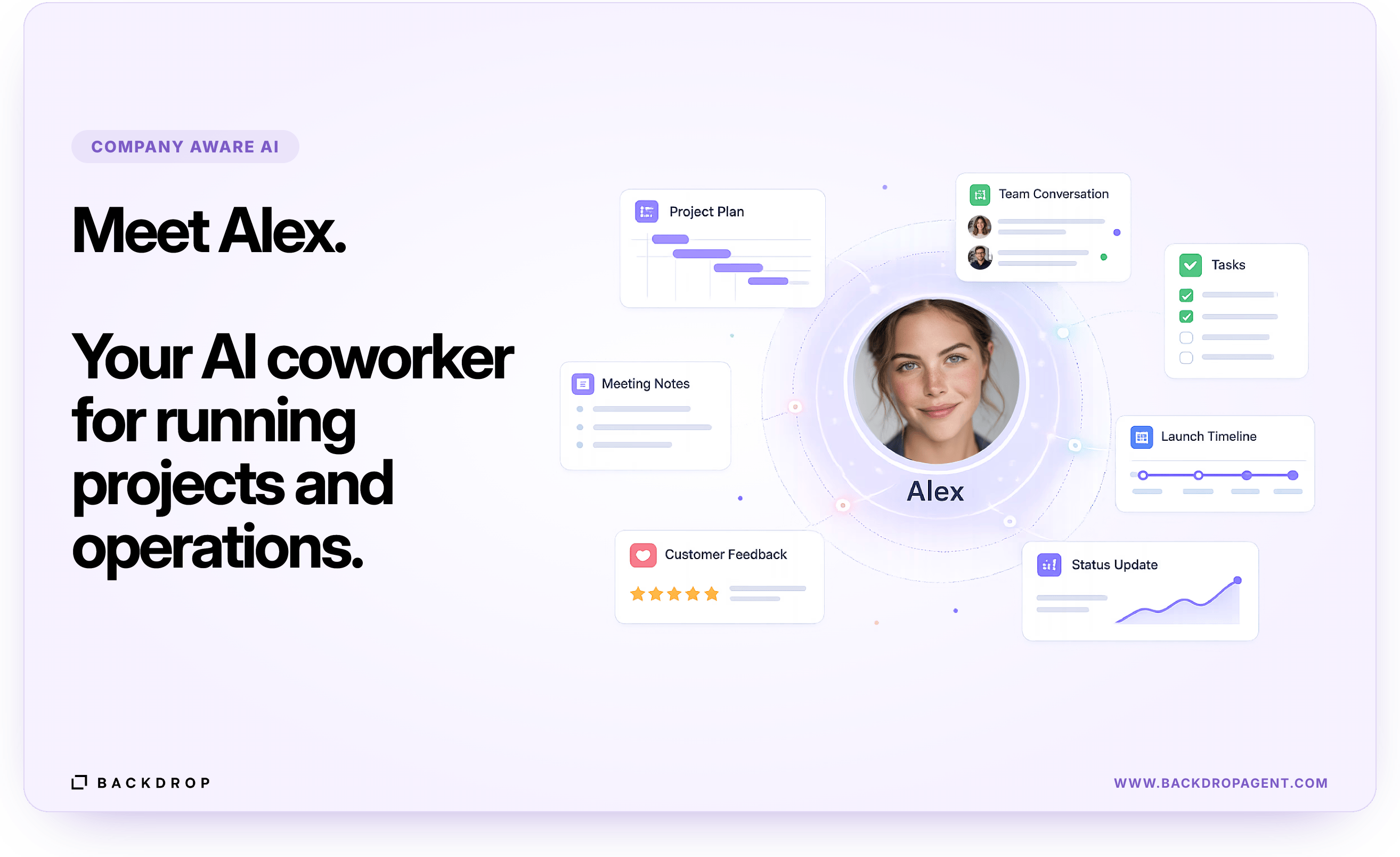
Introducing Backdrop: Your AI Project Management Team
The landscape of work is rapidly evolving, and with it, the tools we use to manage our professional lives. Backdrop emerges as a new entrant, promising to transform project management and operational efficiency through artificial intelligence. The platform positions itself as a provider of "AI Coworkers" designed to take on the burden of running projects and managing day-to-day operations. This isn't just about task automation; it's about creating a virtual team that can proactively handle complex workflows, freeing up human professionals to focus on strategic thinking and high-level decision-making.
At its core, Backdrop aims to address the persistent challenges of project delays, resource misallocation, and the sheer administrative overhead that often bogs down teams. By leveraging AI, the platform seeks to offer a more dynamic and responsive approach to project execution. Imagine a system that not only tracks deadlines but also anticipates potential bottlenecks, reallocates resources based on real-time progress, and even communicates status updates to stakeholders without human intervention. This vision of AI coworkers is less about replacing human interaction and more about augmenting human capabilities, acting as an intelligent layer that optimizes the mechanics of how work gets done.
How Backdrop's AI Coworkers Function
The concept of "AI Coworkers" suggests a sophisticated level of integration and autonomy. Unlike traditional project management software that relies on human input to update statuses, assign tasks, and track progress, Backdrop's AI agents are designed to operate with a degree of independence. This means they can potentially:
- Initiate and manage tasks: Based on project goals and predefined workflows, the AI can break down larger objectives into actionable steps and assign them.
- Monitor progress and identify risks: The AI continuously analyzes project data, looking for deviations from the plan, potential delays, or resource conflicts.
- Automate communication: Status reports, reminders, and necessary escalations can be automatically generated and sent to relevant team members or stakeholders.
- Optimize resource allocation: By understanding team member availability and workload, the AI can suggest or implement adjustments to ensure optimal efficiency.
- Learn and adapt: Over time, the AI is expected to learn from past projects and team performance to improve its predictions and management strategies.
This level of automation is particularly valuable in complex, multi-stage projects where numerous dependencies and variables are at play. For founders and team leads, this translates to reduced cognitive load and more reliable project outcomes. The system is envisioned as a digital partner that understands the nuances of project management, akin to a seasoned project manager who has seen countless projects through to completion.
The Broader Context: AI in Operations
Backdrop's emergence fits within a larger, accelerating trend of AI integration into business operations. We've seen AI move from specialized analytical tools to embedded assistants within existing software. Platforms like Microsoft Copilot and Google's Duet AI are demonstrating the power of AI to enhance productivity within common applications. Backdrop takes this a step further by focusing specifically on the operational and project management layer, aiming to be the central nervous system for how projects are executed. This is not merely about generating text or summarizing data; it's about AI taking on responsibility for critical business processes. The potential impact is significant: reduced operational costs, faster project completion times, and a workforce that can operate at a higher strategic level.
The challenge for Backdrop, and for the field of AI in operations, lies in achieving true autonomy and reliability. AI models can sometimes hallucinate or misinterpret complex human instructions. For an AI coworker to be effective, it must possess a deep understanding of context, possess robust error-handling capabilities, and maintain a high degree of trustworthiness. The success of Backdrop will hinge on its ability to navigate these complexities and deliver on the promise of seamless, intelligent project management. If successful, it could redefine what it means to manage a team and its projects in the digital age, moving beyond static dashboards to dynamic, AI-driven orchestration.
What's Next for AI-Powered Project Management?
The introduction of AI coworkers by Backdrop poses several interesting questions for the future of work. If AI can reliably manage projects, what does that mean for the roles of traditional project managers? Will human roles shift more towards strategic oversight, exception handling, and complex stakeholder negotiation, leaving the day-to-day execution to AI? Furthermore, as AI coworker platforms become more sophisticated, how will they integrate with existing enterprise systems and workflows? The ability of these AI agents to communicate and collaborate not only with human teams but also with other AI systems will be crucial for unlocking their full potential. The journey from AI assistants that help with tasks to AI coworkers that run operations is a significant leap, and Backdrop is positioning itself at the forefront of this transition.