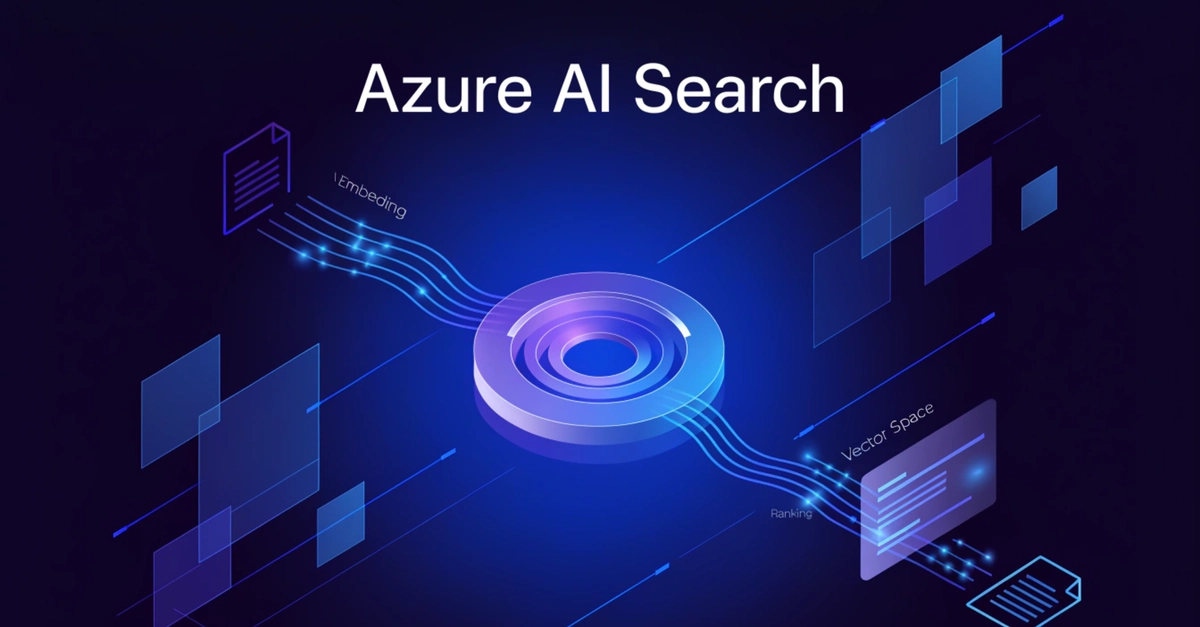
Azure AI Search: Evolving Beyond Basic Vector Search
The standard tutorial for building a Retrieval Augmented Generation (RAG) pipeline is deceptively simple: split documents, generate embeddings, store in a vector database, and query for nearest neighbors to feed an LLM. This pattern, while functional for basic demonstrations, often collapses under the weight of real-world production demands. The core issue lies in the limitations of pure vector search. When a user queries for a specific technical term like "SNAT error in network configuration," a pure vector search might return documents semantically related to general networking or NAT, but miss the exact document containing the crucial term "SNAT" multiple times. Keyword search, in contrast, would pinpoint this immediately. Azure AI Search, by 2026, has evolved significantly to address these shortcomings, offering a more sophisticated hybrid approach that bridges the gap between semantic understanding and precise keyword recall.
The service, rebranded and enhanced from its earlier iteration as Azure Search, now provides a powerful platform for building resilient RAG systems. Its strength lies in its ability to combine vector search with traditional full-text search capabilities, ensuring that both the semantic nuances and the exact lexical matches are considered. This hybrid indexing and querying mechanism is not merely an add-on; it's fundamental to how Azure AI Search operates, making it a compelling choice for production-grade RAG applications where accuracy and relevance are paramount.
Building a Production-Ready RAG Pipeline with Azure AI Search
To construct a RAG pipeline that thrives in production using Azure AI Search, developers must move beyond the simplistic tutorial model. The process involves several key considerations, starting with data ingestion and indexing. Azure AI Search supports a wide array of data sources, including Azure Blob Storage, Azure Data Lake Storage, and SQL databases. The crucial step is configuring the index to leverage both vector and keyword search.
This is achieved by defining fields within the index that can accommodate both dense vector embeddings (for semantic search) and text content (for keyword search). For instance, a document's content could be split into chunks, with each chunk having a corresponding vector embedding and the original text. Azure AI Search allows you to create an index that stores both the text chunks and their associated vector embeddings. When a query is processed, it can be simultaneously converted into a vector for semantic matching and analyzed for keywords.
The querying mechanism in Azure AI Search is where its hybrid power truly shines. Instead of performing a purely vector-based similarity search, a production RAG pipeline leveraging Azure AI Search will execute a hybrid query. This query is designed to retrieve documents that are both semantically similar to the user's query (via vector search) and contain the specific keywords or phrases present in the query (via full-text search). The service then intelligently ranks the results based on a combination of these two search modalities. This ensures that even if the semantic match is slightly off, a document containing the exact terms the user is looking for will likely surface to the top. This is particularly important for technical documentation, error messages, or specific product names where precise keyword matching is non-negotiable.
Advanced Features for Production RAG
Beyond the core hybrid search, Azure AI Search offers several advanced features that enhance RAG pipeline robustness and performance. One such feature is semantic ranking. After an initial set of results is retrieved using the hybrid approach, semantic ranking can be applied to re-order these results based on a deeper understanding of natural language. This helps to surface the most relevant documents even when the initial query is ambiguous or complex. For example, if a user asks about "performance issues with the latest update," semantic ranking can discern the intent behind "performance issues" and "latest update" to prioritize documents discussing bugs or slowdowns introduced in recent versions, rather than general performance tuning guides.
Another critical aspect is the ability to handle diverse data types and complex document structures. Azure AI Search's indexing capabilities can parse and extract information from various formats, including PDFs, Word documents, and HTML. For RAG pipelines dealing with extensive knowledge bases, this capability is essential. Furthermore, the service supports features like custom analyzers, which allow developers to fine-tune how text is processed during indexing and querying, enabling more precise control over keyword matching and stemming. This level of customization is vital for domain-specific applications where standard text processing might not yield optimal results.
The scalability and security of Azure AI Search are also paramount for production deployments. The service is built on Azure's robust infrastructure, offering high availability and performance that can scale to handle massive datasets and high query volumes. For developers building applications that handle sensitive information, Azure AI Search provides enterprise-grade security features, including encryption at rest and in transit, role-based access control, and private endpoints, ensuring data protection and compliance.
The Future of RAG: Beyond Simple Retrieval
As LLMs become more integrated into applications, the demands on RAG systems will only increase. The trend is moving towards more sophisticated retrieval mechanisms that go beyond simple keyword and vector matching. This includes techniques like query expansion, re-ranking based on user context, and even multi-hop retrieval where the system can follow chains of related information. Azure AI Search is positioned to support these evolving requirements through its flexible architecture and continuous development.
What remains to be seen is how effectively these advanced hybrid and semantic capabilities will be integrated into higher-level orchestration frameworks. While Azure AI Search provides the powerful backend, the ease of use for developers in orchestrating complex RAG workflows, potentially involving multiple retrieval steps or conditional logic, is an area ripe for further innovation. The ability to seamlessly chain these advanced retrieval strategies within a developer-friendly SDK or framework will be key to unlocking the full potential of production RAG.
For developers building RAG pipelines today, the message is clear: rely on platforms that offer more than just basic vector search. The production environment demands a nuanced approach that combines semantic understanding with precise information retrieval. Azure AI Search, with its robust hybrid search and advanced semantic capabilities, offers a strong foundation for building intelligent applications that can reliably answer complex user queries.