The Quest for the Cheapest CUDA GPU on AWS
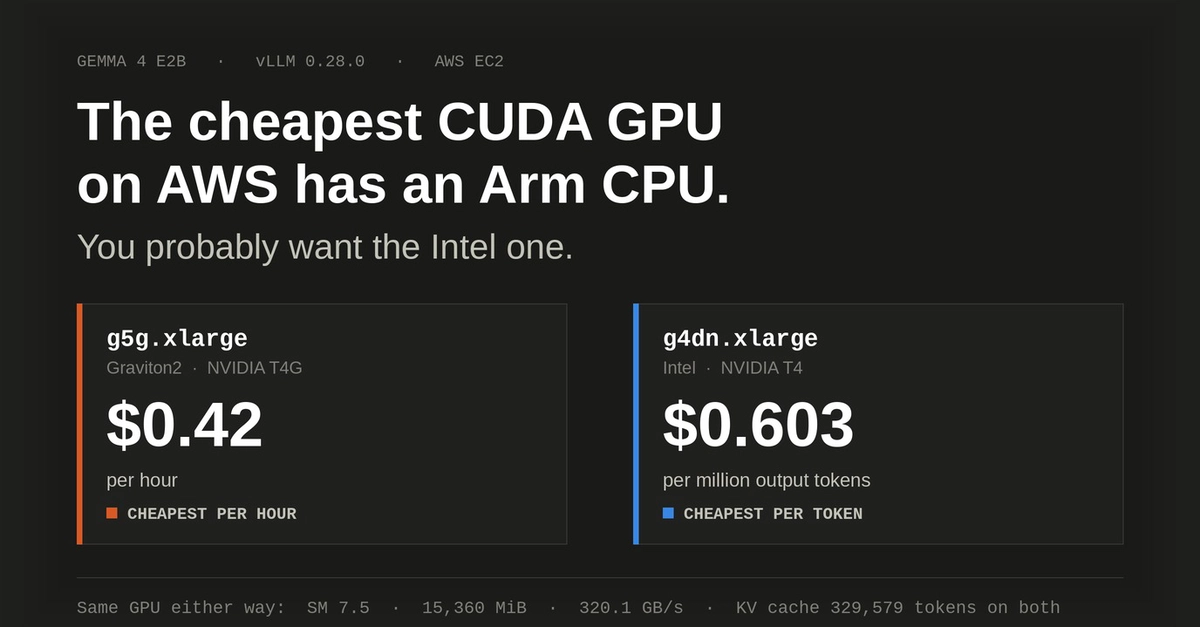
For developers and researchers seeking to leverage GPU acceleration on Amazon Web Services without breaking the bank, the question of cost-effectiveness is paramount. AWS offers several GPU instance types, but two families stand out for their aggressive pricing: the G5g and G4dn instances. Both offer access to the NVIDIA T4G Turing-generation GPU, a capable but not top-tier accelerator. The critical differentiator lies not in the silicon powering the graphics, but in the underlying host CPU architecture: the G5g instances pair the T4G with AWS's Graviton2 processor, an Arm-based chip (aarch64), while the G4dn instances use a more traditional Intel Xeon processor on an x86_64 architecture.
This distinction has significant implications for total cost of ownership, and the optimal choice depends entirely on how you measure that cost—whether by the hour or by token consumption, particularly when running large language models (LLMs) like Google's Gemma.
Benchmarking Instance Performance and Cost
To understand the practical differences, a detailed comparison was conducted using the Gemma 4 E2B model, deployed using Python MCP tools for simplified management of the vLLM-hosted deployment. The testing focused on measuring performance and cost on August 30, 2026, across both instance types in the AWS us-east-1 region. The goal was to answer a simple, yet crucial question: if you want a CUDA GPU on AWS as cheaply as possible, which instance should you rent?
The NVIDIA T4G GPU itself is identical across both the G5g and G4dn instances. It’s a versatile GPU designed for inference, machine learning, and graphics workloads, offering a balance of performance and power efficiency. However, the host CPU, which manages the operating system, data ingress/egress, and orchestrates GPU tasks, presents a variable. The Graviton2 (G5g) is AWS's custom-designed Arm Neoverse-based processor, known for its cost-effectiveness and power efficiency, particularly in I/O-intensive workloads. The Intel Xeon (G4dn) represents the established x86 architecture, often associated with broader software compatibility and mature performance characteristics for CPU-bound tasks.
Hourly Costs: The Graviton2 Advantage
When examining raw hourly pricing, the G5g instances with their Arm CPUs consistently emerge as the more economical option. AWS has optimized its Graviton instances for cost efficiency, and this translates directly to lower on-demand and reserved instance rates. For workloads that can tolerate the potential performance nuances of an Arm architecture for host tasks, the G5g offers a compelling discount.
This hourly cost advantage is particularly attractive for long-running, steady-state workloads. If your application requires a GPU to be available for extended periods, and the CPU's role is primarily to feed data to the GPU and manage the environment, the lower hourly rate of the G5g can lead to substantial savings over weeks or months of operation. This is akin to choosing a fuel-efficient car for a long road trip; the upfront cost per mile is lower, making the journey more affordable.
Token Costs: The Intel Nuance
The narrative shifts when considering costs associated with token generation, especially for LLMs. While the G5g instances boast lower hourly rates, the testing revealed that the G4dn instances with Intel CPUs can become more cost-effective when measured by the cost per token generated. This counterintuitive finding stems from how LLM inference is executed and measured. LLM performance is often bottlenecked by factors beyond raw GPU compute, including data transfer speeds between CPU and GPU, CPU processing of prompts and intermediate results, and the efficiency of the inference server software (like vLLM) in managing these interactions.
The x86 architecture of the Intel host, coupled with potentially more mature drivers and software optimizations for NVIDIA GPUs on this platform, can lead to higher throughput—more tokens generated per unit of time—even if the hourly rate is higher. If your primary metric is the speed and cost of generating output (tokens), the Intel-based G4dn instances, despite their higher hourly price, can deliver a lower cost per token. This is because the increased performance can mean the GPU (and thus the instance) is utilized more efficiently, completing tasks faster and allowing for more inference cycles within the same overall runtime, effectively amortizing the higher hourly cost over more output.
Consider it like hiring two specialists for a project: one charges less per hour but takes longer to complete tasks, while the other charges more per hour but finishes significantly faster. For a short, urgent task, the faster specialist might be cheaper overall. For a long, continuous task, the slower but cheaper specialist might win out. In the context of LLMs, the 'task' is generating tokens, and the Intel CPU's efficiency can make it the faster specialist.
The Role of the CPU in LLM Inference
The surprising detail here is not the raw performance difference, but how the CPU architecture impacts the cost-efficiency of LLM inference. Developers often focus solely on GPU specifications when selecting instances, overlooking the critical role of the host CPU. For LLMs, the CPU is far from a passive component. It handles data preprocessing, tokenization, prompt engineering, managing the inference engine, and efficiently transferring data to and from the GPU. A more performant or better-optimized CPU can directly translate to higher GPU utilization and faster overall inference times.
The Graviton2, while powerful and cost-effective for many cloud-native workloads, may present challenges in certain CPU-bound aspects of LLM inference that have been historically optimized for x86 architectures. This includes specific instruction sets, memory bandwidth characteristics, and the maturity of software stacks that interface with NVIDIA GPUs and inference frameworks like vLLM.
Conclusion: Which Instance Should You Choose?
For those prioritizing the absolute lowest hourly cost for a CUDA GPU on AWS, the G5g instances featuring the Arm-based Graviton2 host CPU are the clear winners. This choice is ideal for steady, long-duration workloads where hourly expenditure is the primary concern, and the CPU's role is less performance-critical.
However, if your objective is to minimize the cost of generating LLM outputs (measured in tokens) or if your application is sensitive to CPU performance in the data pipeline feeding the GPU, the G4dn instances with Intel CPUs often prove to be the more cost-effective and performant choice, despite their higher hourly rate. The increased throughput and efficiency they offer for LLM inference can lead to a lower overall bill when measured by results delivered, not just time spent running.
The decision, therefore, requires a clear understanding of your workload's characteristics and your primary cost metric. If you run a team that relies on GPU instances for LLM inference and are currently optimizing for hourly spend, it is worth re-evaluating your strategy to consider token-based cost-efficiency. The cheapest instance on paper is not always the cheapest in practice when running cutting-edge AI models.