
The Three Paths to LLM Inference on AWS
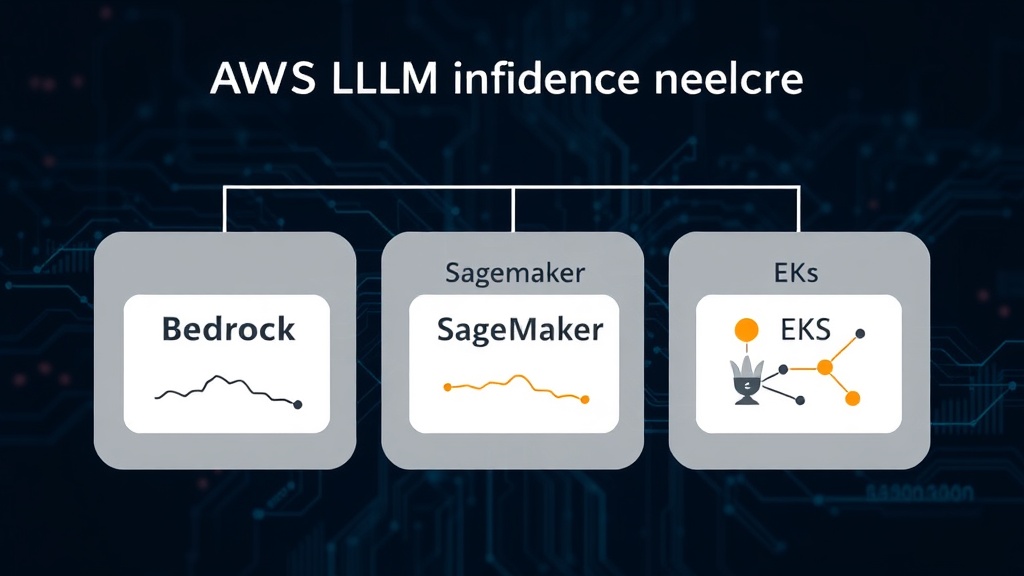
Running Large Language Models (LLMs) in production on Amazon Web Services (AWS) presents developers and businesses with a tiered set of options, each balancing managed services against operational control and cost. The choice is not merely about which service is cheapest, but a strategic decision influenced by workload volume, team expertise, and the acceptable level of operational burden. AWS offers three primary avenues: Bedrock, SageMaker Endpoints, and self-hosting on EKS.
Bedrock stands as the most abstracted, fully managed solution. Users interact with pre-trained foundation models via a simple API, paying strictly on a per-token basis for inference. This path eliminates the complexities of GPU management, cold starts, and the dreaded 3 AM alerts for Out-Of-Memory (OOM) errors on Kubernetes pods. It’s the path of least resistance, ideal for teams prioritizing rapid deployment and minimal infrastructure management, where predictable per-token pricing aligns with usage patterns.
SageMaker Endpoints represent a middle ground. Here, users deploy their own models, which can include fine-tuned versions of foundational models or entirely custom architectures, onto dedicated AWS instances. While SageMaker handles some aspects of deployment and scaling, the user is responsible for managing the underlying compute resources, which are billed by the hour, regardless of whether they are actively serving requests. This model suits scenarios where more control over the model and its environment is needed, and where the cost of idle instances is offset by the flexibility and performance tuning capabilities it offers.
Finally, Self-hosted on EKS offers the pinnacle of control. This approach involves deploying LLMs using frameworks like vLLM or Text Generation Inference (TGI) on GPU spot instances, often orchestrated with tools like Karpenter for efficient node provisioning. While this method promises the lowest cost per token at significant scale, it demands the highest operational overhead. Teams adopting this path must be prepared to manage GPU instance lifecycles, model serving frameworks, autoscaling, and all the intricacies of a self-managed Kubernetes cluster.
Understanding the Cost Crossover Points
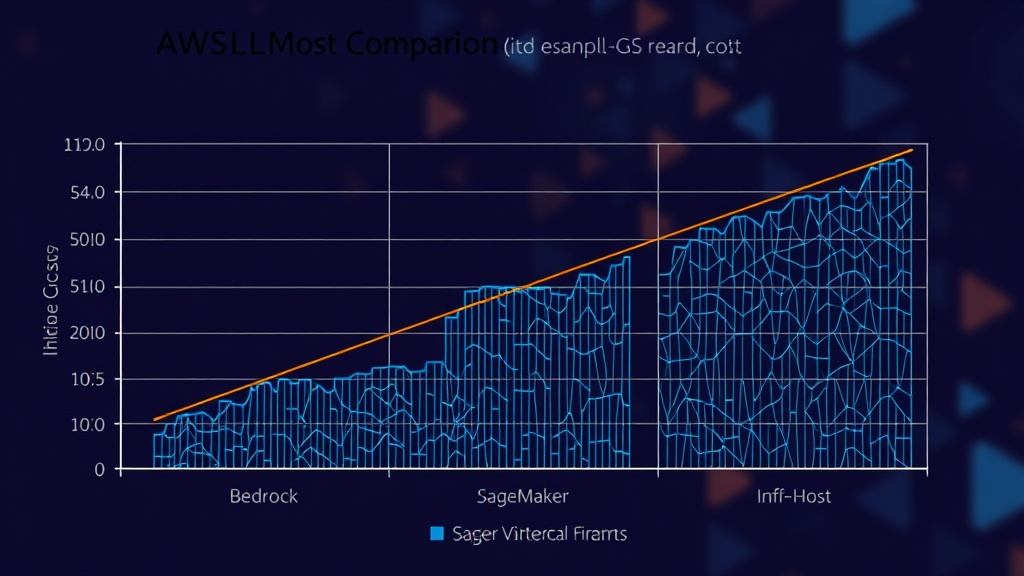
The critical factor that dictates the most economical choice often lies in the cost crossover points between these services. For many, particularly those managing client projects, a consistent framework for evaluating these trade-offs is essential. The decision hinges on predicting the total cost of ownership across different usage volumes and operational capacities.
Consider a scenario with low to moderate inference volume. Bedrock’s pay-per-token model is highly attractive. Its costs are directly proportional to usage, making it predictable and cost-effective when demand is sporadic or low. For instance, a startup experimenting with LLM features or a small application with a few thousand daily requests might find Bedrock to be the most straightforward and cheapest option. The absence of fixed hourly instance costs means there are no sunk costs during periods of low activity. The operational simplicity further reduces indirect costs associated with engineering time spent on infrastructure management.
As inference volume increases, the hourly billing of SageMaker Endpoints begins to present a competitive alternative. If an endpoint is consistently utilized for a significant portion of the day, the per-hour cost can become more economical than paying per token, especially for high-throughput applications. For example, a customer-facing chatbot handling tens of thousands of queries per hour, or a content generation service with steady demand, might find SageMaker offers a better price-performance ratio. The ability to fine-tune models and deploy them on specific instance types also allows for performance optimization that can further reduce the effective cost per inference, provided the team has the expertise to manage these optimizations.
The self-hosted EKS approach truly shines at high volumes, particularly when leveraging spot instances. When an LLM application requires millions of tokens per day, or sustained high throughput, the cost per token on a well-optimized self-hosted cluster can drop dramatically below both Bedrock and SageMaker. This is because spot instances offer significant discounts over on-demand pricing, and frameworks like vLLM are engineered for maximum GPU utilization, squeezing more inferences out of each dollar spent on compute. However, this cost advantage comes with a substantial caveat: the engineering effort required to maintain such a system. The team must be proficient in Kubernetes, GPU instance management, performance tuning of serving frameworks, and robust monitoring and alerting. The savings per token must be weighed against the salaries of the engineers required to keep the system running smoothly. A common rule of thumb is that beyond a certain threshold of daily requests (e.g., hundreds of thousands to millions), the operational cost of self-hosting becomes justifiable by the raw compute savings.
The Impact of Team Size and Expertise
Beyond raw compute costs, the size and skill set of the engineering team are paramount. For small teams or organizations with limited DevOps or MLOps expertise, Bedrock is often the only practical choice. It offloads all infrastructure management, allowing developers to focus solely on integrating LLM capabilities into their applications. The learning curve is minimal, and deployment is typically a matter of days, not weeks or months.
Medium-sized teams or those with dedicated ML engineers might find SageMaker Endpoints a viable option. They can leverage SageMaker's managed services while still having enough control to deploy custom models and tune performance. The overhead is manageable, and the team can build internal expertise in model deployment and management without needing to become full-blown Kubernetes and GPU cluster operators.
Large, experienced teams with a strong MLOps culture are the primary candidates for self-hosted EKS. These teams possess the skills to manage complex distributed systems, optimize GPU utilization, and handle the incident response required for a production environment. For them, the potential cost savings at scale, coupled with complete control over the inference stack, often outweigh the significant operational burden. The ability to integrate custom tooling, fine-tune serving parameters aggressively, and manage the entire lifecycle of their LLM deployments provides strategic advantages that justify the investment in infrastructure management.
Valuing Your Weekends: The Operational Overhead Trade-off
The decision also boils down to how much an organization values its engineers' time and well-being. Bedrock, by abstracting away infrastructure, effectively guarantees fewer late-night emergencies related to LLM inference. The responsibility for uptime and performance lies with AWS. This significantly reduces the risk of costly outages and the stress on engineering teams.
SageMaker Endpoints reduce this risk compared to self-hosting, but issues with instance health, autoscaling misconfigurations, or model deployment failures can still require intervention. While AWS manages the underlying hardware, the deployed model and its serving environment are still the user's responsibility. Engineers might still face pages related to their specific deployment, though typically less frequently than with a fully self-managed solution.
Self-hosting on EKS, especially with spot instances, is the most operationally intensive. Spot instances can be interrupted with little notice, requiring sophisticated handling mechanisms. GPU hardware failures, network issues within the cluster, or misconfigurations in the vLLM/TGI deployment can all lead to downtime. This path demands a robust on-call rotation, comprehensive monitoring, and a highly skilled team capable of rapid troubleshooting. The potential for significant cost savings must be carefully weighed against the constant vigilance required to maintain a stable and performant inference service. For many, the peace of mind and predictable availability offered by managed services like Bedrock or even SageMaker are worth the premium.
When Each Option Makes Sense
Bedrock is ideal for:
- Teams prioritizing speed to market and minimal operational overhead.
- Applications with low to moderate, or highly variable, inference volumes.
- Developers who want to focus solely on application logic and LLM integration.
- Organizations without dedicated MLOps or SRE teams.
SageMaker Endpoints are suitable for:
- Applications requiring custom or fine-tuned models.
- Steady, moderate to high inference volumes where hourly instance costs become competitive.
- Teams needing more control over the inference environment for performance tuning.
- Organizations with some MLOps capabilities to manage deployments and scaling.
Self-hosted on EKS is best for:
- Very high inference volumes where per-token cost is the primary driver.
- Organizations with mature MLOps/SRE teams capable of managing complex infrastructure.
- Use cases demanding absolute control over the inference stack, model serving framework, and hardware.
- When leveraging spot instances for maximum cost efficiency is a priority.
Ultimately, the choice is a balancing act. There is no single Developers must choose between Bedrock's API simplicity (pay-per-token), SageMaker Endpoints for custom models with hourly instance costs, or self-hosting on EKS for maximum cost efficiency at scale but with high operational overhead. Evaluate your team's MLOps maturity and your application's expected inference volume to select the most appropriate path. While none of these options inherently introduce new security vulnerabilities, the self-hosted EKS approach requires robust security practices for Kubernetes clusters, GPU instances, and model serving frameworks. Managed services like Bedrock and SageMaker abstract away much of the underlying infrastructure, reducing the attack surface managed by the user. However, secure API key management and access controls remain critical for all options. The decision impacts your burn rate and engineering resource allocation. Bedrock offers predictable, usage-based costs ideal for early-stage validation, while SageMaker balances control and cost for growing applications. Self-hosting on EKS requires significant upfront investment in MLOps talent but yields the lowest per-token cost at scale, potentially freeing up capital for other growth areas. Assess your runway and the criticality of cost optimization versus rapid iteration. For creators, Bedrock offers the easiest entry point to integrate LLM-powered features into applications without infrastructure headaches. SageMaker provides more flexibility for fine-tuning models for specific creative tasks, while self-hosting on EKS is typically reserved for large-scale creative platforms where cost-per-inference is a major concern. The choice dictates how much time you spend on creative development versus infrastructure management. The choice of inference deployment impacts data pipeline costs and efficiency. Bedrock's per-token pricing is straightforward for data processing tasks but can become expensive at high volumes. SageMaker allows for more control over data processing within inference pipelines, potentially optimizing costs. Self-hosting on EKS offers the most granular control for cost optimization of data-intensive inference tasks, but requires significant expertise to tune effectively.The "So What?" Perspective
Sources synthesised