
The Ambitious Idea
Every ambitious project begins with a seemingly simple question. For developer Amaury Mastr, it was: "Could I build an autonomous Wizarding World content engine that generates its own content, creates its own artwork, and publishes directly to X without human involvement?" The vision was elegant: AI-generated quotes, followed by AI-generated artwork, stored by AWS, and then published to X. In theory, this was a weekend project. In reality, it became an extensive, frustrating education in the labyrinthine world of API authentication, permissions, and OAuth flows.
The initial concept, while grand, underestimated the complexities of integrating disparate services, particularly when dealing with the stringent security and authentication protocols of platforms like X (formerly Twitter). The journey from a straightforward idea to a functional system was paved with error messages and a deep dive into the nuances of token management, API key security, and the various stages of OAuth authorization. This article details the initial stages of this struggle, focusing on the foundational authentication challenges encountered when trying to make AWS Lambda communicate securely and effectively with the X API.
Building the Foundational Blocks
The first hurdle was establishing a secure connection between AWS Lambda, a serverless compute service, and the X API. This isn't as simple as just plugging in credentials. X, like most modern platforms, relies on OAuth 2.0 for API authentication. This protocol involves a multi-step process to grant applications access to user data or to perform actions on their behalf, all without exposing sensitive user credentials directly.
The core of the problem lies in how Lambda functions, which are stateless and ephemeral by nature, manage the persistent requirements of OAuth. Lambda functions are invoked in response to events and execute code. For an OAuth flow, this typically involves redirecting users to a login page, capturing a callback with an authorization code, and then exchanging that code for an access token and a refresh token. Doing this within the confines of a single, short-lived Lambda execution requires careful state management and secure storage of sensitive tokens.
The OAuth Maze
The standard OAuth 2.0 flow for server-to-server applications or those without a direct user interface often involves a client credentials grant or a more complex authorization code grant flow. For publishing to X, the goal is to act on behalf of the application itself, not a specific user, which suggests a client credentials flow might be conceptually simpler. However, X's API often requires an access token that is tied to a specific user's permissions to post content.
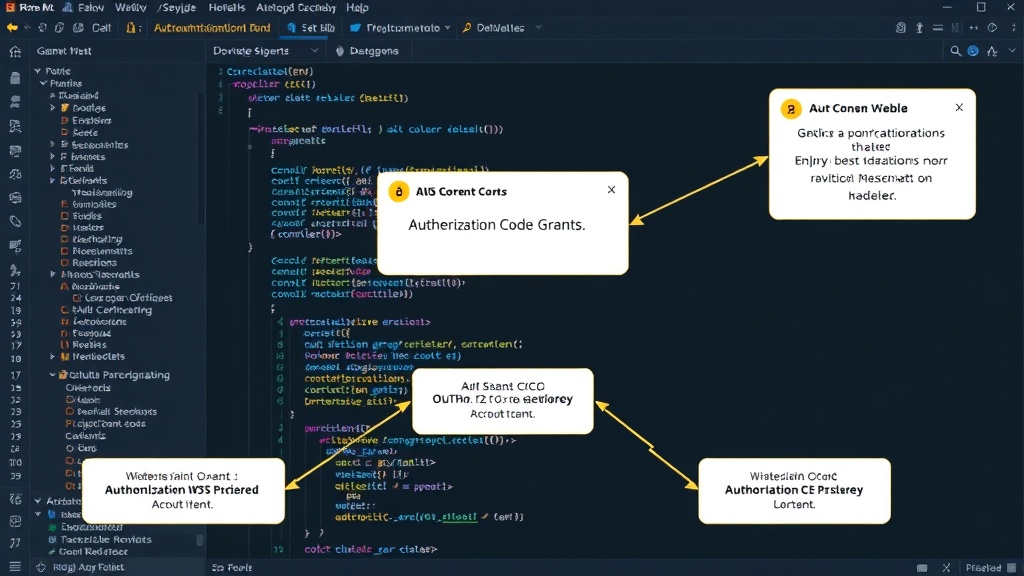
This means the application needs to go through an authorization code grant flow. The process involves:
- The Lambda function initiating a request to X's authorization server to get an authorization URL.
- A user (or an automated process simulating one) visiting this URL, logging into X, and granting the application permission.
- X redirecting the user back to a pre-registered callback URL with an authorization code.
- The Lambda function receiving this code and exchanging it with X's token endpoint for an access token and a refresh token.
The critical challenge here is that Lambda functions don't have a persistent browser context to handle redirects or user interaction. The callback URL needs to point to a publicly accessible endpoint that can receive the authorization code. This endpoint then needs to securely pass the code back to the Lambda function, which can then complete the token exchange. This often necessitates setting up an API Gateway in front of Lambda to create these public endpoints.
Furthermore, storing the obtained access and refresh tokens securely is paramount. Since Lambda functions are stateless, these tokens cannot be stored in memory between invocations. Options include using AWS Secrets Manager, AWS Systems Manager Parameter Store, or a secure database. Each of these services has its own authentication and authorization requirements, adding another layer of complexity to the setup.
Authentication Errors and Debugging Nightmares
The path was littered with authentication errors. Common issues included:
- Invalid Credentials: Incorrect API keys, consumer secrets, or bearer tokens. X's API requires specific types of tokens (e.g., Bearer tokens for v2 endpoints) and they must be generated correctly through the developer portal.
- Scope Mismatches: The requested access token did not have the necessary permissions (scopes) to perform the desired action, such as posting tweets. The application must request the correct scopes during the OAuth flow.
- Expired Tokens: Access tokens have a limited lifespan. If the Lambda function attempts to use an expired token, the request will fail. Implementing a robust refresh token mechanism is crucial.
- Callback URL Mismatches: The redirect URI registered with X's developer portal must exactly match the URI the Lambda function is configured to use as a callback. Even minor differences (e.g., HTTP vs. HTTPS, trailing slashes) can cause failures.
- Rate Limiting: Aggressively calling the API, especially during testing, can lead to rate limiting errors, which are often indistinguishable from general authentication failures without careful log analysis.
Debugging these issues required meticulous log analysis. AWS CloudWatch Logs became an indispensable tool for tracing Lambda function execution, capturing request/response payloads, and identifying the exact point of failure. Understanding the specific error messages returned by the X API was key to diagnosing the underlying problem. For instance, an error indicating insufficient permissions required revisiting the OAuth scopes requested, while an error about an invalid grant type pointed to a flaw in the token exchange process.
The Path Forward
The initial stages of building the autonomous content engine revealed that the