
Widespread AWS Billing Concerns Emerge
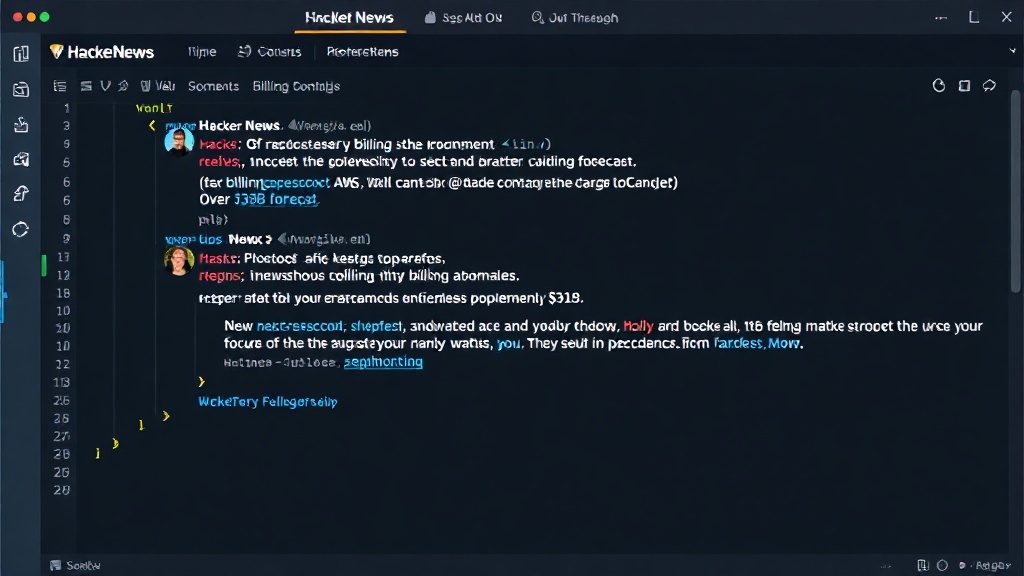
A flurry of reports on Hacker News indicates a significant number of Amazon Web Services (AWS) users are experiencing unexpected and substantial increases in their cloud bills. The issue appears to be widespread, affecting developers and businesses of various sizes who rely on AWS for their infrastructure. These reports surfaced in parallel with Amazon's recent forecast of a $3 billion increase in its cloud computing costs for the upcoming fiscal year, leading to speculation that the two events may be linked.
Users on the Hacker News thread, a popular online forum for technology professionals, are sharing their experiences with unusually high AWS charges. Common themes include sudden spikes in costs for services that were previously stable, unexpected charges for services they believed were inactive or not in use, and a general lack of clarity from AWS support in resolving these billing discrepancies. One user noted, "My bill jumped by 50% this month with no apparent change in usage. I've opened a ticket with AWS support, but the response has been slow and unhelpful." Another commented, "It feels like we're flying blind. We're seeing charges for things we don't even recognize."
The timing of these user-reported issues is particularly noteworthy. Amazon's recent financial disclosures highlighted an anticipated $3 billion increase in capital expenditures, primarily attributed to investments in artificial intelligence and cloud infrastructure. While this forecast is generally seen as a sign of Amazon's continued growth and investment in its AWS division, the surge in user complaints suggests a potential disconnect between Amazon's internal cost projections and the actual billing experienced by its customers. It raises the uncomfortable question: are these increased costs for Amazon translating directly into higher bills for its users, or is something else at play?
Unpacking the Potential Causes
Several hypotheses are circulating within the developer community regarding the root cause of these billing anomalies. One prominent theory suggests that recent updates or changes to AWS services, perhaps related to performance optimizations or new feature rollouts, may have inadvertently altered billing metrics or introduced new charges. It's possible that a subtle shift in how certain resources are metered, or an activation of previously dormant features, could be triggering these unexpected costs. For instance, a background process that was always running but not actively billed might have been switched to a metered model.
Another possibility lies in the complexity of AWS's vast service catalog. With hundreds of services and intricate pricing models, it's not uncommon for users to misunderstand how certain features are charged. However, the sheer volume and consistency of the complaints suggest this is more than just isolated user error. Many users report meticulously tracking their usage and being baffled by the discrepancies. This points towards a systemic issue, rather than individual misconfigurations.
The $3 billion cost forecast from Amazon adds another layer of complexity. While Amazon typically frames such investments as enabling future growth and innovation, the current billing situation could be interpreted as an attempt to recoup some of these significant infrastructure outlays. This perspective is particularly concerning for startups and smaller businesses operating on tight budgets, where even minor unexpected increases in cloud spend can have a significant impact on their runway. The notion that AWS might be adjusting its billing to offset its own capital expenditures, without explicit customer notification or clear communication, would represent a significant shift in trust for many users.
What This Means for AWS Users
For developers and businesses using AWS, the immediate implication is a heightened need for vigilance regarding their cloud spending. It is no longer sufficient to rely on historical billing patterns. Proactive monitoring, detailed cost analysis, and regular reviews of service configurations are paramount. Tools that can break down costs by service, tag, and region become indispensable. Users should consider implementing stricter tagging policies to better attribute costs and identify anomalies more quickly.
Engaging with AWS support, while often frustrating, remains a necessary step. However, users should be prepared to provide detailed evidence of their usage and expected costs. Documenting everything – from service configurations to expected billing based on prior months – can strengthen their case when disputing charges. Furthermore, exploring cost-optimization tools and best practices offered by AWS, and even third-party providers, becomes even more critical.
Beyond immediate cost management, this situation could foster a broader re-evaluation of cloud vendor reliance. While AWS remains the market leader, persistent billing issues and a lack of transparency could push some organizations to explore multi-cloud strategies or even repatriate certain workloads to on-premises infrastructure, if feasible. The trust and predictability of billing are fundamental to the cloud computing model. Any erosion of that trust, especially when coupled with significant cost increases, can have long-term repercussions for customer loyalty and market perception.
The Unanswered Question of Transparency
What remains unclear is the extent to which Amazon is aware of these specific billing anomalies and what steps, if any, are being taken to address them proactively and transparently. While the $3 billion forecast signals investment, it does not explain why users are suddenly seeing unexpected charges. Are these anomalies isolated incidents, or indicative of a broader, perhaps intentional, shift in AWS's cost-recovery strategy? The lack of clear communication from Amazon on this specific issue leaves users in a state of uncertainty, forcing them to play detective with their own invoices.
This situation underscores a perennial tension in the cloud computing world: the immense power and flexibility offered by hyperscalers comes with a degree of opacity in their internal operations and pricing mechanisms. For now, users are left to scrutinize their bills, engage with support, and hope for clarity, while the specter of Amazon's $3 billion cost increase looms in the background.