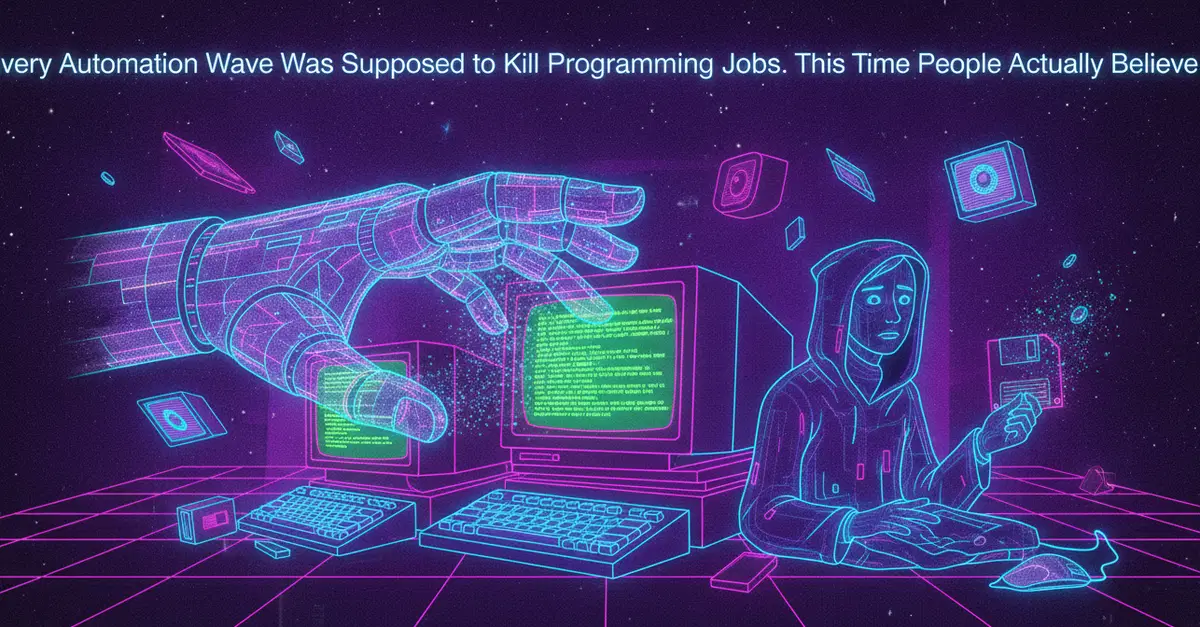
The Echo of Past Predictions
For decades, every significant technological leap in software development has been accompanied by a chorus predicting the demise of programming jobs. Routers and Integrated Development Environments (IDEs) arrived decades ago, touted as tools that would multiply development speed five to ten times. The fear then, as now, centered on the idea that fewer people would be needed to accomplish the same amount of work. Yet, history shows a different outcome. These advancements didn't eliminate jobs; they democratized development and fueled an explosion in software creation. The demand for software grew exponentially, absorbing the increased productivity and creating new roles.
The pattern is consistent: new tools make development easier, leading to an explosion of new software ideas and applications. The world's appetite for software has always outpaced our ability to create it. This has historically resulted in more jobs, not fewer, as the complexity and scope of software projects expanded. We saw this with the rise of the internet, mobile computing, and cloud infrastructure. Each wave of automation lowered the barrier to entry and expanded the possibilities, ultimately requiring more skilled individuals to build and maintain the ever-growing digital landscape.

The AI Difference: Speed and Scale
What feels different this time is the sheer speed and perceived capability of AI-driven coding tools. The pronouncements are no longer tentative; they are delivered with an air of inevitability. Phrases like "this year, obviously" replace the cautious "this year, possibly." This shift in tone reflects a growing sentiment that AI coding assistants are not just incremental improvements but fundamental game-changers. Unlike previous automation waves that automated specific tasks or stages of development, modern AI tools aim to understand and generate entire code blocks, debug complex issues, and even translate natural language into functional code. This perceived ability to automate the core act of writing code is what fuels the current apprehension.
The core of the concern lies in the potential for AI to move beyond assisting developers to replacing them. Tools like GitHub Copilot, Amazon CodeWhisperer, and numerous emerging AI code generators are demonstrating remarkable proficiency. They can suggest lines of code, complete functions, and even write entire scripts based on natural language prompts. This is not merely about making developers faster; it's about the possibility that the AI can do the bulk of the work, leaving humans to oversee or manage the output. This qualitative leap in capability is what distinguishes the current AI wave from earlier forms of automation.
Redefining Roles: Builder vs. Coder
The idea that "software engineer" will become obsolete, replaced by terms like "builder" or "product manager," highlights a fundamental shift in how software creation might be perceived. If AI can handle the intricate syntax and logic of coding, the human role could evolve towards higher-level problem-solving, system design, and product strategy. This perspective suggests that the value will lie less in the ability to write code and more in the ability to define what needs to be built, to architect complex systems, and to ensure the software meets user needs and business objectives. The focus shifts from the craft of coding to the art of creation and management.
This potential role redefinition is not entirely new. We have seen similar discussions with the rise of low-code and no-code platforms, which aimed to empower citizen developers. However, AI coding assistants offer a more potent and pervasive evolution. They integrate directly into the developer's workflow, potentially changing the nature of every coding task. The worry is that if the AI can generate functional code for most common tasks, the demand for individuals whose primary skill is writing that code will diminish. This forces a critical examination of what skills will be truly indispensable in the coming years.
The Unanswered Question: What About Legacy Systems and Niche Expertise?
While the focus is on AI's ability to generate new code, a critical question remains unaddressed: what happens to the maintenance, optimization, and evolution of the vast existing codebase that powers our world? Large-scale enterprise systems, legacy applications, and highly specialized embedded software often require deep domain knowledge and intricate understanding that AI, in its current form, may struggle to replicate. These systems are not always amenable to simple natural language prompts or automated refactoring. Furthermore, the nuanced art of debugging complex, emergent behaviors in large, distributed systems, or the creative problem-solving required for novel algorithmic challenges, may remain a human-centric domain for some time. What is the long-term strategy for ensuring these critical, complex systems continue to be managed and improved if the specialized human expertise for them becomes scarce?
The Human Element: Creativity and Oversight
Despite the growing belief in AI's coding prowess, the human element remains critical. Creativity, critical thinking, and the ability to understand context and nuance are difficult to automate. Developers do more than just write code; they interpret requirements, design solutions, anticipate edge cases, and collaborate with teams. AI can generate code, but it currently lacks the true understanding, intent, and ethical judgment that human developers bring. The ability to ask the *right* questions, to challenge assumptions, and to innovate beyond existing patterns are uniquely human skills. The future likely involves a symbiotic relationship where AI tools augment human capabilities, freeing developers to focus on more complex, strategic, and creative aspects of software engineering.
The current wave of automation, powered by AI, is undoubtedly more potent than its predecessors. The speed at which AI coding tools are advancing, coupled with the increasing belief among developers themselves that their roles are at risk, marks a significant inflection point. While history suggests that technological advancements ultimately create more opportunities, the nature of AI's impact on programming jobs warrants careful consideration and adaptation. The challenge for developers and the industry is to embrace these tools, understand their limitations, and focus on cultivating the uniquely human skills that AI cannot replicate.