The Perishable Nature of Technical Knowledge
Technical books have a shelf life that nobody prints on the cover. While a history book or even a general cookbook from 2018 might still offer valuable insights, a programming guide from the same year is likely riddled with outdated practices, deprecated packages, and syntax errors. The digital landscape shifts so rapidly that what was best practice yesterday can be a legacy pattern today.
This inherent obsolescence poses a significant challenge for authors who aim to provide enduring value. Information on frameworks, languages, and tools can become stale mere months after publication, rendering entire chapters inaccurate or, worse, misleading. The author of this series, Nasrul Hazim, recognizes this problem acutely. He has authored a collection of ebooks covering topics such as PHP, Object-Oriented Programming (OOP), SOLID principles, design patterns, Laravel conventions, testing with Pest, application architecture, and AI-assisted development. He also has two books aimed at teaching children to code. Each was accurate at the time of writing, but Hazim understands that "correct now" is a far more demanding standard.
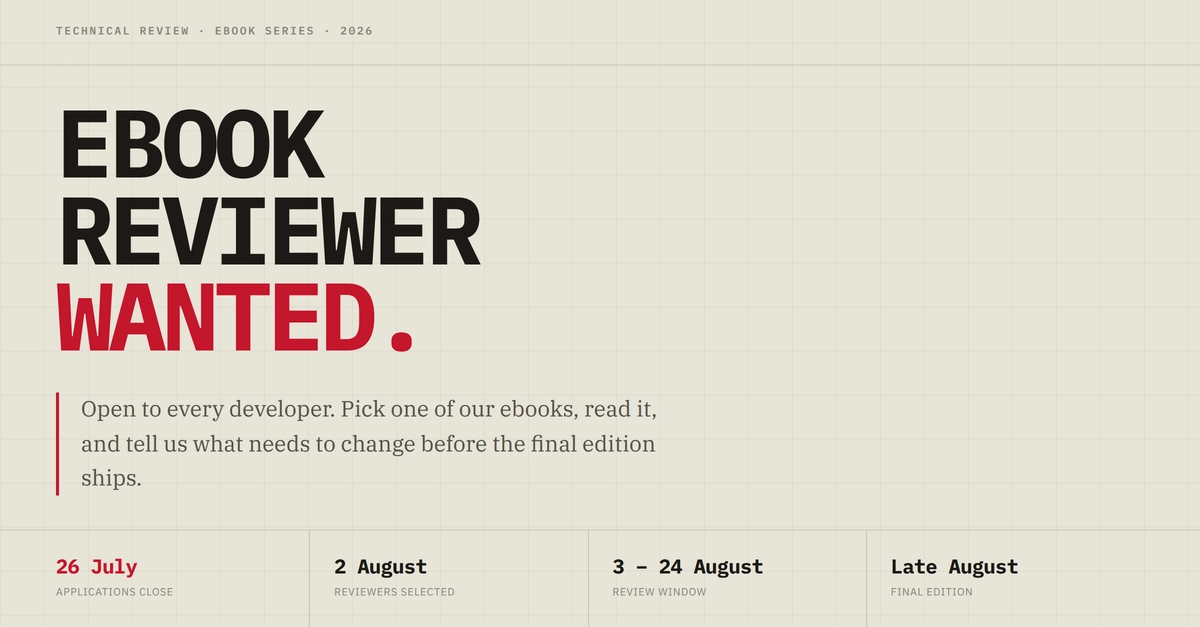
To address this, Hazim is implementing a proactive review process. He is opening his ebook series to technical reviewers before the final editions are shipped. This move is designed to identify and rectify any outdated information, ensuring readers receive content that is not just historically accurate but currently relevant. The application window for these reviewers closes on Sunday, July 26th.
The Unseen Challenge: Authorial Blindness
Hazim explains that he cannot undertake this review process alone, not due to a lack of time, but a lack of distance. When an author spends months or years immersed in creating a technical work, they develop a deep familiarity with its content. This immersion, while necessary for creation, can paradoxically lead to an inability to see the material with fresh eyes. The author might overlook subtle shifts in best practices, fail to notice a package that has fallen out of favor, or not recognize that a recommended syntax is no longer supported.
Think of it like a chef tasting their own signature dish. They know exactly how it should taste, the subtle nuances they aimed for. But they might miss that a key ingredient has been reformulated by the supplier, or that a popular spice has been replaced with a similar but ultimately incompatible alternative. The chef's intimate knowledge blinds them to changes that a new palate would immediately detect. Similarly, Hazim needs external reviewers to act as that fresh palate for his technical ebooks.
These reviewers will provide the critical perspective needed to ensure the ebooks remain authoritative and useful in the long term. Their feedback will be instrumental in updating code examples, clarifying potentially obsolete concepts, and ensuring the recommended tools and libraries are still current. This collaborative approach to content maintenance is crucial in fields where rapid evolution is the norm.
What the Reviewers Will Look For
The specific areas reviewers will scrutinize are directly tied to the rapid pace of change in the technology sector. For books on programming languages and frameworks like PHP and Laravel, this means checking for:
- Deprecated Features: Identifying any code examples or recommendations that use language constructs or framework features that have been officially marked for removal or have already been removed in recent versions.
- Outdated Packages/Libraries: Verifying that recommended third-party packages are still actively maintained and that their APIs have not undergone breaking changes. A package whose maintainer has archived the project, for instance, is a red flag.
- Evolving Best Practices: Ensuring that the advice given aligns with current industry standards and architectural patterns. For example, a Laravel book from 2018 might recommend a middleware pattern that has since been superseded by a more efficient or secure approach.
- Syntax and Tooling Compatibility: Confirming that code examples run with current versions of the language or testing frameworks. A test suite written in a syntax that no longer compiles is a clear indicator of obsolescence.
- Conceptual Accuracy in Evolving Fields: For books on topics like AI-assisted development, even concepts can evolve. Reviewers will help ensure that the foundational principles discussed are still relevant and that any technological examples are up-to-date.
For the children's coding books, the focus will be less on rapid technological obsolescence and more on pedagogical effectiveness and clarity, ensuring the learning methods remain sound and engaging.
The Broader Implications for Technical Publishing
Hazim's initiative highlights a significant, often unaddressed, problem in technical publishing: the lifecycle of digital content. Unlike physical books, digital texts can be updated, but this requires a conscious effort and resources. Many authors, especially independent ones, may not have the capacity to continually re-evaluate and revise their work. This can lead to a proliferation of outdated technical literature that, while perhaps well-intentioned, can hinder rather than help learners.
The demand for technical reviewers, as advertised, signifies a shift towards a more dynamic model of content creation and maintenance. It suggests that authors are becoming more aware of the need for ongoing quality control beyond the initial publication. This model, if adopted more widely, could lead to more reliable and up-to-date technical resources for developers, students, and hobbyists alike.
What remains to be seen is how scalable this model is for authors producing larger volumes of content or for those in even faster-moving sub-fields. Will a community of volunteer reviewers emerge, or will this become a paid service? The success of Hazim's current call for reviewers will offer valuable insights into the viability of such an approach.
Ultimately, this proactive review process is about respecting the reader's time and investment. By seeking out and correcting inaccuracies before they reach the audience, Hazim aims to build trust and ensure his ebooks provide lasting value, a goal that should be central to all technical content creation.