The Audit Trail Imperative for AI Email Agents
When an autonomous AI agent gains access to an email address, the primary concern for security and compliance teams shifts from mere functionality to provability. Six months from now, can you definitively state precisely what the agent communicated and to whom? This is a critical distinction from simply proving the agent *works*. While a demo showcasing automated support replies might impress during a sprint review, the real-world implications are far more serious. Imagine a customer claiming the bot promised a refund, or a regulator demanding a complete record of automated communications with a data subject. Without a defensible, immutable trail of every outbound and inbound message the agent handled, such situations become unmanageable. The agent's live mailbox is not this audit log; it's mutable, subject to retention policies, and can even be manipulated by the agent itself.
This necessitates an architecture that captures communications outside the agent's direct control. The live mailbox, while convenient for the agent's operation, is inherently untrustworthy as a sole record. It's akin to using a whiteboard for critical financial transactions—easy to update, but impossible to audit retrospectively with certainty. For AI agents tasked with communication, an external, immutable logging mechanism is not optional; it's foundational for trust and accountability.
Escalation: Knowing When the AI Should Step Back
Many demonstrations of AI email agents gloss over a crucial failure point: the assumption that the agent can handle *everything*. The standard loop involves pointing a model at an inbox, generating a reply, sending it, and repeating. This works fine until the agent encounters a message it's ill-equipped to handle—an irate customer, a complex legal query, or a refund request beyond its authorization limits. In such scenarios, the agent might confidently generate a reply that exacerbates the problem. The most expensive failures aren't the threads the AI gets slightly wrong, but the ones it attempts to answer at all when it should have deferred to a human.
This is where the concept of *escalation* or *handoff* becomes paramount. It's not about building a perfect classifier to identify risky messages, but about establishing a robust mechanism for when the agent recognizes its limitations. Once a thread is flagged as needing human intervention, the system must be able to extract the entire conversation, isolate it from the agent's purview, and place it in a context where a human can review and act. This ensures the agent remains focused on tasks within its capabilities, preventing potentially damaging interactions and maintaining a controlled communication environment.
The Criticality of Human Approval Before Sending
The common endpoint in most AI email agent demonstrations is a triumphant `send` command. The model crafts a response, the code executes the POST request, and a message lands in a recipient's inbox. While effective for showcasing capabilities, this is a dangerous default for production systems. Granting an LLM the authority to send emails from a corporate address without oversight is akin to handing over the keys to the kingdom. A single hallucinated price, a confidently incorrect refund promise, or an apology misdirected to the wrong customer can lead to significant legal and reputational damage. Explaining to legal counsel why an automated system signed off on company communications is an untenable position.
A more prudent and enduring solution, one that predates AI by decades, is to shift from an immediate `send` to a `draft` state. This involves staging the message, placing a human reviewer in the loop, and only proceeding with the send action after explicit approval from an authorized individual. Email systems have long featured a 'Drafts' folder for this exact purpose. By leveraging APIs like the Nylas Drafts API, this functionality is transformed into a structured approval queue. The AI agent populates this queue with its drafted responses, and human reviewers then drain the queue by approving or editing messages before they are sent. This provides a vital layer of control and accountability, ensuring that all outgoing communications are reviewed and sanctioned by a human with the authority and judgment to do so.
Building a Defensible Email Communication System
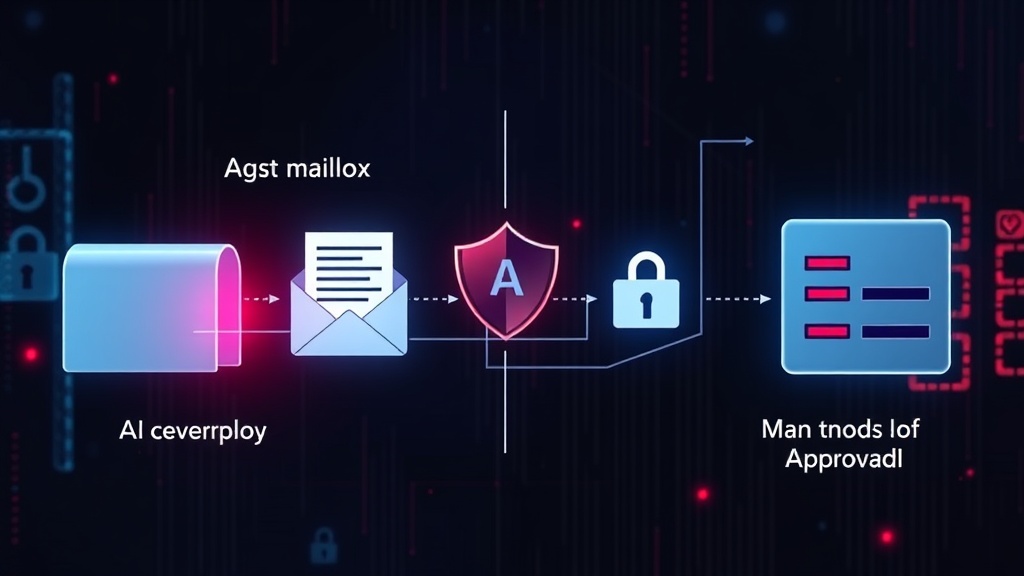
To address these challenges, a robust system must incorporate three core components: immutable logging, intelligent escalation, and mandatory human approval for outgoing messages. First, all inbound and outbound email traffic related to an AI agent must be logged to an external, tamper-proof system. This log serves as the single source of truth, providing an auditable trail for compliance, security investigations, and dispute resolution. Think of this less like a standard database and more like a digital notary, stamping every message with an unalterable timestamp and content record.
Second, the system needs a mechanism to identify messages that require human intervention. This isn't about perfect classification but about establishing clear triggers for escalation. When such a trigger is hit, the conversation thread must be seamlessly transferred to a human queue, preventing the AI from further engagement. This ensures that sensitive or complex issues are handled by individuals with the appropriate judgment and authority.
Finally, any email drafted by the AI agent intended for external sending must first enter a human approval workflow. This 'draft-to-approve' process leverages existing email infrastructure but formalizes it into a queue. Human reviewers can then inspect, edit, or reject the AI's proposed message before it ever reaches a recipient. This multi-layered approach transforms an AI agent from a potential liability into a controlled, accountable tool for communication.