The Core Philosophy Divide: Control vs. Cloud Protection
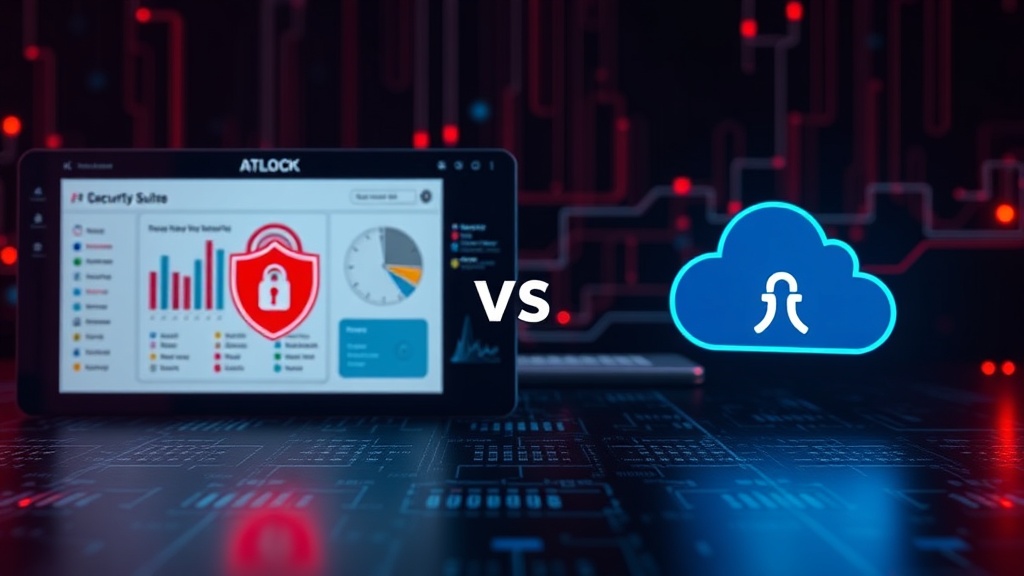
Typical third-party security software operates on a fundamental principle: protecting users from the vast, often hostile, landscape of the internet. These suites are designed to combat malware, block phishing attempts, and thwart network intrusions. They achieve this by maintaining large, constantly updated cloud-based threat intelligence databases and employing complex background services. If your primary concern is defending against external online threats, these comprehensive suites offer a robust, if opaque, solution.
ATLOCK v4, however, represents a starkly different philosophy. It is a single, offline executable file. This design choice eschews the common industry practices of account creation, recurring subscriptions, and the deployment of unseen background telemetry or cloud-dependent services. The core trade-off is clear: users sacrifice the broad, internet-facing protection of traditional suites for direct control over their data and software, without reliance on external services.
The author of ATLOCK is upfront about this divergence. "I'm not going to pretend ATLOCK beats a billion-dollar security company at every single thing. That would be dishonest, and dishonest comparisons age badly," they state. The goal is not to claim universal superiority, but to provide an honest breakdown of the distinct features and philosophies, enabling users to make an informed decision based on their specific needs and threat model.
Feature Comparison: What ATLOCK v4 Offers and Lacks
Understanding the differences requires a feature-by-feature comparison. Traditional security suites often bundle a wide array of functionalities, many of which are cloud-dependent. These can include real-time malware scanning against live threat feeds, advanced heuristic analysis powered by massive data sets, secure browsing features that monitor traffic in real-time, parental controls that rely on cloud-based content filtering, and VPN services that route traffic through company servers.
ATLOCK v4, by its offline nature, cannot replicate these cloud-centric features. It does not offer real-time scanning against a global threat database because it doesn't connect to one. It cannot provide live phishing protection that analyzes website reputation in real-time because it has no live internet access for such analysis. Similarly, features like cloud-based identity theft monitoring or secure cloud backup are outside its scope.
Instead, ATLOCK v4 focuses on providing security through its core design: an isolated, self-contained application. Its strengths lie in its transparency and user control. There is no account to create, meaning no personal information is linked to its usage. There is no subscription to manage, eliminating recurring costs and the potential for price hikes or service discontinuation. Crucially, there is no telemetry or background cloud communication. Users know exactly what the software is doing because it's all contained within the executable they run. This is akin to using a well-maintained, offline toolkit versus subscribing to a comprehensive, cloud-connected workshop. You have all the tools you need for specific tasks, but you lose the automated diagnostics and external expert support.
The Trade-Offs: What You Give Up
The most significant trade-off when choosing ATLOCK v4 over a typical third-party security suite is the reduction in internet-facing threat mitigation. While ATLOCK v4 can offer protection against certain types of local file corruption or unauthorized access to the application itself, it does not actively scan for or block new malware downloaded from the internet. It cannot protect against zero-day exploits that are actively being used in the wild because it lacks the real-time threat intelligence feed that commercial suites rely on.
Phishing protection is another area where a divergence is apparent. Traditional suites often integrate browser extensions or network-level filtering to identify and block malicious websites. ATLOCK v4, being offline, cannot perform this function. Users must rely on their own vigilance and other browser-based security measures for protection against fraudulent sites.
Furthermore, advanced features common in suites, such as secure password managers with cloud sync, VPN services, or robust parental controls, are generally not present in an offline-first application like ATLOCK v4. These features inherently require connectivity and often involve cloud infrastructure for data storage, synchronization, and management.
The Benefits: Control, Privacy, and Simplicity
The advantages of ATLOCK v4 are compelling for a specific segment of users. Privacy is paramount. By operating offline and without requiring an account, ATLOCK v4 ensures that no user data is collected, stored, or transmitted to external servers. This eliminates the risk of data breaches originating from the security provider's infrastructure and safeguards against potential misuse of telemetry data.
Simplicity is another key benefit. The absence of background services, constant updates pushed from the cloud, and complex configuration options reduces the software's footprint and potential for conflicts with other applications. An offline executable is often easier to manage, understand, and deploy, especially in environments where internet connectivity is limited or unreliable.
Cost is also a factor. ATLOCK v4, as a single purchase or potentially a one-time fee, avoids the recurring subscription costs associated with most commercial security suites. This can lead to significant long-term savings. The absence of cloud infrastructure also means the company behind ATLOCK has a different cost structure, potentially allowing for more accessible pricing.
Who is ATLOCK v4 For?
ATLOCK v4 is best suited for users whose threat model is primarily focused on local data integrity and software control, rather than comprehensive internet security. This includes individuals who:
- Are highly privacy-conscious and wish to avoid data collection by software vendors.
- Prefer to manage their own security and understand the tools they are using.
- Have limited or no reliable internet access.
- Are looking for a simpler, more transparent security solution.
- Already use other robust security measures (e.g., network firewalls, secure OS configurations) and seek a complementary tool for specific local tasks.
It is crucial to reiterate that ATLOCK v4 is not a direct replacement for a full-spectrum internet security suite. If your daily activities involve extensive browsing, online transactions, or downloading files from untrusted sources, relying solely on ATLOCK v4 would leave you exposed to a wide range of online threats that traditional suites are designed to mitigate.
Conclusion: A Different Kind of Security
ATLOCK v4 offers a distinct approach to software security, prioritizing user control, privacy, and simplicity over the broad, cloud-dependent protection offered by typical third-party security suites. It trades real-time internet threat detection, phishing protection, and advanced cloud-synced features for a transparent, offline experience with no recurring costs or data collection. The choice between ATLOCK v4 and a traditional suite hinges entirely on an individual's specific threat model, privacy requirements, and technical comfort level. For users who value autonomy and understand the implications of an offline tool, ATLOCK v4 presents a compelling alternative. For those whose primary concern is a robust defense against the ever-evolving landscape of online threats, established internet security suites remain the more comprehensive, albeit less transparent, option.