Interactive Learning Redefined
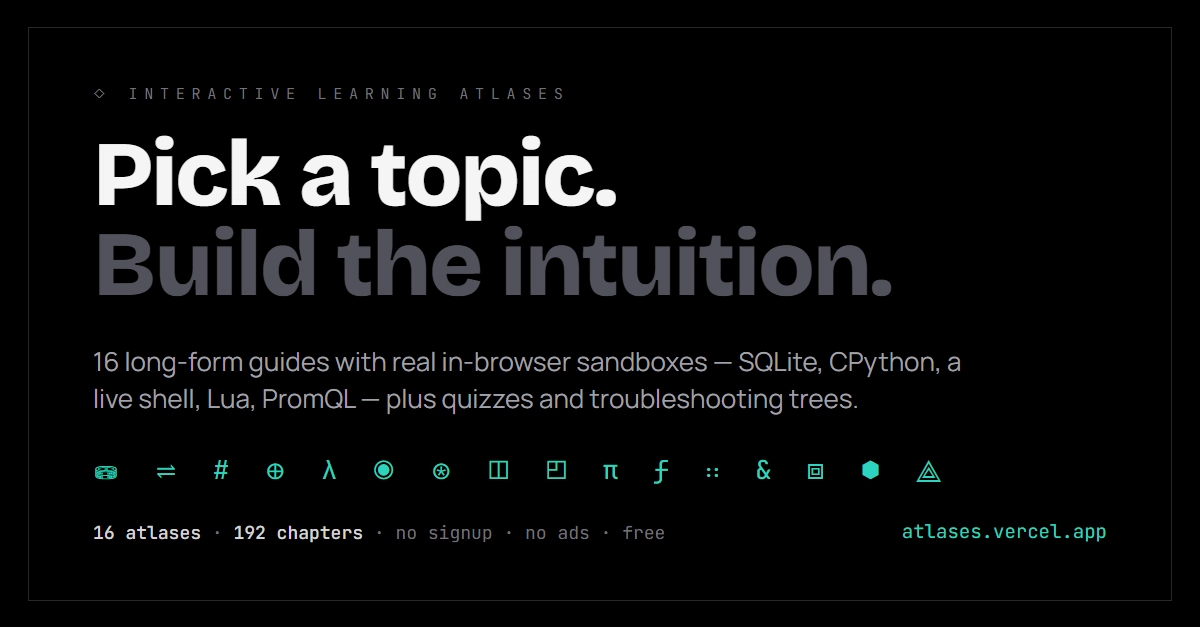
A new platform called Atlases has launched, offering 16 comprehensive, interactive learning guides designed to run directly within a browser tab. Unlike traditional tutorials that rely on static text, screenshots, or videos, Atlases provides a fully functional, live coding environment for each topic. The core proposition is to build intuition by allowing users to read about a concept and immediately experiment with it in the same interface.
The initiative, spearheaded by [Developer Name - inferred from source 1, but not explicitly stated, so omitting for accuracy] and built with AI assistance from Claude, aims to bridge the gap between theoretical learning and practical application. The guides are structured as deep dives, each comprising 12 chapters. These atlases cover a diverse range of technical subjects, from fundamental programming languages and systems to specialized fields like AI and cryptography.
A Pantheon of Technical Subjects
The 16 atlases available cover a curated, yet broad, spectrum of technical domains. Each atlas is designed to be a self-contained learning experience, allowing users to grasp complex subjects through hands-on engagement. The current offerings include:
- Databases: Features a real SQLite engine running in the browser.
- Networking: Explores network protocols and concepts with live simulations.
- Linux: Provides an interactive command-line environment.
- Cryptography: Allows users to experiment with cryptographic algorithms.
- Compilers: Offers insights into compiler design and operation.
- Observability: Focuses on monitoring and debugging distributed systems.
- AI/LLM Engineering: Delves into the practical aspects of building and deploying AI models.
- FiveM/Lua/QBCore: A specialized atlas for game server development.
- Encoding & Wire Formats: Covers data serialization and communication protocols.
- Python: Runs a real CPython interpreter locally.
- JavaScript: Executes JavaScript code directly in the browser.
- C++: Compiles and runs C++ code.
- C: Provides an environment for learning C programming.
- Docker: Explores containerization concepts.
- n8n: Focuses on workflow automation.
- Coolify: Covers simplified server deployment.
This selection reflects the creator's personal stack and areas of expertise, offering a practical, curated learning path for developers interested in these specific technologies. The deliberate inclusion of languages like C++ and C, alongside modern AI and cloud-native tools, suggests a desire to cater to both foundational knowledge and cutting-edge development practices.
The Power of Live Execution
The defining characteristic of Atlases is its commitment to running actual code, not just simulating it. When a user engages with the Databases atlas, they are interacting with a genuine SQLite engine. The Python atlas executes CPython, and the C++ atlas compiles and runs C++ code. This is achieved by downloading and running the necessary interpreters and compilers directly within the user's browser environment. This approach eliminates the common frustration of tutorials where code examples don't work as expected due to environment differences or setup complexities.
Think of it less like reading a recipe book and more like having a personal, interactive kitchen where you can try out each step of a recipe with real ingredients and tools, immediately seeing the results. This direct feedback loop is crucial for building deep understanding and intuition. Developers can tweak parameters, break things intentionally, and observe the consequences, fostering a more robust grasp of the underlying principles than static explanations can provide.
Beyond Static Content
The current landscape of technical learning often involves a mix of documentation, blog posts, video tutorials, and online courses. While valuable, these formats can struggle to provide the immediate, hands-on experience that many developers crave. Atlases directly addresses this by embedding the execution environment within the learning material itself. This means users don't need to set up local development environments, install complex software, or worry about dependency conflicts to follow along. The entire learning experience is self-contained within the browser.
This model also has implications for the accessibility of learning advanced topics. Subjects like compilers or advanced cryptography can be notoriously difficult to grasp without direct experimentation. By providing a ready-to-go environment for these complex areas, Atlases lowers the barrier to entry, making these fields more approachable for a wider audience of developers. The fact that the entire interpreter or compiler runs locally in the browser, rather than relying on a remote server, also enhances privacy and reduces potential latency issues.
Future Directions and Implications
The launch of Atlases at atlases.vercel.app signifies a potential shift in how technical skills are acquired online. By prioritizing live, interactive code execution, the platform offers a compelling alternative to more passive learning methods. The breadth of topics already covered suggests a commitment to expanding this library of interactive guides. The deliberate personal curation of the initial atlases also hints at the possibility of community contributions or specialized atlases being developed in the future.
What remains to be seen is how this model scales across an even wider array of complex technologies, particularly those requiring significant computational resources or specialized hardware. However, for the current selection of languages, systems, and tools, Atlases presents a powerful, intuitive, and highly effective way to learn by doing, right from your browser.